
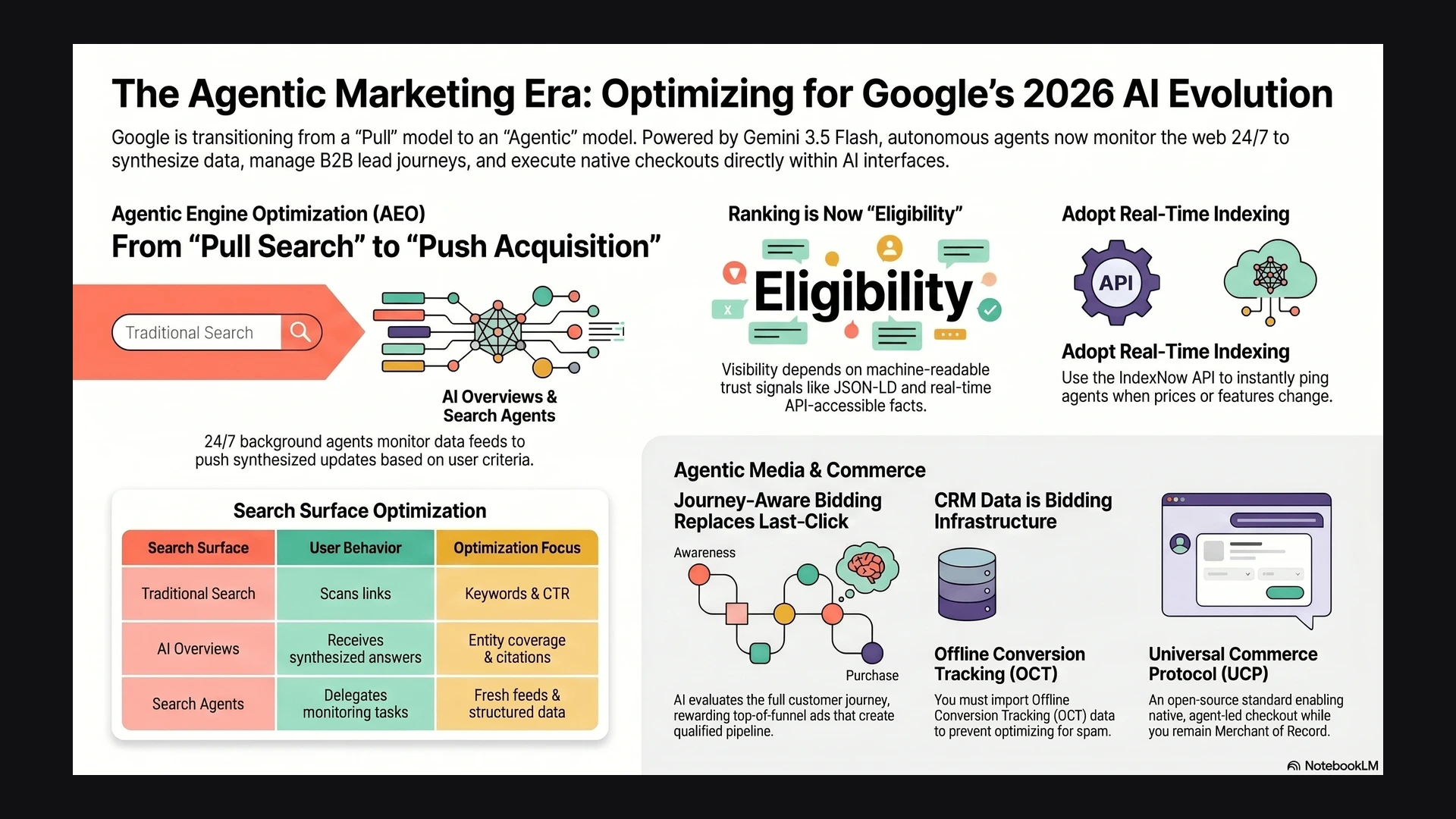
The Death of the Traditional E-Commerce Funnel
Until today, the goal of Performance Max and Shopping ads was to drive a click to your Shopify product page. The Universal Commerce Protocol disrupts this entirely.
With UCP, if a user asks Gemini for a specific waterproof hiking boot, the AI parses structured intent against retailer catalogs and offers a native checkout button via the Agent Payments Protocol (AP2). The transaction is completed without the user ever leaving the conversational context.
For the managed background-agent layer around Gemini, the Gemini Spark agentic workflows guide covers cloud execution, tool access, and human approval gates.
On the acquisition side, this pairs with Google's move toward Journey-Aware Bidding: both updates reward brands that can feed cleaner, downstream business data back into the systems deciding visibility and conversion paths.
Pipeline Architect Note
AI-referred traffic converts significantly higher than standard search traffic. If you are not optimizing for Agentic Commerce, your competitors will build a structural discovery advantage on the fastest-growing checkout pipe on the internet.
Why UCP Matters for Retailers
Universal Commerce Protocol is not just another feed format. It is a shared commerce language that helps AI agents, merchant systems, and payment providers coordinate across discovery, checkout, and post-purchase support.
That matters because the buying surface is moving upstream. The product detail page is no longer guaranteed to be the place where a shopper compares specs, checks compatibility, evaluates offers, and decides to buy.
This commerce shift is part of the same pipeline change behind Google Search Agents and Agentic Engine Optimization. Discovery, comparison, and checkout are all becoming more dependent on fresh, structured, machine-readable data.
In Google's rollout, UCP supports checkout from eligible product listings in AI Mode in Search and the Gemini app. That puts product data quality and AI optimization directly inside the moment of AI-assisted purchase intent.
- Discovery becomes conversational: Shoppers describe outcomes, constraints, and preferences instead of typing short keywords.
- Comparison becomes agent-led: AI systems can evaluate compatibility, substitutes, shipping, price history, and offers before the user lands on a product page.
- Checkout becomes embedded: The transaction can happen inside Google AI surfaces while the retailer remains the Merchant of Record.
UCP vs. Agent Payments Protocol (AP2)
UCP and Agent Payments Protocol (AP2) solve different parts of the same agentic commerce stack. Treating them as the same thing creates bad implementation priorities.
Universal Commerce Protocol is the commerce layer. It helps agents and merchant backends exchange product, cart, checkout, and post-purchase information through a common operating language.
Agent Payments Protocol (AP2) is the payment trust layer. It focuses on secure agent-led payments, strict user guardrails, verifiable transaction records, and accountability between the user, merchant, and payment processor.
- UCP answers: Which product should the AI agent recommend, configure, add to cart, and route to checkout?
- AP2 answers: Was the payment authorized, constrained, recorded, and executed on behalf of the user?
- Merchant Center answers: Is the product data complete enough for Google surfaces to understand, trust, and match it to intent?
Merchant Control Still Matters
The strategic detail is that the retailer remains the Merchant of Record. That means fulfillment, customer relationship, transaction data, returns, and post-purchase support still belong to the brand's commerce operation.
How to Execute Agentic Commerce Optimization (ACO)
Search Engine Optimization was about ranking pages. Agentic Commerce Optimization (ACO) is about ranking product data. To get featured in native AI checkouts, upgrade your infrastructure:
- Exploit Conversational Data Attributes: Populate new Merchant Center fields detailing product compatibility, substitute recommendations, and highly specific feature sets.
- Structure Your Product Graph: The AI does not read your website design; it reads your raw product feed. Ensure your GTINs and descriptions are flawlessly mapped.
- Prepare for UCP Integration: Mid-market brands must prepare their backend inventory systems for headless API checkouts utilizing UCP's modular framework.
The ACO Checklist for Product Data
The brands that win in Agentic Commerce will not simply have more products. They will have products that are easier for an AI agent to understand, compare, verify, and transact.
Start with the product feed because it is the lowest-friction path into Google's commerce surfaces. Then work backward into the systems that make the feed reliable.
- Product identifiers: Validate GTIN, MPN, brand, variant, size, color, material, and category mappings.
- Compatibility attributes: Add use cases, accessories, substitutes, fitment data, bundle logic, and constraints that answer conversational buying questions.
- Commercial policies: Keep shipping speed, shipping cost, return windows, warranty terms, and pickup availability accurate.
- Inventory freshness: Sync stock, price, sale price, and availability frequently enough that an AI checkout flow does not recommend dead inventory.
- Review signals: Make rating, review count, product quality, and customer Q&A data clean enough to support AI-assisted comparison.
- Checkout readiness: Confirm your payment processor, tax logic, fulfillment rules, and order management system can support headless checkout paths.
What Brands Should Do in the Next 30 Days
You do not need to rebuild your entire ecommerce stack immediately. You do need a practical readiness sprint before UCP-powered surfaces become a larger discovery and checkout channel.
Think of this as technical merchandising for AI agents. The goal is to make every high-margin product legible, complete, and safe to recommend.
- Week 1: Export your Merchant Center feed and score every product on identifier completeness, attribute depth, and policy accuracy.
- Week 2: Rewrite thin product titles and descriptions so they answer real shopping constraints, not just keyword variants.
- Week 3: Add compatibility, substitute, bundle, and accessory data for your top-selling and highest-margin SKUs.
- Week 4: Audit checkout, inventory sync, payment token support, order routing, and customer-service handoff for native AI checkout readiness.
Once the feed work goes live, use the UTM Link Builder to keep campaign tagging clean and the SERP Simulator to QA how related SEO assets appear before launch.
The New Ranking Asset
Your product feed is becoming a real-time sales interface. In the Agentic Commerce era, feed quality is not a back-office hygiene task; it is conversion-rate infrastructure.
FAQ: Universal Commerce Protocol and Agentic Commerce
How is UCP different from Agent Payments Protocol (AP2)?
UCP defines the commerce layer for discovery, checkout, and post-purchase interactions between agents and merchant systems. Agent Payments Protocol (AP2) focuses on the payment layer, including authorization, guardrails, and verifiable records for agent-led purchases.
Why does UCP matter for ecommerce brands?
UCP compresses the traditional ecommerce funnel by letting shoppers research and buy inside Google AI surfaces. Brands that maintain cleaner product feeds, richer attributes, and stronger inventory data will be easier for AI agents to select.
Does the retailer stay the Merchant of Record with UCP?
Yes. Google states that the brand or retailer stays the seller or Merchant of Record, which helps preserve ownership of the customer relationship, transaction, fulfillment, and post-purchase experience.
What should brands do first to prepare for Agentic Commerce Optimization?
Brands should start by auditing Merchant Center feeds, product identifiers, structured attributes, inventory freshness, shipping settings, return policies, and checkout readiness. The practical goal is to make product data complete enough for an AI agent to recommend and transact with confidence.
Official References
Use Google's own updates as the source of truth for implementation planning. The most important signals are the launch of Universal Commerce Protocol, the expansion of Universal Cart, and the role of Agent Payments Protocol (AP2) in secure agentic purchases.
- Google Ads & Commerce: New tech and tools for retailers to succeed in an agentic shopping era
- Google Shopping: Introducing the Universal Cart and more ways to help you shop
- Google Cloud: Announcing Agent Payments Protocol (AP2)
More Agentic Commerce Notes
For more public notes on commerce data, product feeds, and AI search behavior, my LinkedIn profile and resource library are the best places to start.
Connect on LinkedIn