
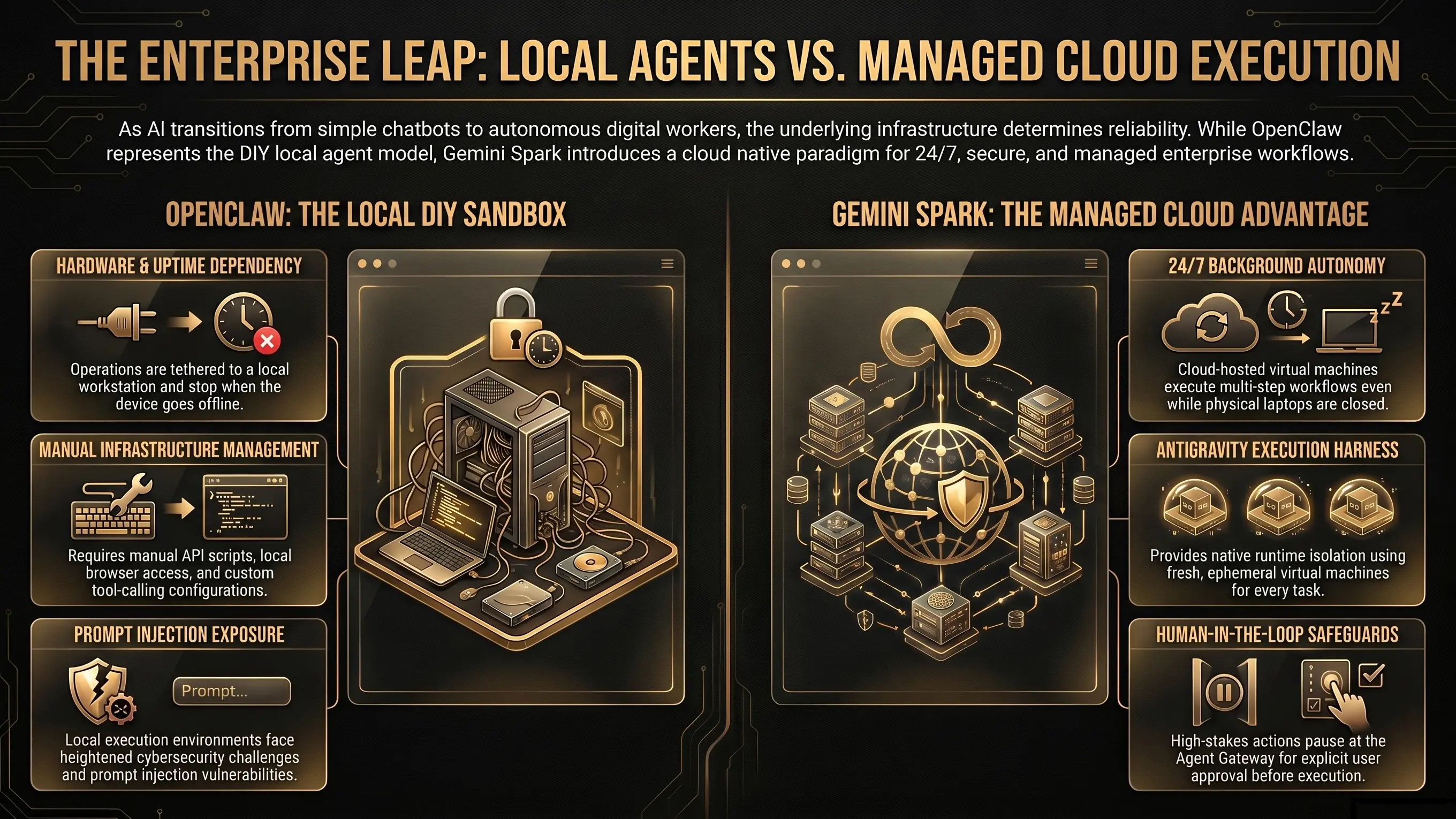
What is Google Gemini Spark?
Introduced at Google I/O 2026, Gemini Spark is an autonomous, 24/7 personal AI agent running in fully managed, secure cloud environments. Unlike standard chatbots that operate strictly on a request-and-response model, Gemini Spark executes complex, multi-step asynchronous workflows natively across Google Workspace, enterprise CRMs, and third-party platforms entirely in the background.
The Death of the Local Agent Sandbox: Spark vs. OpenClaw
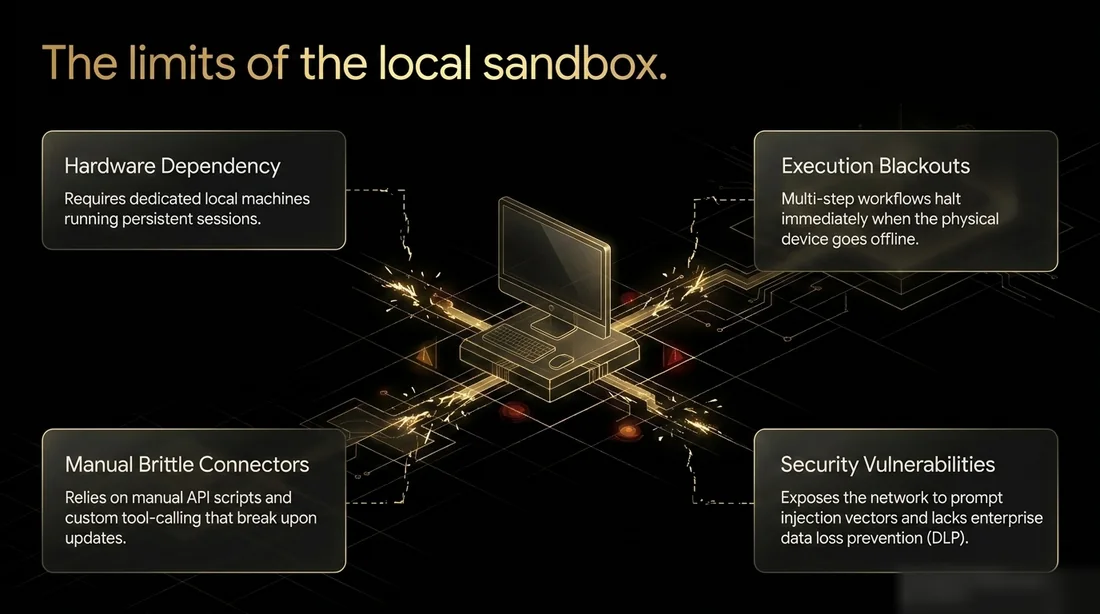
The open-source release of OpenClaw triggered a massive wave of DIY agent adoption. However, running a persistent local agent required dedicated hardware like a local Mac Mini, bringing intense cybersecurity challenges, potential prompt injection vectors, and local execution limitations when a device went offline.
Gemini Spark shifts this paradigm by operating on a cloud-native infrastructure powered by the Google Antigravity runtime harness. Every background task executes within a fresh, strictly isolated, ephemeral virtual machine on Google Cloud, providing enterprise-grade security and data loss prevention (DLP) without local infrastructure management. Because it is cloud-hosted, Gemini Spark continues executing multi-step pipelines 24/7, even when your physical laptop is closed.
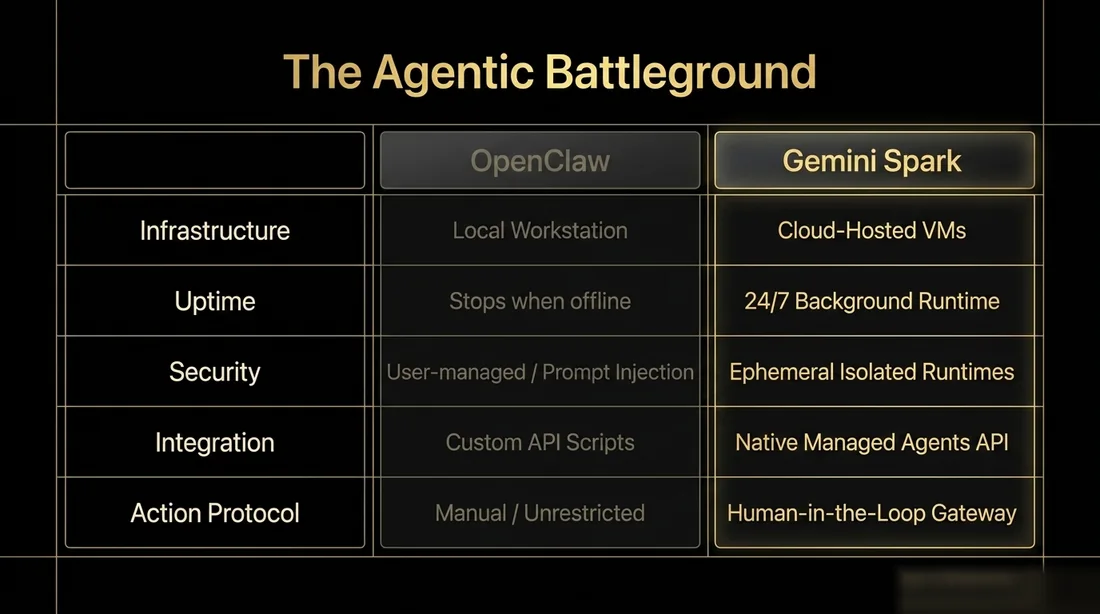
Gemini Spark vs. OpenClaw: Enterprise Workflow Comparison
The practical difference is not just where the agent runs. The real shift is who owns uptime, isolation, system access, approval logic, and operational risk.
| Workflow Layer | OpenClaw Local Agent Model | Gemini Spark Managed Cloud Model |
|---|---|---|
| Runtime | Runs on a local laptop, workstation, or dedicated always-on device. | Runs through cloud-hosted virtual machines and managed agent infrastructure. |
| Availability | Depends on local power, network access, and device uptime. | Designed for 24/7 background execution even when the user device is offline. |
| Security Boundary | Requires users to manage local permissions, credentials, browsers, and file access. | Uses isolated cloud runtimes, explicit approval gates, and managed execution policies. |
| Tool Integration | Relies on custom scripts, API keys, local connectors, and manual configuration. | Maps into Google Workspace, CRM systems, and third-party services through managed agent infrastructure. |
| Enterprise Fit | Best for technical early adopters who can tolerate local setup complexity. | Better suited for teams that need auditability, isolation, uptime, and repeatable workflow deployment. |
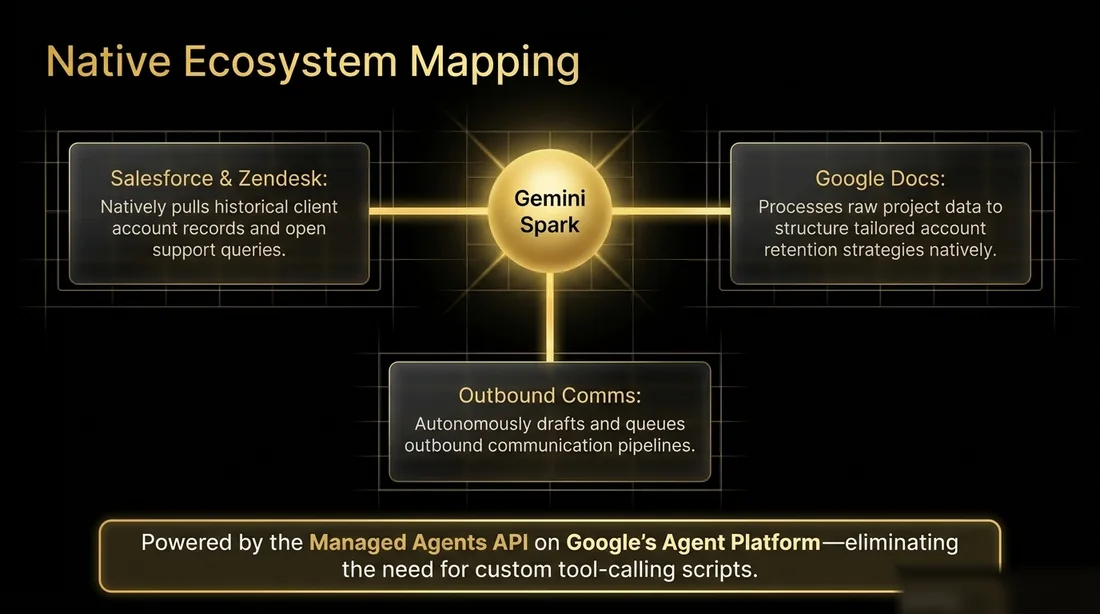
Architectural Advantage: Native Ecosystem Mapping
While OpenClaw requires custom tool-calling scripts and API configurations to connect to external databases, Gemini Spark leverages the Managed Agents API on Google's Agent Platform for instant, native ecosystem mapping:
- Downstream CRM Integration: Gemini Spark natively pulls historical client account records from Salesforce and open support queries from Zendesk.
- Asynchronous Execution: Gemini Spark reasons through raw project data, structures tailored account retention strategies in Google Docs, and queues up outbound communication drafts.
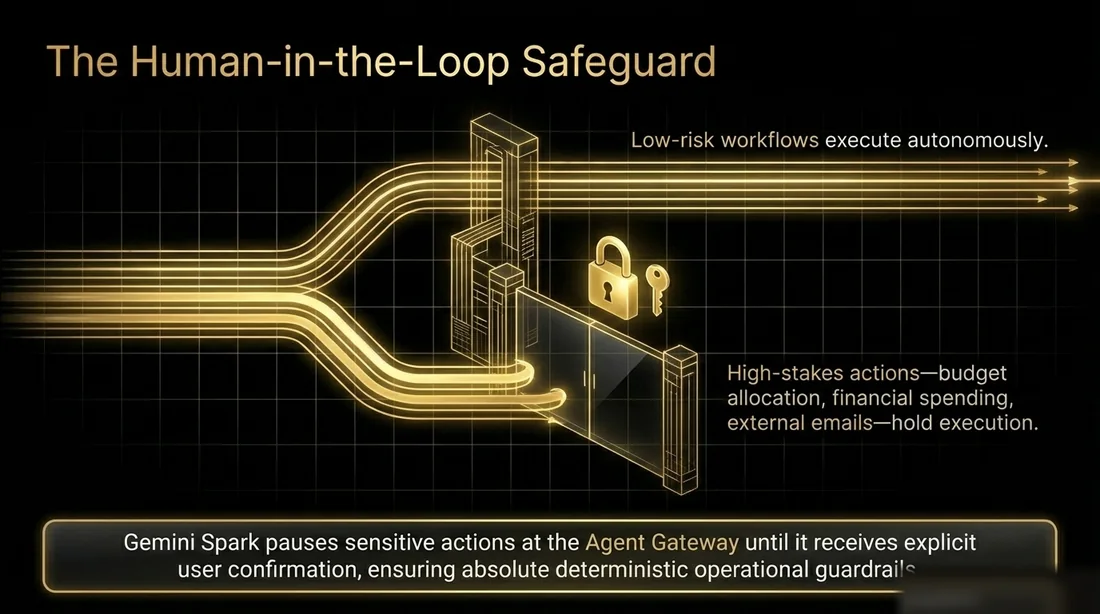
- The Human-in-the-Loop Safeguard: For high-stakes actions like budget allocation, financial spending, or external emails, Gemini Spark holds execution until it receives explicit user confirmation via the secure Agent Gateway.
Pipeline Architect Note: This is where the conversion funnel fundamentally breaks. Gemini Spark is deeply integrated with the Universal Commerce Protocol (UCP) and the Agent Payments Protocol (AP2). It can autonomously match buyer intent, evaluate promotions, and process transaction checkouts natively inside Gemini's agentic framework.
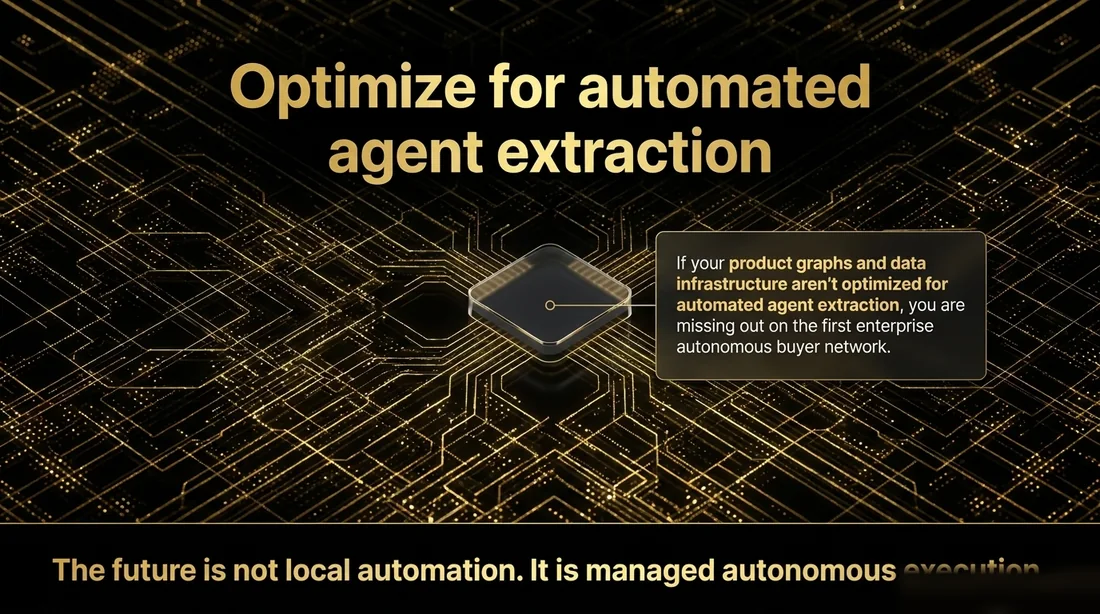
If your product graphs and data infrastructure aren't optimized for automated agent extraction, you are missing out on the first enterprise autonomous buyer network.
What Google Actually Announced for Managed Agents
The broader Gemini Spark story matters because Google is also formalizing the developer stack behind managed agents. In its Google I/O 2026 developer highlights, Google describes the move from prompts to action through Gemini 3.5 Flash, Google Antigravity, and managed agents in the Gemini API.
- Gemini 3.5 Flash: Google positions the model as the high-speed reasoning engine for real-world agentic workflows.
- Google Antigravity: The agent-first development platform provides the harness for orchestrating, extending, and deploying agent behavior.
- Managed Agents API: Developers can spin up agents that reason, use tools, and execute code in isolated environments.
- Custom Skills: Teams can extend agents with instructions, templates, and markdown-based skill definitions.
Why this matters for SEO and GEO
Search engines and AI answer engines reward pages that connect the product narrative to verifiable technical primitives. This page should therefore rank not only for Gemini Spark, but also for adjacent searches around Google Antigravity, Gemini 3.5 Flash, Managed Agents API, isolated agent runtimes, and enterprise agent workflows.
How Gemini Spark Executes an Enterprise Workflow
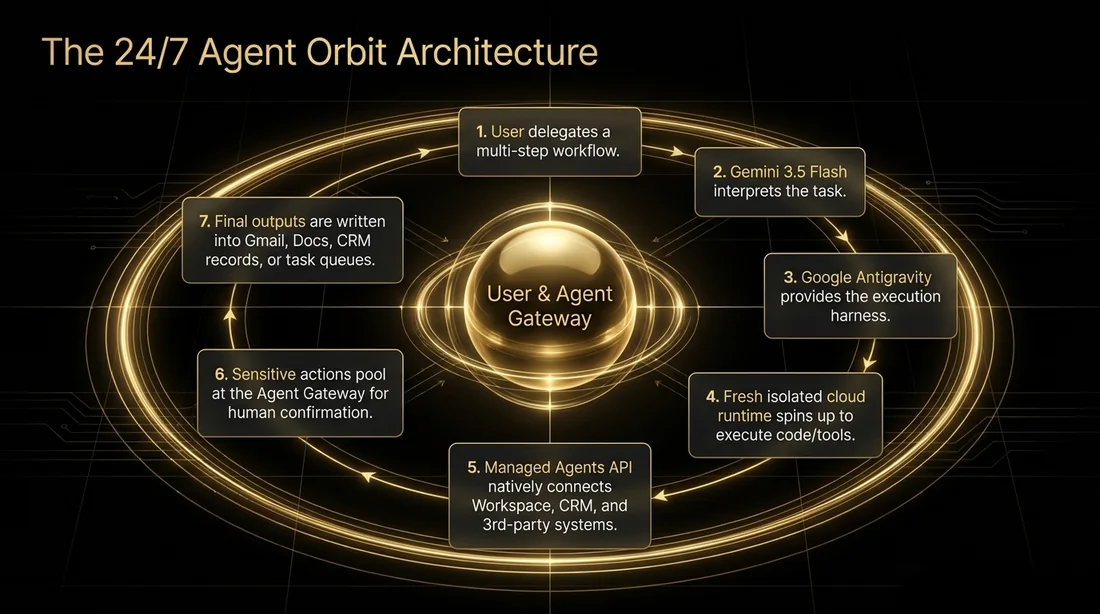
The cleanest way to understand Gemini Spark is as an execution pipeline. A user does not simply ask a question; they delegate a task that moves through planning, tool use, data access, approval, and final delivery.
- 1. User delegates the objective: The workflow starts with an outcome, such as summarizing account risk, preparing renewal notes, or monitoring buyer intent.
- 2. Gemini 3.5 Flash plans the work: The agent decomposes the request into steps, dependencies, required systems, and sensitive action checkpoints.
- 3. Google Antigravity runs the harness: The execution layer coordinates tools, files, code, memory, and subtask orchestration.
- 4. Ephemeral runtimes isolate the task: Work is executed inside secure cloud environments instead of an exposed local desktop session.
- 5. Managed Agents API connects systems: The workflow can reach Google Workspace, CRM records, help desk data, and external business platforms.
- 6. Agent Gateway pauses sensitive actions: Spending, emailing, publishing, and other high-risk steps wait for explicit human confirmation.
- 7. Final output lands where work happens: The agent writes drafts, updates records, queues tasks, or creates structured documents for review.
Infographic Angle: Show OpenClaw as a local machine stack on the left and Gemini Spark as a managed cloud execution stack on the right. The winning visual contrast is "local agent sandbox" versus "enterprise autonomous worker."
Deploying Custom Skills via the Managed Agents API
For engineering teams, Google's introduction of the Managed Agents API allows organizations to instantly spin up customized versions of Gemini Spark using a single API call. By offloading infrastructure routing, prompt insulation, and sandbox isolation to Google Cloud, technical teams can focus entirely on mapping complex enterprise behaviors, custom database connectors, and deterministic operational guardrails.
The age of the static AI assistant is officially over. Gemini Spark marks the transition into the era of the autonomous digital worker powered by Gemini 3.5 Flash, Google Antigravity, and managed cloud execution.
Enterprise Readiness Checklist for Agentic Workflows
Before teams deploy managed agents into production, they need a readiness model that goes beyond prompt quality. The operational question is whether the agent can act safely, consistently, and measurably across business systems.
- Identity and access: Map which systems the agent can read, write, update, or trigger.
- Data boundaries: Define what customer, financial, legal, and employee data must stay sandboxed.
- Approval gates: Require human confirmation before external emails, payments, budget changes, publishing, or record deletion.
- Audit logs: Preserve a clear trail of instructions, tool calls, approvals, outputs, and exceptions.
- Fallback handling: Route ambiguous cases to a human owner instead of letting an agent improvise risky actions.
- Measurement layer: Track cycle time saved, error rate, approved actions, rejected actions, and downstream business impact.
FAQ: Gemini Spark, OpenClaw, and Managed Agents
How is Gemini Spark different from OpenClaw?
OpenClaw represents the local DIY agent model, where users manage hardware, credentials, tool calls, browser access, and security boundaries themselves. Gemini Spark shifts that model into managed cloud execution, using isolated runtimes, Google Antigravity, and native Google ecosystem integrations.
Does Gemini Spark run when your computer is off?
Yes. Gemini Spark is positioned as a cloud-hosted agent runtime, which means delegated workflows can continue in the background even when a user's physical laptop or phone is offline.
What is Google Antigravity?
Google Antigravity is Google's agent-first development platform and execution harness for building, orchestrating, and deploying agentic workflows. In the managed agent stack, Google Antigravity provides the infrastructure layer that lets agents reason, use tools, execute code, and operate inside isolated environments.
Why do managed agents matter for enterprise workflows?
Managed agents matter because enterprises need auditability, isolation, human approval gates, ecosystem integrations, and persistent execution without maintaining local agent infrastructure. They turn AI from a chat interface into an operational worker that can safely move across systems.
More Agentic Search Notes
For more public notes on AI search, commerce protocols, and enterprise workflow design, my LinkedIn profile and resource library are the best places to start.
Connect on LinkedIn