
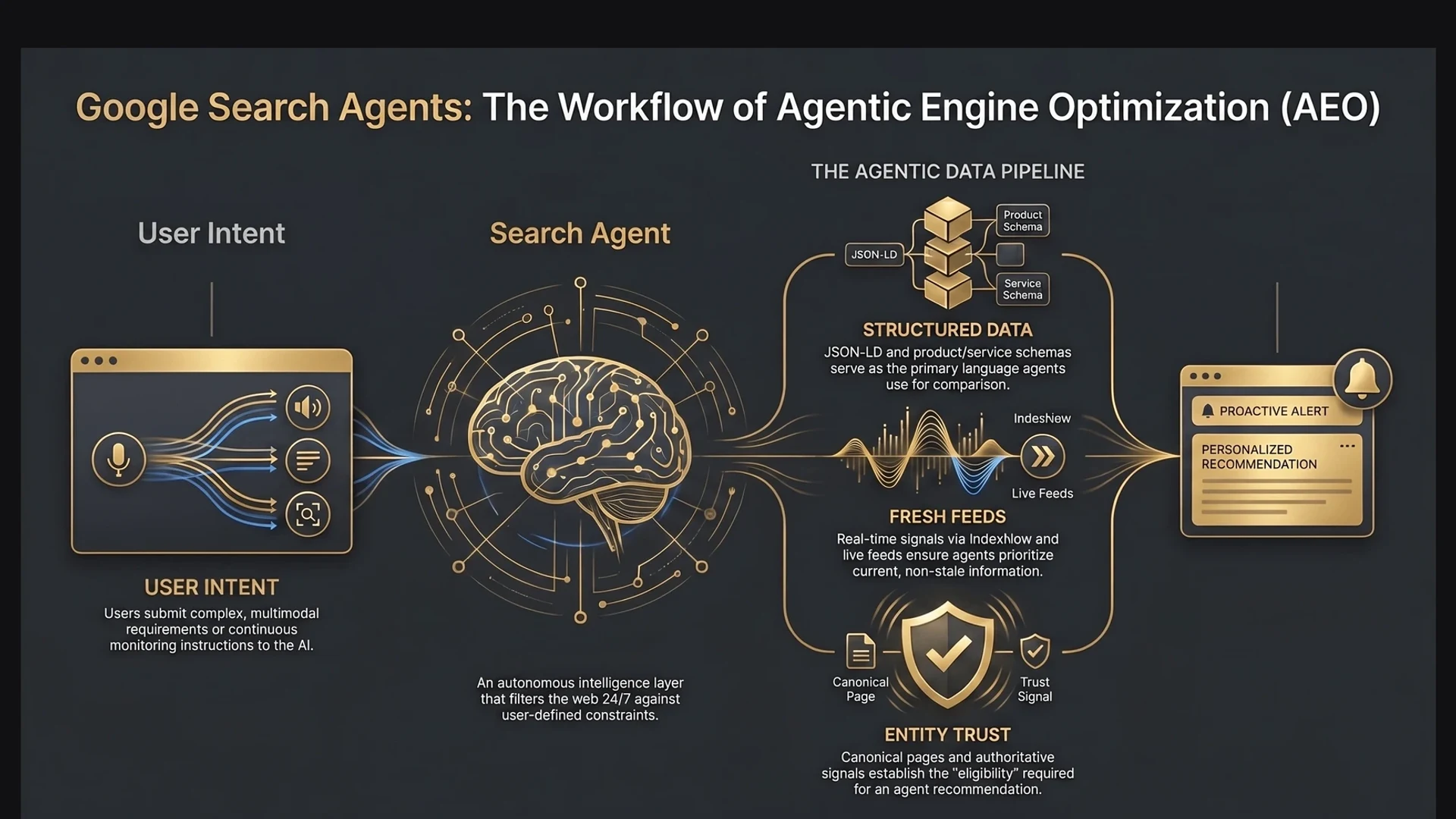
What are Google Search Agents?
Announced at Google I/O 2026, Google Search Agents are AI-powered Information Agents that operate in the background 24/7 to synthesize real-time data across the web. Instead of a user executing a one-time search query, they can instruct an agent to continuously monitor blogs, news sites, and retailer feeds for specific criteria, such as a B2B feature release or a sneaker drop, and push a synthesized update when the conditions are met.
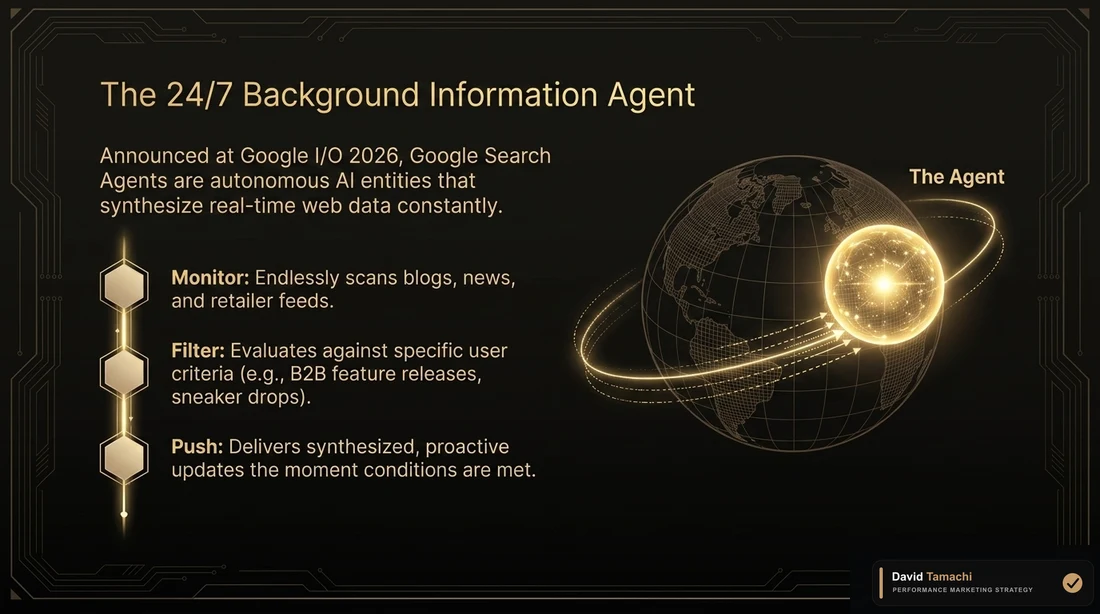
The Shift from "Pull Search" to "Push Acquisition"
For the last 25 years, performance marketing has relied on a "Pull" model. You bid on a keyword or optimize a landing page, and you wait for a user to pull that information by typing a query into the search bar.
With the global rollout of Gemini 3.5 Flash as the default AI Mode model, Google has effectively inverted the funnel. The new Intelligent Search Box allows users to brain-dump complex, multimodal requirements. The agent then takes over, turning search into a "Push" mechanism.
The same persistent-agent model is emerging in managed workflows. The Gemini Spark agentic workflows guide examines the cloud runtime, tool use, and approval gates behind that shift.
Marketers are no longer trying to rank for a momentary click. They must optimize their data feeds so that an autonomous Search Agent selects them to push to the end user.
That same shift is already showing up in paid media through Journey-Aware Bidding in Google Ads, where the algorithm cares less about a single last click and more about the full path that creates qualified pipeline.
Pipeline Architect Note
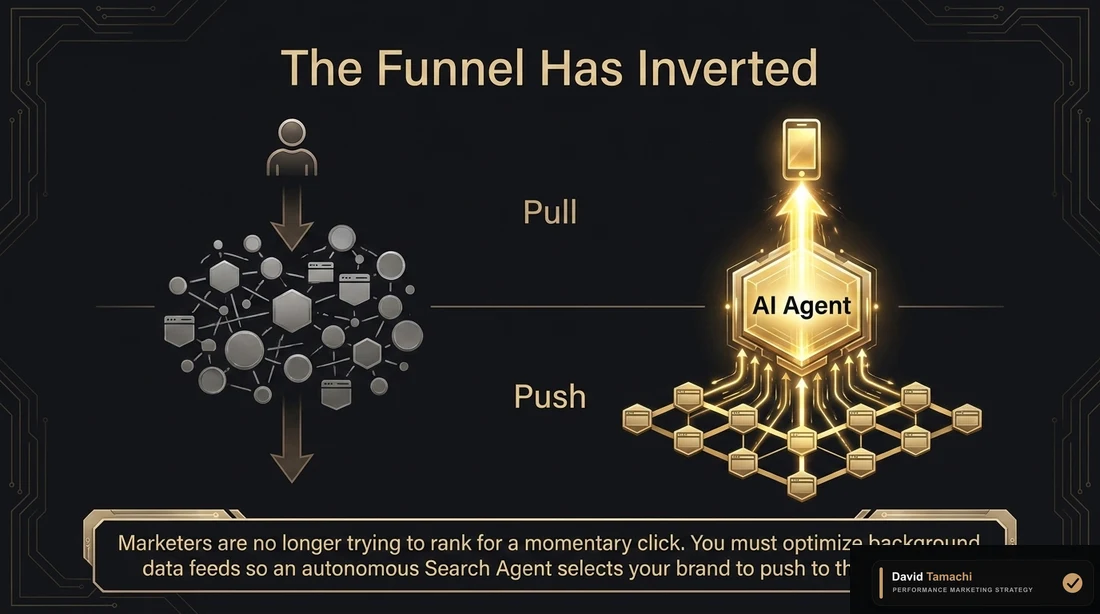
We are entering the era of Agentic Engine Optimization (AEO). If your site relies on legacy caching or slow crawling architectures, your brand will effectively become invisible to Information Agents that prioritize real-time data synthesis.
Why Search Agents Change SEO Strategy
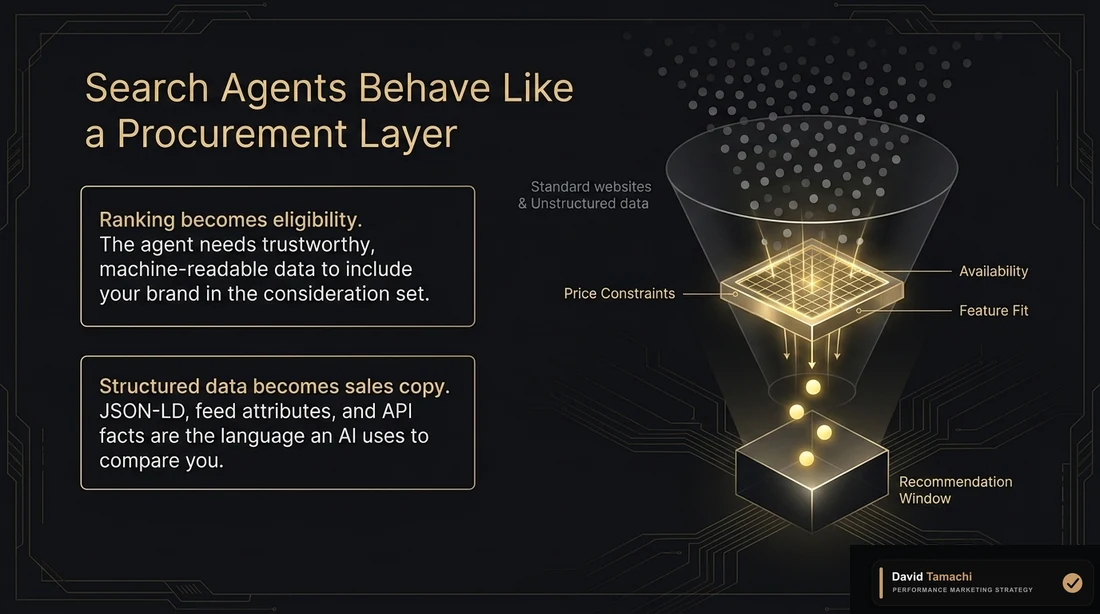
Search Agents do not behave like a normal searcher scanning ten blue links. They behave more like a procurement layer, filtering options against constraints before surfacing a short answer or proactive alert.
That means your competitive set is no longer just the pages ranking above you. It is every structured feed, news source, product graph, pricing update, and documentation page that can satisfy the agent's criteria.
- Ranking becomes eligibility: The agent needs enough trustworthy data to include your brand in the consideration set.
- Freshness becomes a conversion lever: A stale price, old inventory count, or delayed feature update can remove you from the agent's recommendation window.
- Structured data becomes sales copy: Your JSON-LD, feed attributes, and API-accessible facts become the language an AI system uses to compare you.
Search Agents vs. AI Overviews vs. Traditional Search
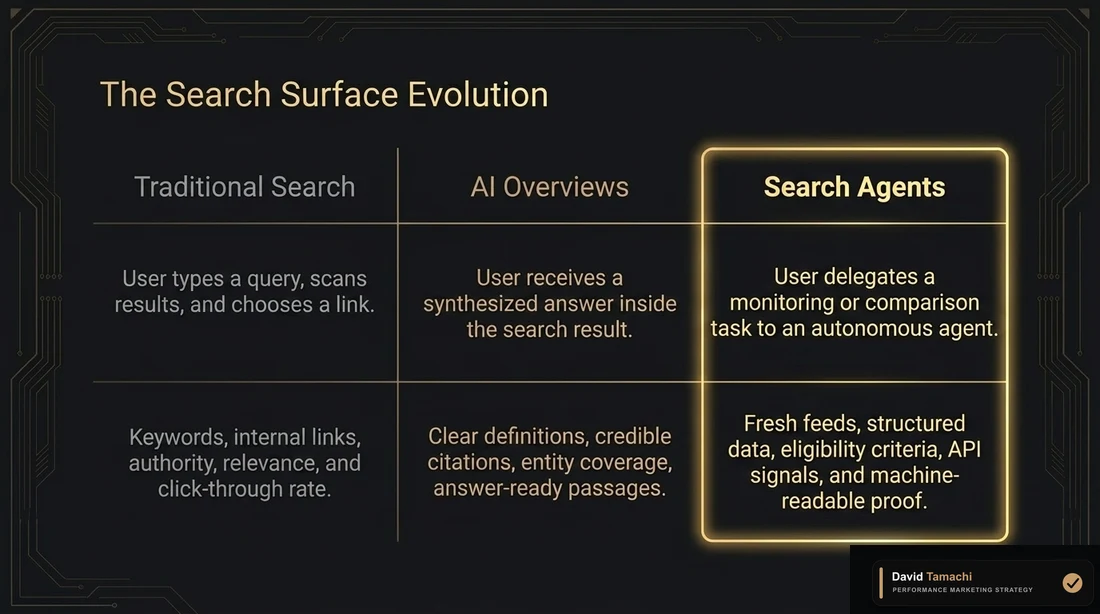
It is useful to separate Search Agents from the AI answer formats marketers already know. AI Overviews summarize a query response, while Search Agents can keep working after the first prompt.
Traditional SEO still matters because pages, links, and authority help establish trust. The difference is that Agentic Engine Optimization (AEO) also requires operational data that stays current after publication.
| Search Surface | User Behavior | Optimization Focus |
|---|---|---|
| Traditional Search | User types a query, scans results, and chooses a link. | Keywords, internal links, authority, relevance, and click-through rate. |
| AI Overviews | User receives a synthesized answer inside the search result. | Clear definitions, credible citations, entity coverage, and answer-ready passages. |
| Search Agents | User delegates a monitoring or comparison task to an autonomous agent. | Fresh feeds, structured data, eligibility criteria, API signals, and machine-readable proof. |
How to Execute Agentic Engine Optimization (AEO)
To ensure your B2B software or E-commerce catalog is picked up by these 24/7 background agents, your technical pipeline needs an immediate upgrade.
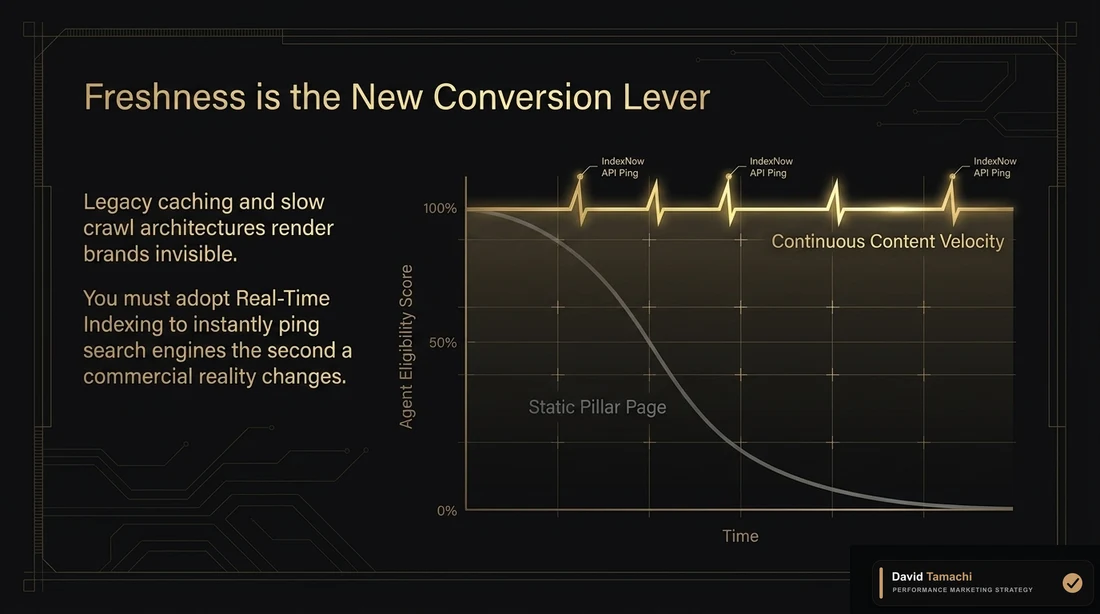
- Adopt Real-Time Indexing: Agents require the freshest data. You must implement the IndexNow API to instantly ping search engines the second a price drops, inventory updates, or a new feature ships.
- Aggressive JSON-LD Rule Mapping: Agents do not read marketing copy; they parse conditional logic. Use highly structured product schemas so the agent knows exactly what criteria your offering meets.
- Continuous Content Velocity: Because agents continuously scan the web, static "pillar pages" are no longer enough. You need dynamic, updating data feeds, like live interactive calculators, to trigger agent notifications.
The AEO Technical Stack
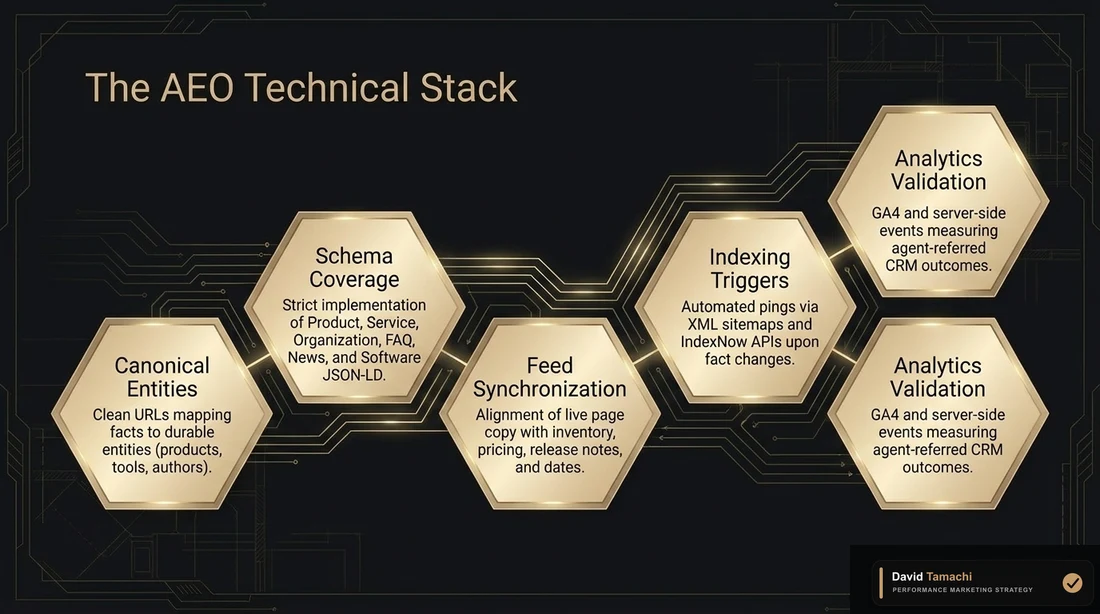
The fastest way to prepare for Google Search Agents is to treat your website as a data product. Your content management system, analytics layer, product feed, and schema layer need to agree on the same facts.
For most brands, the issue is not a lack of content. The issue is that the most important conversion facts are trapped in disconnected systems that agents cannot reliably parse.
- Canonical entity pages: Maintain clean URLs for products, services, categories, locations, authors, and tools so Google can connect facts to durable entities.
- Schema coverage: Use Product, Service, Organization, FAQPage, NewsArticle, SoftwareApplication, and HowTo schema where they match the content.
- Feed synchronization: Keep inventory, availability, pricing, release notes, event dates, lead magnets, and calculator outputs aligned with the live page.
- Indexing triggers: Connect publishing workflows to the IndexNow API, XML sitemap updates, and internal link updates when critical facts change.
- Analytics validation: Use GA4, server-side events, and CRM outcomes to measure whether agent-referred sessions create qualified pipeline.
For paid media teams, one of the cleanest bridge metrics is Attributed Branded Searches: it helps connect visual exposure, later branded search behavior, and the AI citation visibility that shows up in Bing, Copilot, Gemini, and ChatGPT referral reporting.
Data Pipeline Rule
If a fact matters to conversion, it should exist in human-readable copy, structured schema, and a refreshable feed. Search Agents need all three layers to trust that the information is current.
What B2B Brands Need to Change
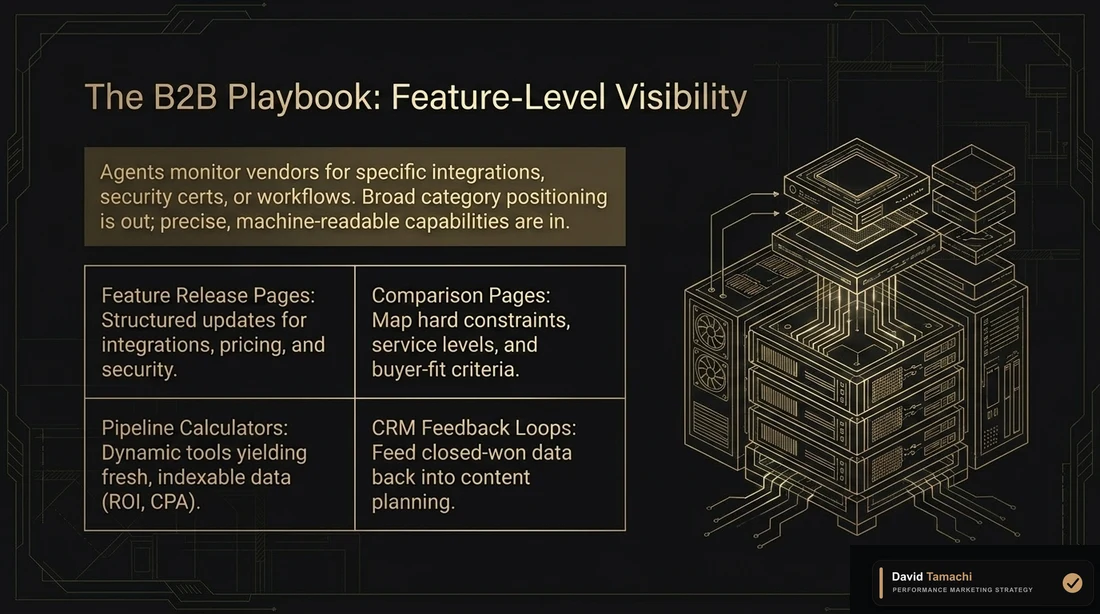
For B2B teams, Search Agents will make feature-level visibility more important than broad category positioning. A buyer might ask an agent to monitor vendors that add a specific integration, security certification, regional service area, or workflow capability.
If your release notes, comparison pages, and service pages are vague, the agent has less evidence to match you to the request. The winning B2B pages will expose precise capabilities in language that both buyers and machines can parse.
- Feature release pages: Publish structured updates for integrations, pricing changes, supported industries, security controls, and implementation timelines.
- Comparison pages: Map use cases, constraints, integrations, service levels, and buyer-fit criteria instead of relying on generic competitor claims.
- Pipeline calculators: Build interactive tools that produce fresh, indexable support content around ROI, CPA, LTV, and payback thresholds.
- CRM feedback loops: Feed qualified lead and closed-won data back into content planning so Agentic Engine Optimization (AEO) reflects revenue, not traffic vanity.
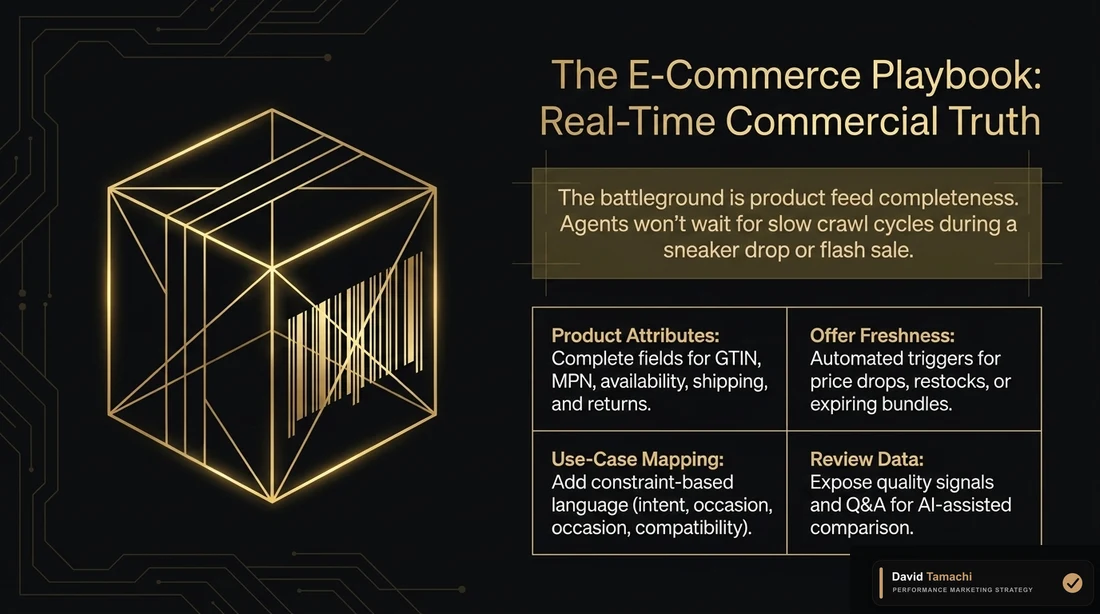
What E-Commerce Teams Need to Change
For E-commerce teams, the battleground shifts toward product feed completeness and real-time commercial truth. An agent monitoring a sneaker drop, price change, bundle, or inventory threshold will not wait for a slow crawl cycle.
Your product detail pages still need persuasive creative. But your feed attributes, variants, return policies, compatibility details, and availability signals decide whether the product is eligible for an agent recommendation.
The commerce version of this shift is the Universal Commerce Protocol, where product data, checkout readiness, and AI-agent compatibility start to influence who gets selected inside native buying flows.
- Product attributes: Keep size, color, material, GTIN, MPN, availability, condition, shipping speed, and return policy fields complete.
- Offer freshness: Trigger updates when prices change, discounts launch, stock returns, bundles expire, or fulfillment timelines shift.
- Use-case mapping: Add compatibility, buyer intent, audience, occasion, and constraint-based language so agents can match products to complex prompts.
- Review data: Keep ratings, review count, product quality signals, and customer Q&A content accessible enough for AI-assisted comparison.
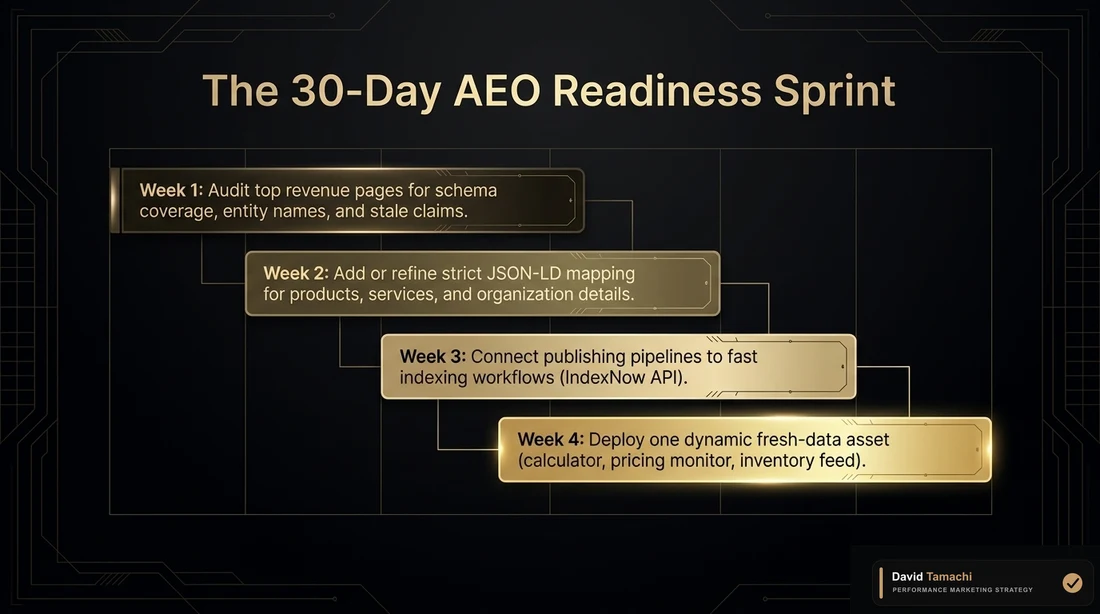
The 30-Day AEO Readiness Sprint
You do not need to rebuild the entire site before Search Agents influence acquisition. You do need a focused sprint that turns your highest-value commercial facts into structured, current, and crawlable assets.
- Week 1: Audit your top revenue pages for schema coverage, canonical clarity, internal links, entity names, and stale claims.
- Week 2: Add or refine JSON-LD for products, services, FAQs, articles, tools, authors, and organization details.
- Week 3: Connect publishing and feed updates to fast indexing workflows, including the IndexNow API where supported.
- Week 4: Build one fresh-data asset, such as a calculator, release tracker, pricing monitor, comparison matrix, or inventory feed.
How to Measure Search Agent Visibility
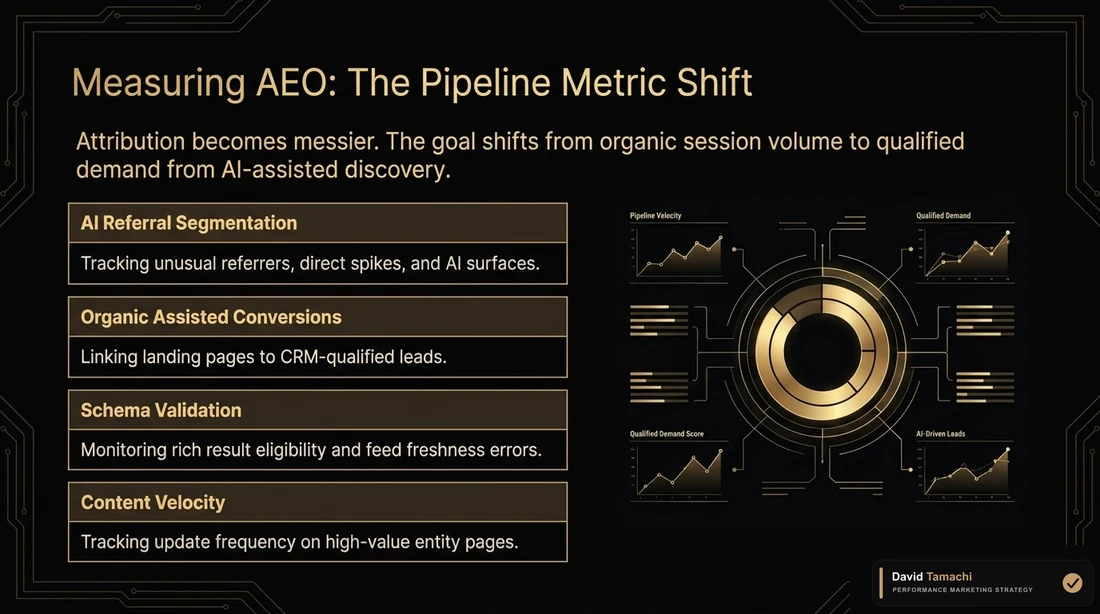
Search Agents will make attribution messier before it gets cleaner. Some users will arrive after an AI system narrows the options, while others may convert after receiving a background recommendation.
That means the measurement model has to combine traditional SEO reporting with pipeline-quality indicators. The goal is not just more organic sessions; it is more qualified demand from AI-assisted discovery.
- Organic assisted conversions: Track whether organic landing pages influence CRM-qualified leads and revenue.
- AI referral segmentation: Use Search Console generative AI performance reports alongside views for AI surfaces, unusual referrers, direct spikes, and query patterns that suggest agent-assisted discovery.
- Schema validation: Monitor structured data errors, rich result eligibility, feed freshness, and sitemap recrawl behavior.
- Content velocity: Measure how often high-value entity pages receive meaningful updates tied to product, pricing, inventory, or service changes.
The New KPI
The practical KPI is not "rank number one for a keyword." In the Agentic Engine Optimization (AEO) era, the KPI is whether your brand is eligible, current, and trustworthy when an autonomous system decides what to recommend.
FAQ: Google Search Agents and AEO
How are Search Agents different from traditional SEO?
Traditional SEO optimizes pages for users who actively search, click, and compare results. Agentic Engine Optimization (AEO) optimizes structured, fresh, machine-readable data so an autonomous agent can select a brand before the user ever opens a results page.
What should brands do first for Agentic Engine Optimization?
Brands should start by improving real-time indexing, JSON-LD coverage, product or service schema depth, and feed freshness. The goal is to make every high-value offer easy for Search Agents to understand, verify, and recommend. Use the LLM Crawlability & Context Auditor to preflight crawler access, robots policy, schema validity, and source readability before larger AEO sprints.
Does traditional SEO still matter after Search Agents?
Yes. Technical SEO, authority, internal linking, page quality, and clear topical coverage still help Google trust your site, but Search Agents add a new requirement for live, structured, operational data.
More AI Search Notes
For more public notes on structured data, indexing, and AI search, my LinkedIn profile and resource library are the best places to start.
Connect on LinkedInFor the paid-search side of the same crawlability story, read Google Delays DSA to February 2027 for the migration timeline and Q4 playbook.