
What is Journey-Aware Bidding in Google Ads?
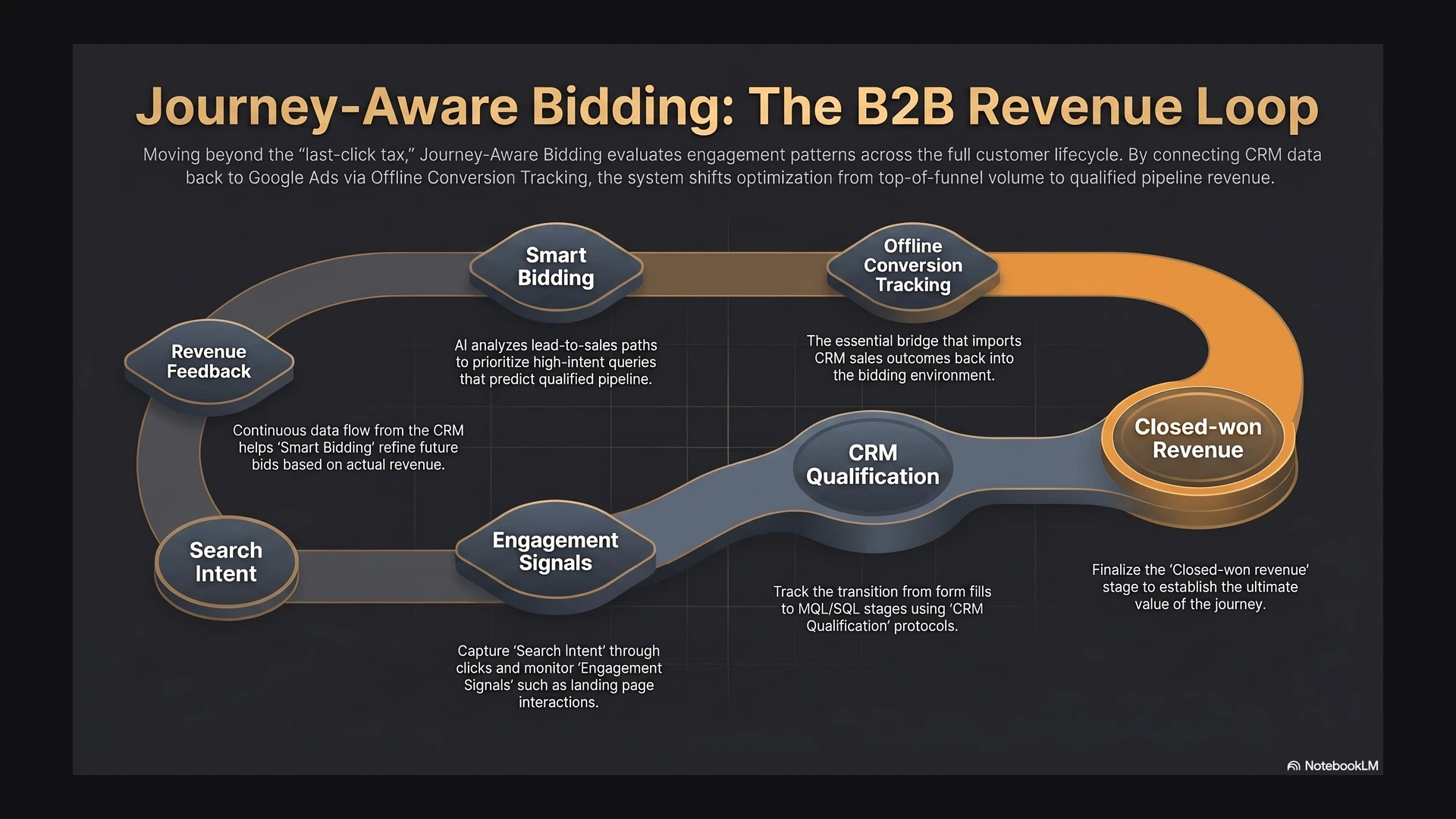
Journey-Aware Bidding is a new algorithmic bidding model for Target CPA Search campaigns that evaluates engagement patterns across the full customer journey. Instead of optimizing only for a single isolated action, the AI uses early engagement signals (like brochure downloads) and later-stage qualification signals to make comprehensive bidding decisions.
Why This Changes B2B Pipeline Architecture
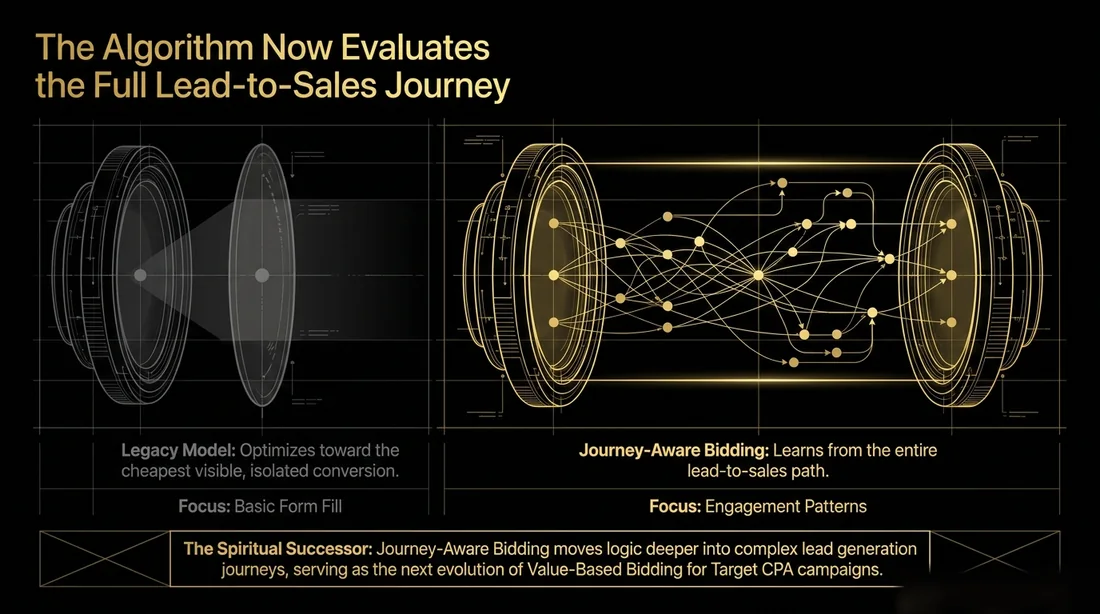
For years, B2B marketers have suffered under the "last-click tax." You run top-of-funnel educational Search ads, a user clicks, leaves, and returns weeks later via a branded search to convert. Historically, the branded keyword got 100% of the credit, starving your top-of-funnel campaigns.
With Journey-Aware Bidding, Google's Smart Bidding now understands the latency and multi-touch reality of B2B buying cycles. It acts as a spiritual successor to Value-Based Bidding, allowing you to bid aggressively on high-intent queries knowing the system maps the downstream impact.
This is the paid-media side of the same agentic search shift covered in Google Search Agents and Agentic Engine Optimization: ranking is moving from one visible click toward structured signals, journey context, and machine-readable trust.
Pipeline Architect Warning
Journey-Aware Bidding will violently expose broken CRM integrations. If you are still optimizing for basic form fills instead of importing Salesforce CRM "Closed-Won" data via Offline Conversion Tracking (OCT), this model will optimize your multi-touch journey toward low-quality spam.
Journey-Aware Bidding vs Last-Click Attribution
Last-click attribution is tidy, but it is rarely honest for B2B. It rewards the final touchpoint that captured the form fill, not the earlier search query, asset download, phone call, newsletter signup, or product page visit that moved the buyer forward.
Journey-Aware Bidding changes the optimization layer by letting Google Ads learn from the lead-to-sales path rather than only the final biddable conversion. That matters because a technical buyer may touch five assets before becoming an MQL, then disappear into sales follow-up before revenue appears in the Salesforce CRM.
- Old model: Optimize toward the cheapest visible conversion and hope sales quality follows.
- Journey-aware model: Teach Smart Bidding which early and late signals tend to precede qualified pipeline.
- Revenue implication: Campaigns that create real buying momentum can receive more credit even when they are not the final click.
Journey-Aware Bidding vs Value-Based Bidding
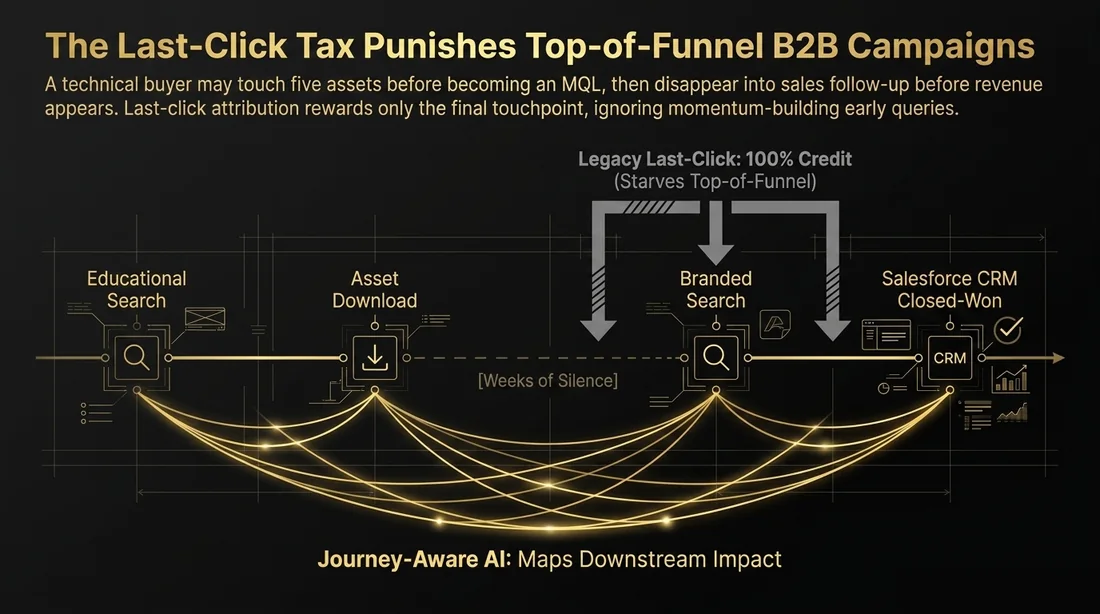
Value-Based Bidding asks the advertiser to assign different values to different conversion outcomes. That works well when you can reliably tell Google Ads that a booked demo, qualified opportunity, or closed deal is worth more than a generic lead.
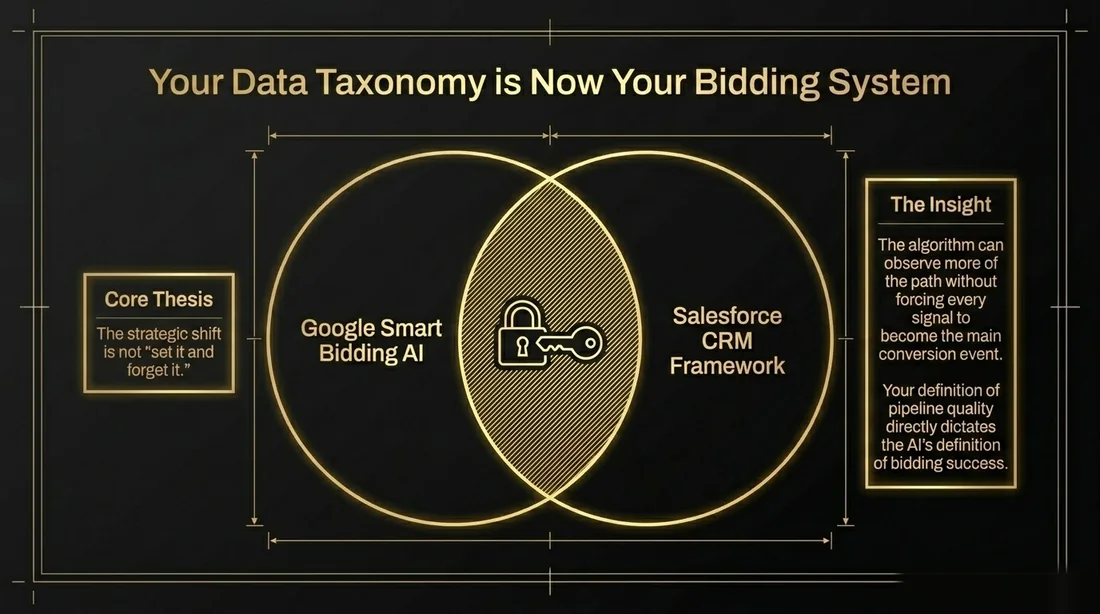
Journey-Aware Bidding appears to move that logic deeper into lead generation journeys by helping Target CPA Search campaigns learn from both biddable and non-biddable conversion goals. In plain English, the algorithm can observe more of the path without forcing every signal to become the main conversion event.
The strategic shift is not "set it and forget it." The strategic shift is that your data taxonomy becomes part of the bidding system.
- Use Value-Based Bidding when: You have stable monetary values for conversion stages and enough volume to support value optimization.
- Use Journey-Aware Bidding when: Your lead journey has meaningful non-purchase signals that predict later sales quality.
- Use both concepts together when: Your CRM can distinguish casual hand-raisers from qualified opportunities and closed revenue.
The CRM Data Requirement Nobody Can Skip
Journey-Aware Bidding is only as smart as the journey you feed it. If your conversion setup treats every form fill as equal, the model has no clean way to separate a student downloading a template from a buyer asking for pricing.
Your Salesforce CRM, HubSpot instance, or lead management system needs to send back the stages that actually matter. At minimum, that usually means lead created, MQL, SQL, opportunity created, closed-lost, and closed-won.
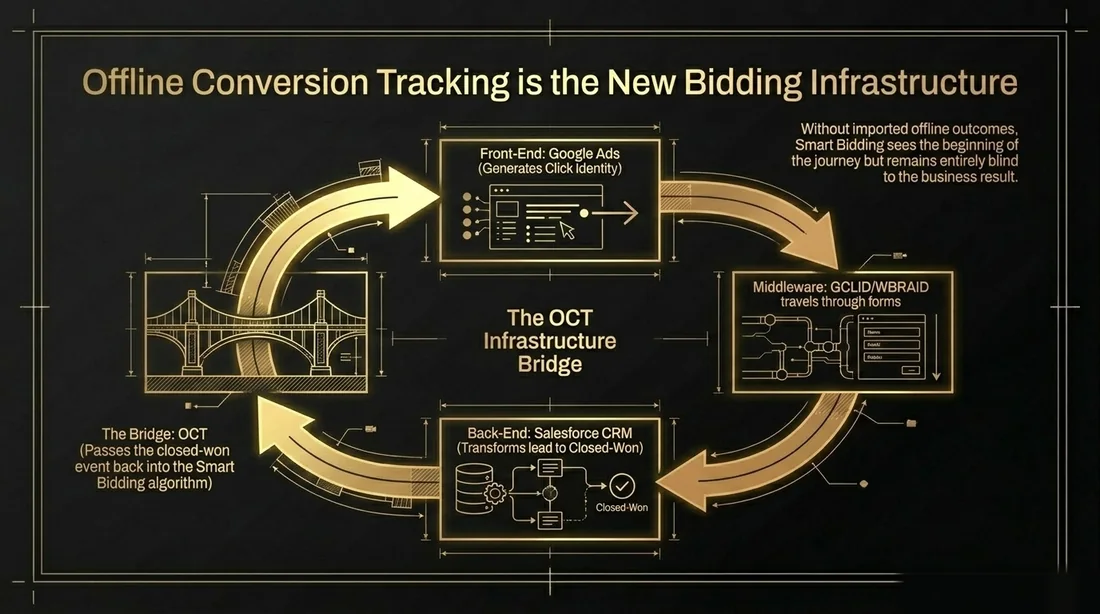
This is where Offline Conversion Tracking (OCT) stops being a reporting nice-to-have and becomes bidding infrastructure. Without imported offline outcomes, Smart Bidding sees the beginning of the journey but not the business result.
This can be understood as lead-quality-path optimization: the bidding system learns from a sequence of increasingly valuable outcomes instead of treating every form fill as equal. The phrase is only useful when each stage has a stable CRM definition and an auditable import.
For ecommerce teams, the equivalent infrastructure problem is product-feed quality and checkout readiness, which I cover in the Universal Commerce Protocol guide.
- Capture the click identity: Preserve GCLID, GBRAID, WBRAID, and UTM fields through every form and routing layer.
- Normalize lifecycle stages: Use consistent CRM statuses so Google Ads receives clean downstream signals.
- Import quality events: Send qualified stages back through Offline Conversion Tracking (OCT), not just front-end form submissions.
- Exclude junk signals: Keep spam, duplicates, students, vendors, and support requests out of the primary optimization goal.
Use the Offline Conversion and CRM Feedback Loop Checklist to audit lifecycle stages, identifiers, upload cadence, match quality and bidding-goal selection.
Common Failure Modes for B2B Lead Gen Accounts
The biggest risk is not that Journey-Aware Bidding fails. The bigger risk is that it faithfully optimizes toward the wrong definition of success because the account never defined quality in the first place.
If your pipeline is messy, the new model may expose the mess faster. That is useful, but only if you are ready to fix the measurement layer instead of blaming the bid strategy.
- Every lead is marked equal: The account optimizes toward volume, not pipeline quality.
- Offline uploads are delayed: The algorithm receives sales outcomes too late to learn efficiently.
- Campaigns are over-segmented: Each campaign has too little data for the model to map longer journeys.
- Micro-conversions are noisy: Newsletter signups and content downloads help only when they correlate with real opportunity creation.
- Sales feedback is missing: Marketing sees conversions while sales sees bad-fit leads, and the loop never closes.
Data Hygiene Priority
Before enabling Journey-Aware Bidding, audit your conversion actions like a revenue operations project. The question is not "can Google see more signals?" The question is "can Google see the signals that predict qualified revenue?"
How to Prepare Your Lead Gen Account
This feature is rolling out for Target CPA Lead Gen campaigns. To prepare your pipeline:
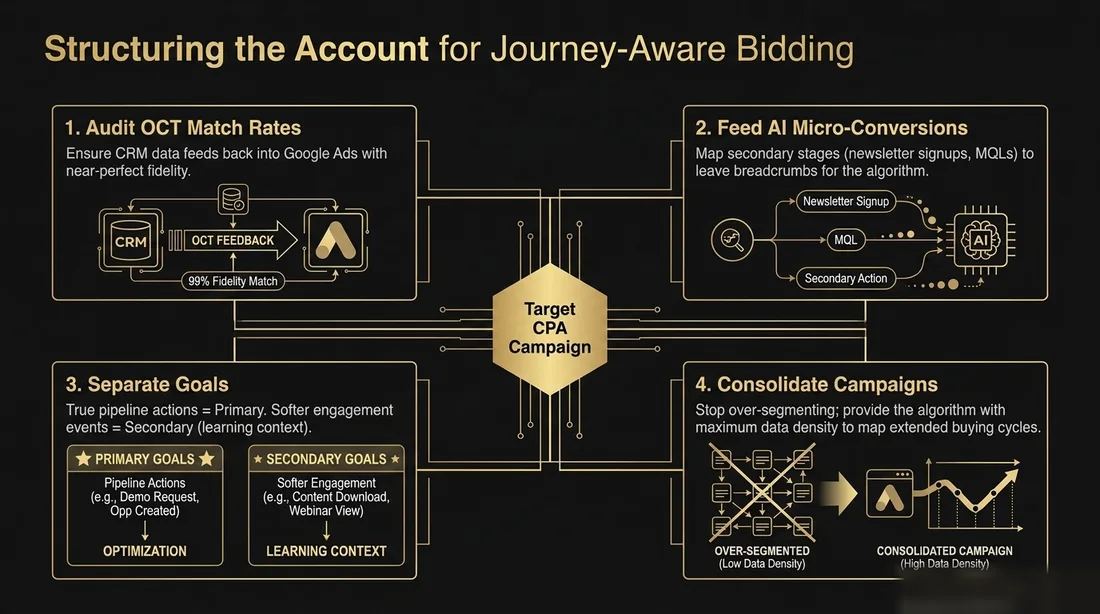
- Audit Offline Conversion Tracking (OCT): Ensure your CRM data feeds back into Google Ads with a high match rate.
- Feed the AI with Micro-Conversions: Map secondary pipeline stages (newsletter signups, MQLs) so the algorithm has breadcrumbs to follow.
- Consolidate Campaigns: The algorithm needs data density to map these longer journeys successfully. Stop over-segmenting.
- Separate primary and secondary goals: Keep true pipeline actions as primary conversion goals, and use softer engagement events as learning context.
- Monitor lead quality weekly: Compare Target CPA, MQL rate, SQL rate, opportunity rate, and closed-won value before judging the strategy.
What to Measure After Launch
Do not judge Journey-Aware Bidding only by short-term CPL. A model designed around the full journey needs a readout that includes speed, quality, and downstream conversion rate.
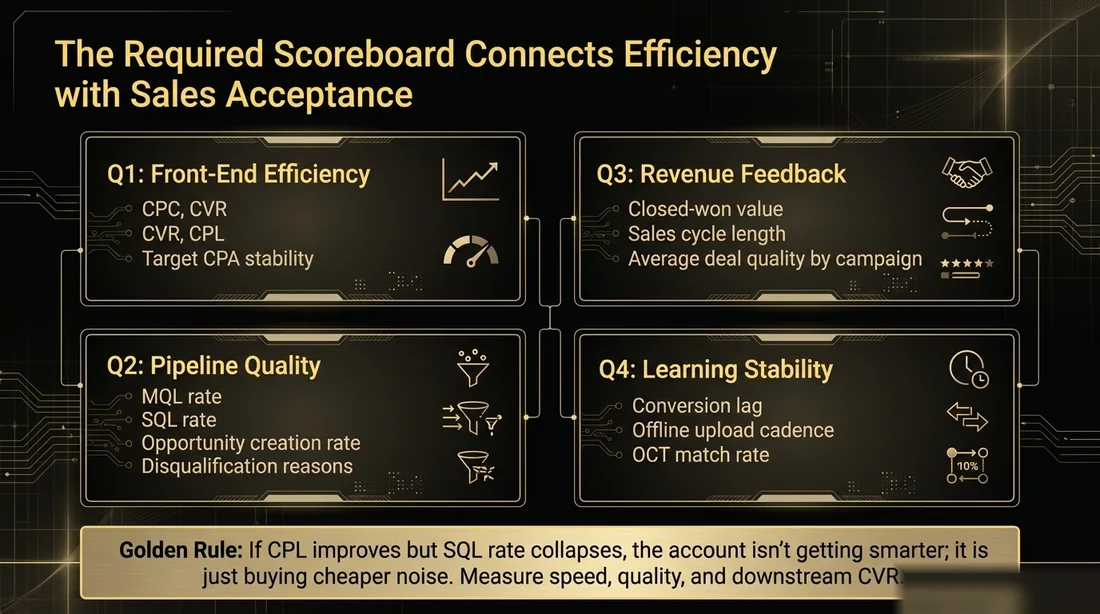
The best scoreboard connects platform efficiency with sales acceptance. If CPL improves but SQL rate collapses, the account is not getting smarter; it is just buying cheaper noise. For causal readouts, pair the launch with Google Ads Conversion Lift and the Conversion Lift study requirements checklist.
- Front-end efficiency: CPC, CVR, CPL, and Target CPA stability.
- Pipeline quality: MQL rate, SQL rate, opportunity creation rate, and disqualification reasons.
- Revenue feedback: Closed-won value, sales cycle length, and average deal quality by campaign.
- Learning stability: Conversion lag, offline upload cadence, and match rate inside Offline Conversion Tracking (OCT).
Official Source
Google announced Journey-Aware Bidding as a beta for Search campaigns optimizing to Target CPA. The official launch language says the system can learn from the full lead-to-sales journey, including both biddable and non-biddable conversion goals.