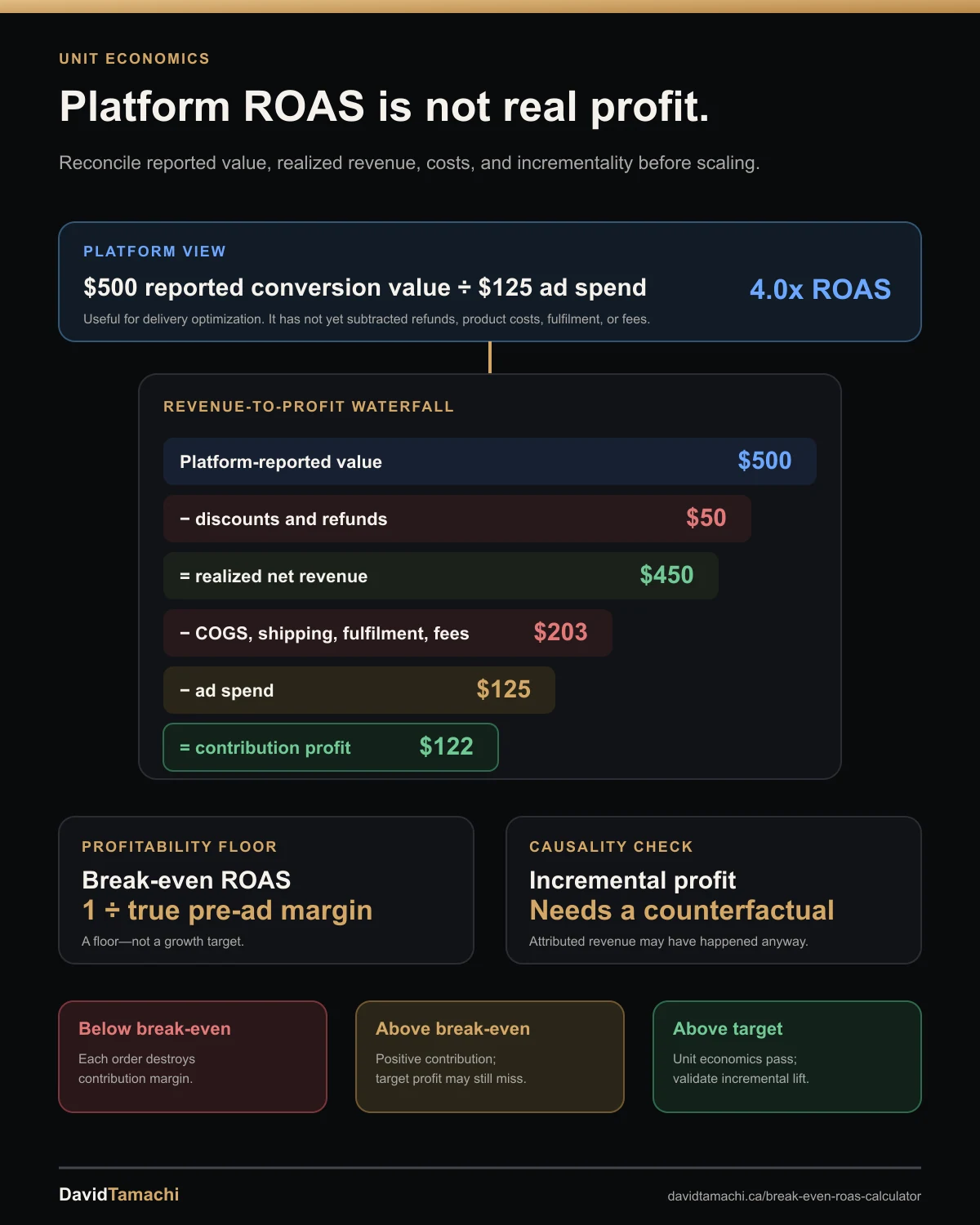
From Platform ROAS to Real Contribution Profit
Platform ROAS divides attributed conversion value by ad spend. It does not automatically subtract discounts, refunds, COGS, shipping, fulfilment, payment fees, packaging, or the advertising cost itself. Start with realized net revenue, subtract the variable cost stack, then subtract ad spend to estimate contribution profit. Use the conversion reconciliation workflow when platform value does not align with GA4, CRM, or the order system.
Clearing break-even means the campaign contributes more gross profit than it spends on ads. It does not mean the campaign reached the desired profit buffer, created incremental demand, or covered every fixed operating expense. Use the cross-channel performance-drop checklist when profitability changes alongside delivery, response, conversion, or measurement.
The Danger of Vanity Metrics: Why Raw ROAS is Deceptive
Platform-reported ROAS can look healthy while the business quietly loses money. True profitability requires accounting for COGS, fulfilment, gateway fees, discounts, refunds, and return risk before evaluating ad performance.
Deconstructing the E-Commerce Profit Margin
Gross profit is not net profit. This calculator models the cost stack that determines your real unit economics and allowable customer acquisition cost ceiling before you scale spend.
The Break-Even ROAS Formula Explained
Break-Even ROAS = 1 / Gross Margin. If your true gross margin is 40% (0.40), your break-even threshold is 2.5x. That is a practical floor, not a target, and it should be built from true net revenue rather than platform-reported revenue alone.
Moving Beyond Break-Even: Calculating Target ROAS
Break-even is survival, not scale. Target ROAS models your desired net margin on top of all variable costs so you can set proactive media buying guardrails that still leave room for profit and working capital. Once a campaign clears break-even, use Google Ads Conversion Lift to see whether that ROAS is incremental or merely attributed.
The Impact of Returns, Refunds, and Attribution on Profitability
Refunds compress realized revenue and raise the ROAS needed to stay solvent. Attribution noise can inflate reported performance, so use consistent campaign tagging and validated tracking governance through the UTM Link Builder.
Actionable Strategies to Fix Unprofitable Campaigns
If you are below break-even, prioritize one of three levers: raise AOV, reduce variable costs, or reduce CPA. For measurement integrity, generate consistent campaign links with the UTM Link Builder and sanity-check efficiency with the KPI Calculator.
Frequently Asked Questions (FAQs)
What does break-even ROAS mean?
It is the minimum revenue-to-ad-spend ratio required to cover variable costs and acquisition expense without net profit or net loss.
What is the exact formula for break-even ROAS?
Break-Even ROAS = 1 / Gross Margin, where Gross Margin is based on true post-discount revenue minus total variable costs.
What is the difference between ROAS and Break-Even ROAS?
ROAS is a topline efficiency ratio. Break-Even ROAS is a business-specific profitability threshold rooted in your unit economics.
How do payment processing fees affect profitability?
Gateway fees are a direct variable cost per order, which compresses margin and pushes break-even ROAS higher.
What should I do if actual ROAS is below break-even?
Lower CPA, increase AOV, or reduce COGS/fulfillment costs immediately. Operating below break-even means each new sale destroys cash flow.