
What is Happening to Google Display Ads?
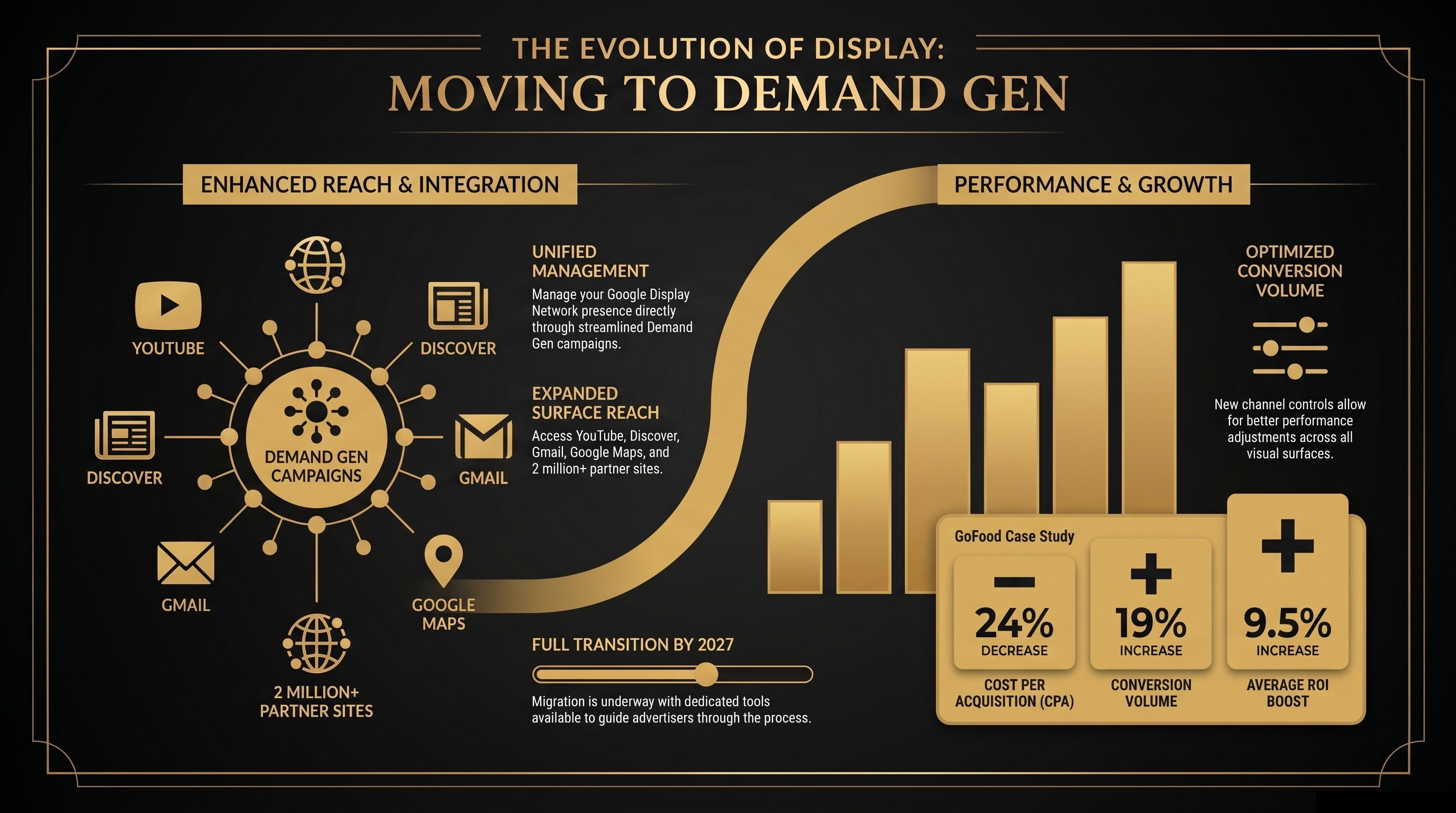
Google Display Ads is transitioning into Demand Gen campaigns. Instead of treating the Google Display Network as a separate campaign environment forever, Google is bringing GDN management into Demand Gen so advertisers can plan visual reach across more surfaces from one place.
The practical translation: your Display strategy is not disappearing, but the operating system around it is changing. Google says advertisers can manage their GDN presence directly through Demand Gen, continue reaching audiences across GDN inventory, and still choose GDN-only delivery when that is the right control for the account.
This matters because Demand Gen already spans visually oriented Google surfaces like Discover, Gmail, and Google Maps, plus video inventory. Adding Display into that environment turns Demand Gen into a broader discovery-to-action campaign type rather than only a feed-based format.
Why Google is Moving Display Into Demand Gen
The move reflects a bigger shift in paid media: discovery, shopping research, short-form video, email, maps, and open-web browsing are increasingly connected parts of one consumer journey. A buyer may see a product in a feed, watch a related video, compare nearby options on Maps, and later convert after another visual touchpoint.
Demand Gen is designed for that kind of behavior. It gives advertisers a campaign environment built around visual assets, audience intent, and cross-surface demand creation. Bringing GDN into Demand Gen gives the system more places to find incremental reach while giving advertisers a more centralized place to manage visual performance.
For performance marketers, the point is not simply "more inventory." The real question is whether the campaign can create profitable discovery without collapsing into low-quality placements, weak creative, or noisy conversion data.
What Changes
GDN management moves deeper into Demand Gen, with more campaign planning happening through Demand Gen surfaces, controls, and migration workflows.
What Stays
Advertisers can still reach the Google Display Network and can still use controls to serve exclusively on GDN when that matches the account strategy.
Google Display vs Demand Gen Comparison
The migration does not make the two operating models identical. Use this matrix to decide which controls, assets and measurements need attention before moving spend.
| Decision | Traditional Display workflow | Demand Gen workflow |
|---|---|---|
| Inventory | Google Display Network placements. | Visual discovery surfaces with GDN available through channel controls. |
| Creative | Responsive display and uploaded image assets. | Image and video storytelling designed for discovery-oriented placements. |
| Audience role | Often used for remarketing, contextual reach or managed prospecting. | First-party lists, lookalikes and broader discovery signals work across more surfaces. |
| Channel control | Display inventory is the campaign environment. | Advertisers must choose whether to use broader Demand Gen reach or keep GDN-only delivery. |
| Measurement | Placement, view-through and conversion reporting. | Requires channel-aware reporting, creative breakdowns and demand-creation signals. |
Key Benefits for Advertisers
The best-case version of this migration is cleaner management plus more intelligent visual reach. Google says advertisers adding GDN to Demand Gen campaigns see a 9.5% average ROI increase, based on Google internal global data from August 2025. Google also cites GoFood, which saw a 24% decrease in CPA and 19% higher conversion volume after adding GDN.
Those are useful directional signals, but they should not be treated as guaranteed account outcomes. The lift depends on creative strength, conversion tracking, audience quality, feed quality, placement suitability, and whether the campaign has enough conversion data for the model to learn from.
What This Means Strategically
This migration reinforces something Google has been doing across the platform for years: moving advertisers away from isolated campaign silos and toward AI-assisted campaign types with broader inventory access. Performance Max did this for commerce and conversion coverage. Demand Gen is doing it for visual discovery and mid-funnel growth.
The risk is that advertisers read "streamlined" as "hands off." That would be a mistake. A more unified campaign type still needs deliberate inputs: clear conversion goals, strong image and video assets, audience exclusions, channel controls, and landing pages that match discovery intent.
If your account already struggles with creative fatigue, mixed conversion quality, or blurry remarketing strategy, this migration will not magically solve those problems. It may simply give the system more room to amplify them.
Pipeline Architect Take
Treat the migration as a measurement and creative readiness project. Before you migrate, decide what success means by channel, what conversion actions should shape bidding, and what placements are actually allowed to influence budget.
How to Prepare Before the 2027 Migration
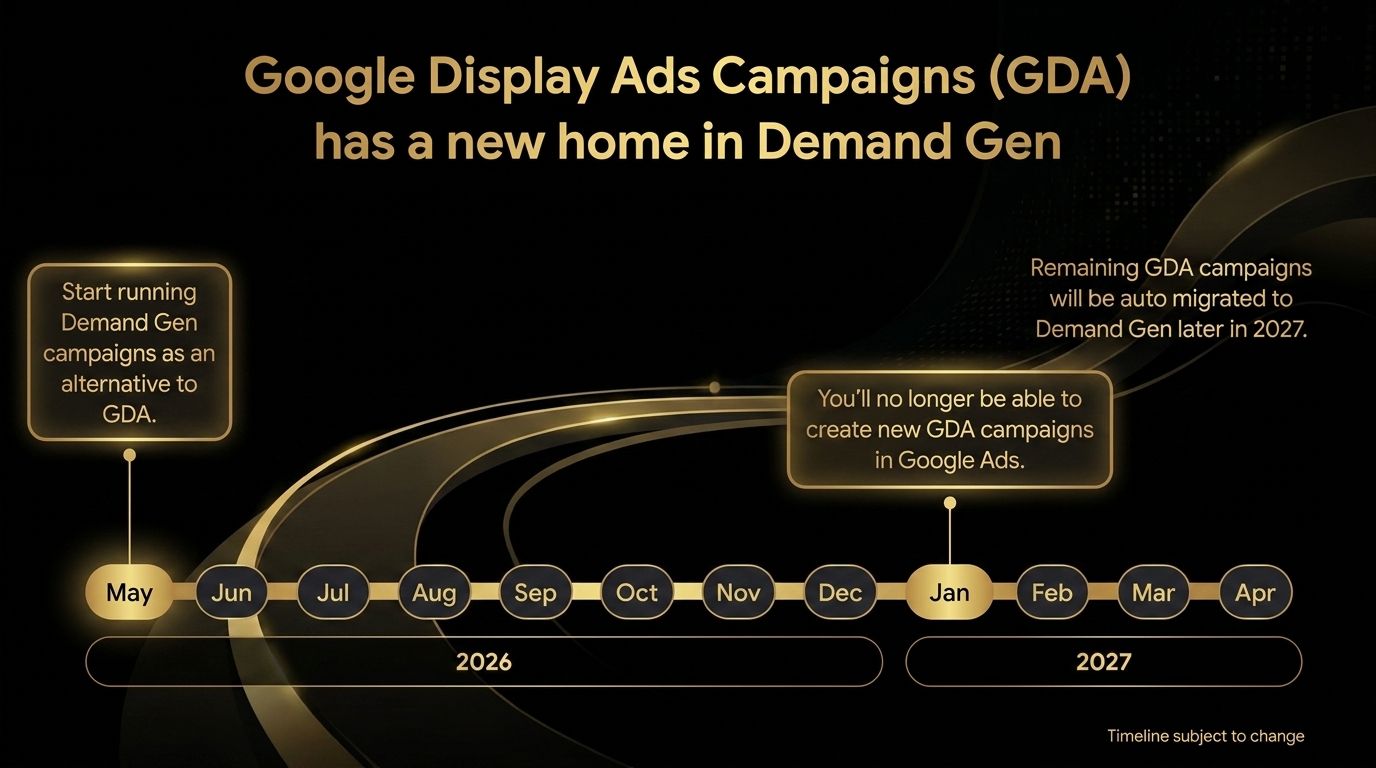
The transition is expected to finish by 2027, so advertisers have time to get ready. The accounts that handle this well will not wait for an auto-migration notice. They will test the new structure while they still have room to compare results.
- Audit existing Display campaigns: Identify which campaigns are prospecting, remarketing, retention, or placement-specific before moving them into a broader Demand Gen strategy.
- Separate campaign intent: Do not mix cold discovery, cart recovery, customer upsell, and generic awareness into one unreadable campaign just because the interface allows it.
- Clean up conversion actions: Keep the primary goal focused on business outcomes. Move soft engagement events into secondary measurement where appropriate.
- Upgrade creative assets: Demand Gen is visual. Refresh square, landscape, vertical, short-form video, product, and lifestyle assets before scale testing.
- Use channel controls intentionally: If GDN-only delivery is important, set it intentionally. If you test broader surfaces, compare performance by channel and conversion quality.
- Watch incrementality: Compare new Demand Gen plus GDN results against existing Display baselines, not just last-click platform conversions.
Migration gate
Do not scale until channel selection, brand suitability, conversion actions, audience exclusions, creative coverage and post-click quality have each been reviewed and assigned an owner.
What to Measure After You Add GDN to Demand Gen
Do not judge the migration only by cheaper CPA. Display and Demand Gen can generate assisted demand that shows up later through branded search, direct traffic, video engagement, or remarketing pools. That makes the scorecard more nuanced than a single platform column.
- Efficiency: CPA, ROAS, CPC, CPM, CTR, CVR, and cost per engaged session.
- Quality: MQL rate, SQL rate, assisted conversion paths, new customer rate, and lead disqualification reasons.
- Channel mix: Discover, Gmail, Maps, video, and GDN contribution by spend, conversion volume, and post-click quality.
- Creative health: Asset fatigue, format-level performance, image versus video contribution, and landing page fit.
- Incrementality: Lift in non-brand demand, branded search demand, retargeting pool quality, and blended CAC.
For the Demand Gen measurement layer, connect this migration to Attributed Branded Searches, the attributed branded search reporting guide, and Google Ads Conversion Lift. That gives the migration a demand-creation scorecard instead of only a platform CPA readout.
If you need a baseline before testing, use the KPI calculator to capture current campaign efficiency and the break-even ROAS calculator to sanity-check profitability thresholds.
Frequently Asked Questions
What is happening to Google Display Ads?
Google Display Ads is moving into Demand Gen campaigns. Advertisers will manage GDN presence through Demand Gen while continuing to access Display inventory.
Will I still be able to advertise only on the Google Display Network?
Yes. Google says advertisers can still serve ads exclusively on GDN by using channel controls in Demand Gen.
What are the main benefits of the migration?
The main benefits are more unified campaign management, access to visual surfaces like Discover, Gmail, and Google Maps, continued GDN reach, and access to ongoing Demand Gen product innovation.
Does adding GDN to Demand Gen improve performance?
Google cites a 9.5% average ROI increase for advertisers adding GDN to Demand Gen campaigns. However, account-level performance depends on measurement quality, creative, audience strategy, landing pages, and budget structure.
When is the migration deadline?
Google says the transition is expected to complete by 2027. Advertisers should watch Google Ads notifications, the Google Ads Help Center, and Google's FAQ for account-specific migration guidance.
The Bottom Line
The move from Google Display Ads to Demand Gen is not just a naming change. It is another step toward a Google Ads environment where campaign types are organized around business outcomes, creative surfaces, and machine-learning signal density instead of legacy channel silos.
For advertisers, the winning move is to migrate with discipline: clean goals, strong creative, intentional channel controls, and a measurement plan that can separate real demand generation from cheap last-click noise.
Official Sources
More Public Resources
Use the free tools and writing on this site to think through Google Ads structure, measurement, and profitable growth.
View Free Tools