
Short Version
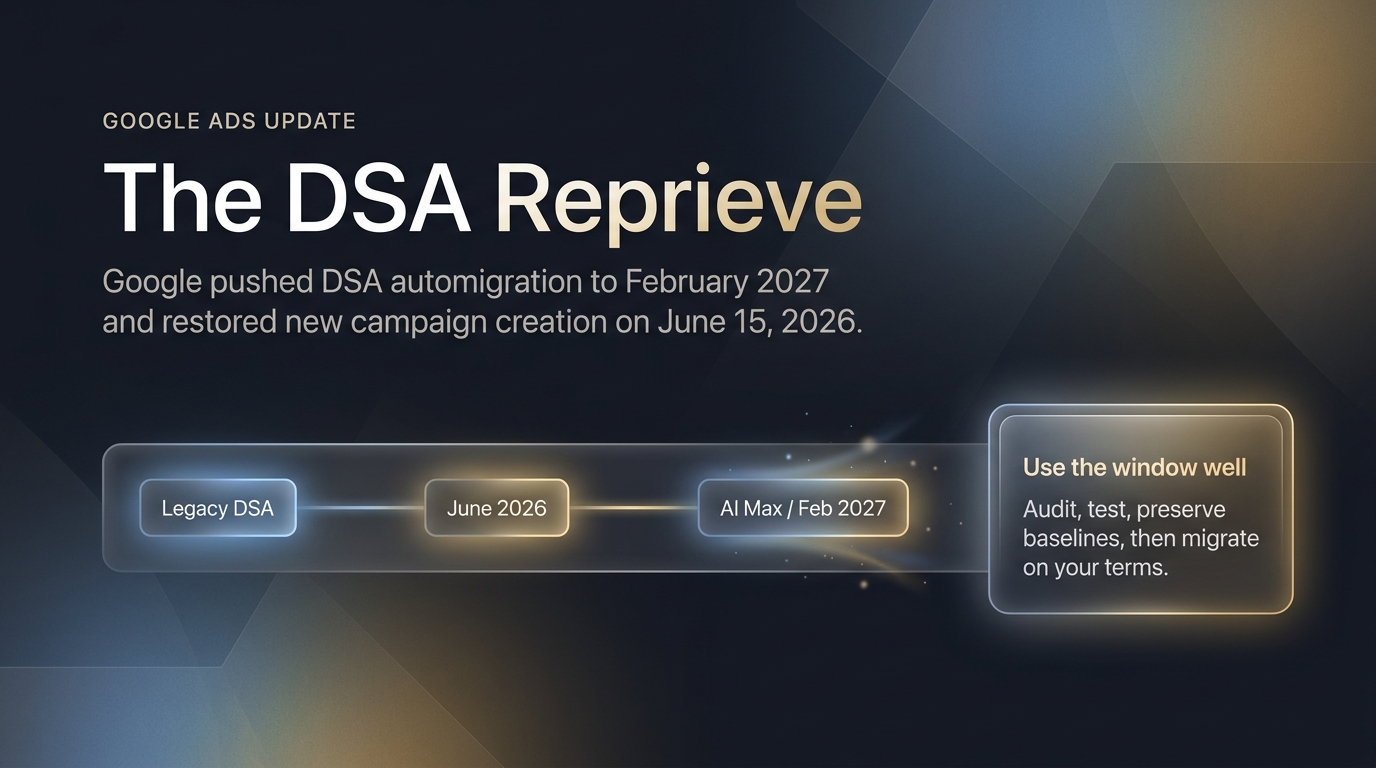
Google did not abandon the move from Dynamic Search Ads to AI Max for Search. It moved the deadline, restored campaign creation, and effectively handed advertisers a short-term buffer to test and document the transition on their own terms.
That matters because the busiest planning window for many advertisers is Q4. Getting a little more runway before the mandatory upgrade is a real operational advantage, not just a cosmetic delay.
What Changed, Exactly?
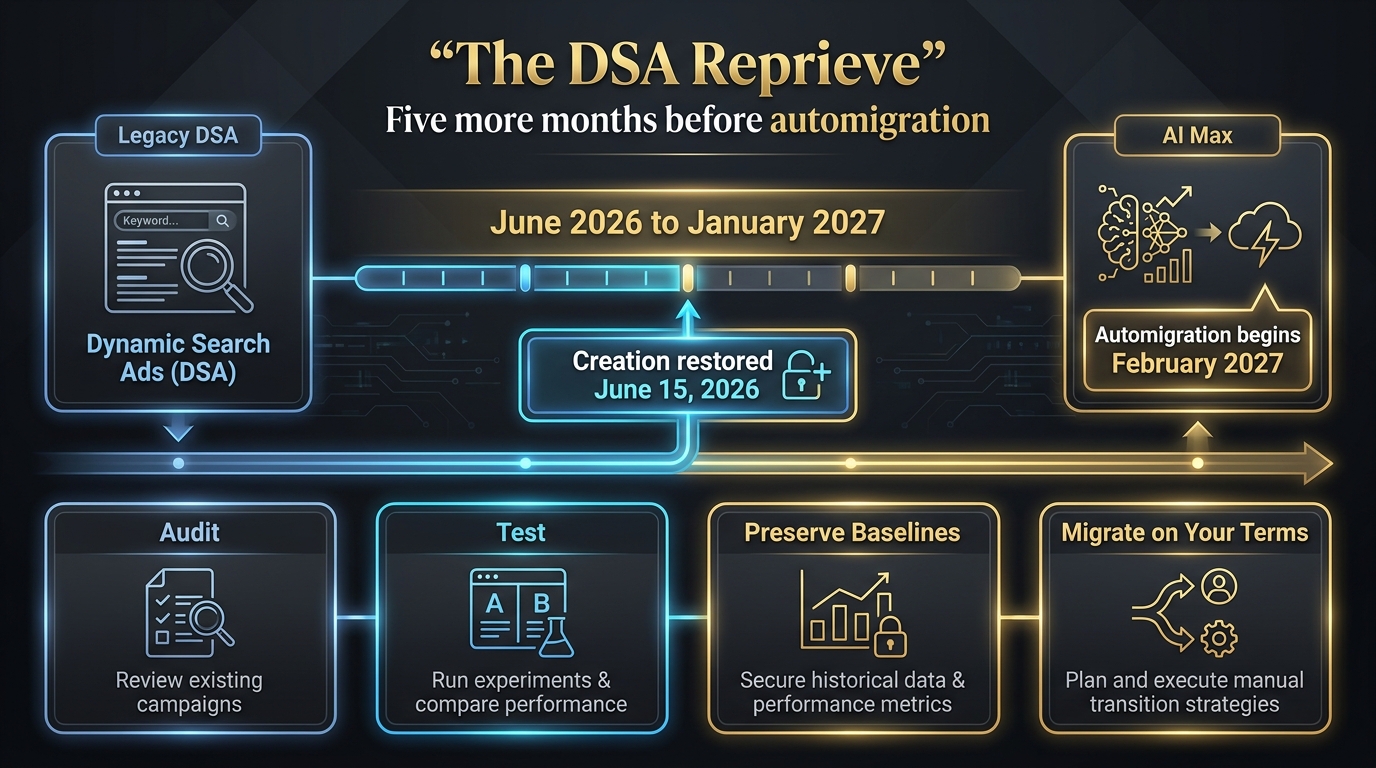
Google's official announcement on the Ads Developer Blog says the automatic upgrade of DSA campaigns to AI Max was pushed from September 2026 to February 2027. The same post says the ability to create new DSAs is being restored on June 15, 2026.
The matching Google Ads Help page now reflects the February 2027 timing as well. So the official position is consistent: creation returns for a while, but the end state is still migration.
The DSA delay does not cancel every September change. The September 2026 AI Max auto-upgrade guide explains which legacy Search settings remain on the September path and which controls should be audited first.
| Date | What Happens | Why It Matters |
|---|---|---|
| June 11, 2026 | Google announces the delay and the restored creation window. | Advertisers get immediate clarity that the September deadline is no longer the active cutoff. |
| June 15, 2026 | New DSA creation is restored. | Teams can rebuild or extend baselines while they test AI Max side by side. |
| January 2027 | New DSA creation disappears. | The last chance to launch a fresh DSA ends before the final migration sweep. |
| February 2027 | Automigration begins. | Remaining active DSA campaigns are moved into AI Max or the newer Search setup. |
Why This Matters for PPC Teams
The obvious takeaway is timeline relief. The less obvious takeaway is control.
DSA is one of the few Google Search structures that still lets media buyers keep a fairly direct connection between page inventory, query expansion, and search coverage. When that structure gets absorbed into AI Max, the strategic question is not just "will performance hold?" It is "how much structural authority do we lose while the platform learns?"
- Q4 planning gets safer: You can hold onto proven DSA inventory a little longer instead of rushing an untested migration before peak demand.
- Baseline data matters more: The strongest transition plans will keep clean performance snapshots, query exports, and landing-page notes before anything gets moved.
- Experimentation becomes the point: Side-by-side tests with AI Max are now the smart move, not an optional nice-to-have.
- Account structure still matters: If your site taxonomy, page feeds, and exclusions are sloppy, the migration will expose that quickly.
The Practical Read
This is not a license to wait. It is a short runway to preserve what is working, test the replacement, and avoid a forced migration during the most sensitive part of the retail calendar.
What to Do During the Reprieve
- Audit every active DSA campaign and document which landing pages, page feeds, and dynamic targets actually drive conversions.
- Export historical search term, landing page, and conversion data so you can compare the old structure against the new one later.
- Use the restored creation window to keep a true baseline alive while you test AI Max in a separate campaign or experiment.
- Clean up page feeds, URL exclusions, and negative keywords so the transition does not inherit avoidable noise.
- Review whether the site architecture still supports clean crawl paths and tight thematic grouping.
- Plan the migration like a launch, not like a checkbox: assign owners, QA steps, and success metrics before January 2027.
If you are already maintaining account history carefully, pair this work with the Google Ads data retention checklist so older reporting does not disappear before the transition is complete.
Why Page Structure Still Matters
This is first and foremost a DSA migration story, but the same page quality that makes DSA and AI Max work also helps search engines and AI assistants parse the site correctly. Crawlable pages, clear headings, clean internal links, and page-level specificity all make the transition easier to manage and easier to understand.
That is why the broader Google AI Optimization Guide and Google Search Agents articles still matter here: they cover the same structural fundamentals from the GEO and AEO side. If you want a quick sanity check before shipping the migration plan, use the LLM Crawlability & Context Auditor and the SERP simulator.
Related Reading
Official Sources
- Google Ads Developer Blog: Dynamic Search Ads (DSA) Automigration Delayed to February 2027 and Campaign Creation Restored
- Google Ads Help: About Dynamic Search Ads
- Google Ads Help: About Dynamic Search Ads, Ad Rank, and performance
- Google Ads Help: Use a feed to target Dynamic Search Ads and Performance Max
- Google Ads Blog: We’re upgrading Dynamic Search Ads to AI Max
FAQ
Did Google kill Dynamic Search Ads?
No. Google delayed the automatic migration to AI Max and restored the ability to create new DSAs for now, but the sunset still exists on the current timeline.
What should advertisers do first?
Preserve baseline data, audit current DSAs, and run AI Max tests side by side instead of waiting for the February 2027 automation sweep.
What happens in January 2027?
Google says the ability to create new DSA campaigns will be removed in January 2027, before the remaining active campaigns are migrated in February.
Why does this matter for GEO and AEO?
Because both DSA and AI Max reward sites that are easy to crawl, categorize, and understand. Cleaner structure improves paid search automation and answer-engine visibility at the same time.