
What Did Google Announce?
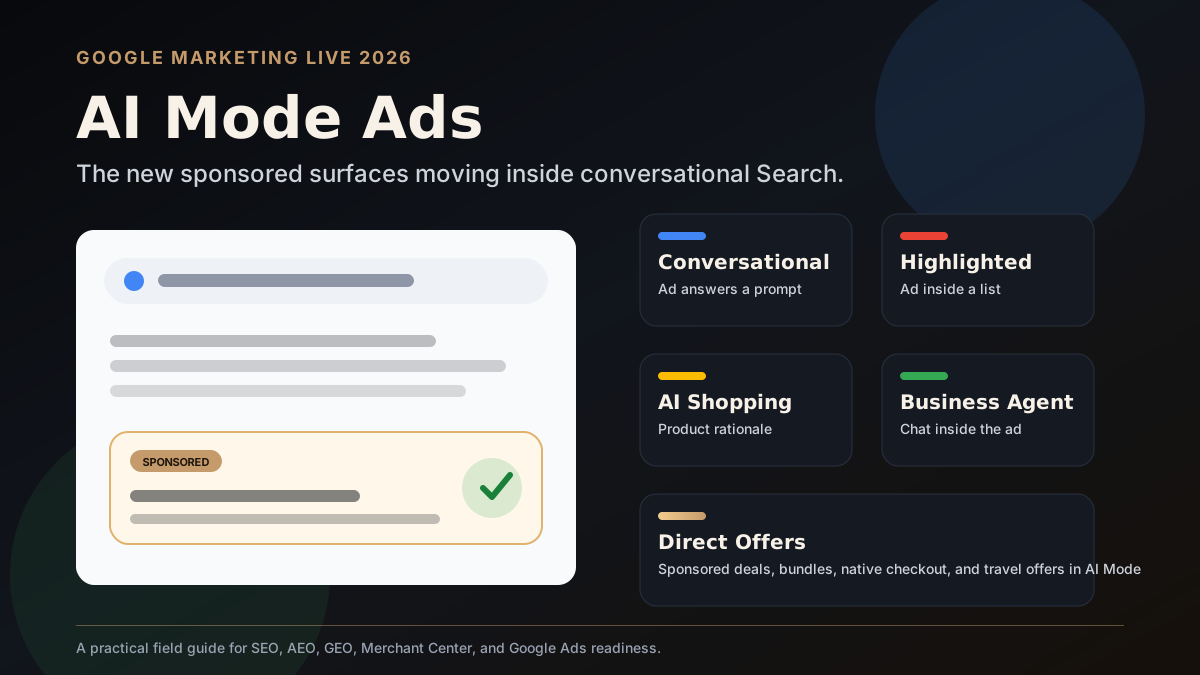
At Google Marketing Live 2026, Google previewed a new generation of AI Search ad experiences built with Gemini. The company positioned these formats as ads that can answer, explain, recommend, chat, and help complete a transaction inside AI-assisted Search journeys.
The user source was right to focus on the visuals. These are not just new labels in Google Ads. They are new placements inside the way people now research: conversational questions, AI-generated lists, high-consideration product comparisons, AI chat, and AI-assisted checkout.
The Format Map
Here is the clearest way to separate the announcements. Two formats are native to AI Mode answers. Two extend regular Search ads with Gemini-powered explanations and chat. Direct Offers connects AI Mode discovery to commercial action.
| Format | Where it shows | What it looks like | What feeds it |
|---|---|---|---|
| Conversational Discovery ads | AI Mode | A sponsored card or module that answers the user's specific prompt with Gemini-written creative and an independent AI explainer. | Search campaign signals, AI Max readiness, website content, product/service facts, and advertiser creative. |
| Highlighted Answers | AI Mode recommendation lists | A labeled sponsored item inside an AI-generated shortlist, not just beside the answer. | Ad relevance, quality, brand/product proof, landing page clarity, and query fit. |
| AI-powered Shopping ads | Search | Shopping ads with a Gemini-generated reason the product may fit the shopper's needs. | Merchant Center feed, product data, optional attributes, page content, reviews, and Shopping campaign structure. |
| Business Agent for Leads | Search lead ads | A "Chat" action inside the ad that opens a brand agent before a static lead form. | Advertiser website, business facts, lead qualification logic, and conversion measurement. |
| Direct Offers | AI Mode responses | A sponsored deal, bundle, native checkout action, or travel offer that appears while the user is researching. | Promotion data, eligible products, offer guardrails, UCP integration, and merchant/travel inventory. |
1. Conversational Discovery Ads
Conversational Discovery ads are built for long, nuanced prompts. Google gives the example of someone asking how to make a home smell like a spa or rainy forest without high maintenance. Instead of matching a short keyword, Gemini generates creative that responds to the intent of the full question.
What makes this format different is the independent AI explainer. Google says Gemini evaluates and synthesizes product or service information beside the advertiser's creative, while the placement remains labeled "Sponsored." That matters because the ad is not only a link. It is a machine-written argument for why the offer fits the moment.
- SurfaceAI Mode response, not a classic text ad slot.
- SignalThe ad stays labeled Sponsored inside the answer flow.
- ShiftGemini writes the fit explanation beside the advertiser creative.
Optimization implication: the landing page and feed need to contain the facts Gemini should be able to use. If your page only says "premium scent products" but never explains maintenance, room type, fragrance profile, safety, ingredients, subscriptions, or use cases, the AI has less useful context to synthesize.
2. Highlighted Answers
Highlighted Answers place a sponsored option inside an AI-generated recommendation list. Google's example is a user researching language apps for an upcoming trip. If the ad is relevant and high quality, it can become part of the list as a labeled sponsored answer.
This is the most important visual shift in the announcement. The paid unit is no longer only above, below, or beside the answer. It can sit inside the same recommendation structure the user is using to make a decision.
- SurfaceAI Mode shortlist and recommendation lists.
- SignalThe sponsored answer is blended into the list, not separated above it.
- ShiftPaid media starts competing on relevance to the generated answer set.
Optimization implication: comparison pages, category pages, review proof, use-case pages, and structured FAQs matter more. The system needs to understand why an offer belongs in a recommendation set, not merely that the advertiser can bid on a term.
3. AI-Powered Shopping Ads
AI-powered Shopping ads add a Gemini-written explainer to product discovery. Google describes a shopper searching for something like an espresso machine, fridge, or TV. Gemini can pull relevant products and write why a product may be the right fit for that specific search.
That means product ads become less like static cards and more like miniature buying guides. Product title, image, price, and merchant still matter, but the model-generated rationale becomes a new persuasive layer.
- SurfaceSearch shopping results for considered product queries.
- SignalProduct data is paired with an AI-written buying rationale.
- ShiftShopping ads move from static cards toward product explanation.
Optimization implication: Merchant Center hygiene becomes a GEO input. Product feeds should include dimensions, compatibility, materials, warranties, use cases, return policy, variants, optional attributes, product highlights, and clean landing page alignment. Weak feeds will produce weaker explanations.
4. Business Agent for Leads
Business Agent for Leads puts a Gemini-powered chat inside the ad. Instead of pushing every prospect into a static form, the ad can invite the user to chat, ask questions, and move into a lead flow when there is enough confidence.
Google's university example is a good mental model: a student can ask about programs, cost, location, prerequisites, or next steps before submitting details. For local services, B2B, healthcare-adjacent, automotive, education, finance, and real estate, that is a meaningful shift from form capture to pre-lead conversation.
- SurfaceSearch lead ad with a branded chat layer.
- SignalThe user can ask questions before submitting lead details.
- ShiftLead gen moves from form-first capture to pre-lead conversation.
Optimization implication: lead-gen websites need to become agent-ready knowledge bases. Your service pages should answer qualification questions, pricing context, service area, eligibility, exclusions, timelines, proof points, and contact expectations. Then offline conversion tracking needs to tell Google which chat-led leads became real pipeline.
5. Direct Offers
Direct Offers are the commerce layer inside AI Mode. Google introduced the pilot in January 2026, then expanded it at Marketing Live with promotion bundling, native checkout for Universal Commerce Protocol merchants, and future travel deal integrations from partners like Booking and Expedia.
The key difference from a normal promotion extension is context. Gemini can construct a relevant deal from eligible promotions, products, and advertiser guardrails. In the best version, the user is still researching when the offer appears, and the purchase or booking path is close by.
- SurfaceAI Mode commerce moments inside research.
- SignalOffers can sit closer to checkout, booking, or native purchase paths.
- ShiftPromotions become contextual actions, not just coupon extensions.
Optimization implication: promotion architecture now matters as much as campaign setup. Retailers need eligible products, offer rules, bundle logic, UCP readiness, checkout reliability, and clean inventory data. Travel advertisers need live availability and offer data that can survive an AI-assisted planning journey.
What This Means for SEO, GEO, and AEO
The new ad formats make paid media and organic AI visibility more connected, not less. Gemini can only assemble helpful ad explanations if it can understand what the business sells, who it is for, where it applies, and why the offer is credible.
That is why this announcement belongs beside Google AI Optimization and Agentic Search SEO. The same facts that help a brand get cited, summarized, or selected in AI surfaces can also help the ad system produce better explainers and match more specific prompts.
For GEO
Build pages that function as source nodes: clear entity facts, product/service attributes, use cases, limitations, comparisons, proof, and freshness. AI systems need retrievable details, not vague brand language.
For AEO
Answer the exact questions a buyer would ask before clicking: best fit, who it is for, who it is not for, cost drivers, setup steps, shipping, service area, support, and alternatives.
For SEO
Keep the technical floor clean: indexable pages, strong titles, structured data, internal links, image/video context, fast loading, and content that earns trust outside the ad platform.
For PPC
Prepare the campaign layer with AI Max, Performance Max, Merchant Center quality, AI Brief guidance, primary conversion discipline, and offline conversion feedback for lead quality.
The Advertiser Readiness Checklist
If these formats matter to your business, do not wait for a toggle. The foundational work is available now.
- Audit your answer coverage: collect the 30 to 50 questions buyers ask before purchase and make sure the website answers them clearly.
- Strengthen Merchant Center: add optional product attributes, clean titles, accurate descriptions, product highlights, shipping, returns, reviews, and variant clarity.
- Prepare AI Brief inputs: document what the brand should say, what it should avoid, who each audience is, and which queries or categories should be prioritized or avoided.
- Build offer guardrails: decide which discounts, bundles, local coupons, free shipping, loyalty perks, or travel deals are safe for AI to assemble.
- Make lead-gen pages chat-ready: publish accurate service details, qualification rules, pricing context, timelines, proof points, policies, and FAQs.
- Fix measurement before scale: primary conversions should reflect business value. For B2B and services, connect offline conversion stages so Google can learn from qualified pipeline, not just form volume.
- Watch blended impact: AI Mode ads may influence branded search, direct visits, chat leads, assisted conversions, and checkout behavior. A last-click report alone will under-explain the impact.
For the measurement side, pair this with Journey-Aware Bidding, Conversion Lift, and the KPI calculator. For commerce, connect it to the Universal Commerce Protocol guide.
The Bottom Line
Google's new AI ad formats are not just more inventory. They are a signal that Search ads are becoming answer-shaped. The winning inputs are shifting from only keywords, bids, and RSA assets toward structured business knowledge, product data, conversion quality, offer logic, and brand guardrails.
Advertisers that treat AI Mode as a new results page will probably under-build. Advertisers that treat it as a conversational decision environment will be closer to what Google is actually building.
Frequently Asked Questions
What new AI ad formats did Google announce at Google Marketing Live 2026?
Google announced Conversational Discovery ads, Highlighted Answers, AI-powered Shopping ads, Business Agent for Leads, and an expanded Direct Offers pilot for AI Mode and Search.
Are Conversational Discovery ads live?
Google says it is testing the formats. Search Engine Land reported that Conversational Discovery ads and Highlighted Answers are being tested in the U.S. on mobile and desktop.
How do Highlighted Answers appear?
Highlighted Answers appear as sponsored entries inside an AI Mode recommendation list, such as a list of apps, products, or services that fit a user's prompt.
What is Business Agent for Leads?
Business Agent for Leads is a Gemini-powered chat experience inside a lead-generation ad. A user can ask questions before submitting contact details.
Do these ad formats replace SEO?
No. They make SEO, GEO, and AEO more important because the AI system needs clear, trustworthy, machine-readable business and product information to build useful ad explainers.
Research Sources
- Google Ads & Commerce Blog: A new generation of ads for the AI era of Search
- Google Ads & Commerce Blog: Google Marketing Live 2026 collection
- Google Blog: UCP-powered features and AI tools for retailers
- Google Ads & Commerce Blog: AI Max features and AI Brief
- Search Engine Land: Google tests new conversational ad formats in AI Mode and Search
- Search Engine Journal: Google expands AI Mode with new ad placements for advertisers
- Frankwatching: Google Marketing Live 2026 visual demo clips
More AI Search Resources
Use the companion guides to connect AI Mode ads with organic AI visibility, measurement, and Google Ads infrastructure.
Read the AI Optimization Guide