
For enterprise advertisers, the update is the operational sequel to Google's June platform activity around Google Ads API v24.2, SyntheticContentInfo, the DSA migration reprieve, and the impending access-control rollout. The strategic content gap is no longer "what did Google announce?" It is "what breaks in live account governance after the new terms are active?"
2018 Legacy Terms vs. July 2026 Operating Reality
The July 2026 terms replace a narrower automation posture with a broader system-level authorization model that treats machine-generated advertising outputs as the advertiser's responsibility.
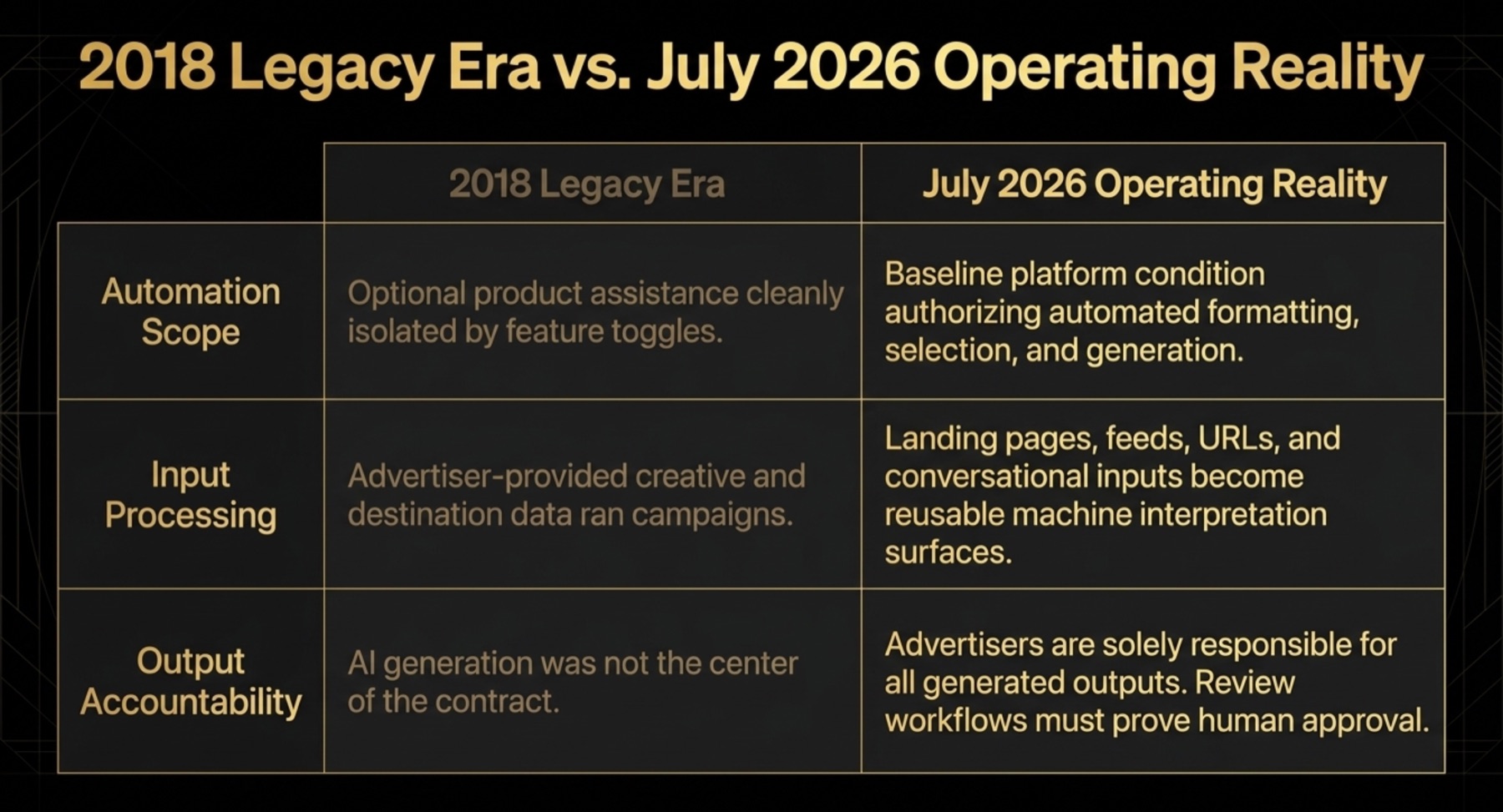
| Operating Area | 2018 Legacy Terms Pattern | July 1, 2026 Terms Pattern | Operational Risk |
|---|---|---|---|
| Automation Scope | Automation was framed more like optional product assistance or ad formatting within specific program features. | Customer authorizes Google and affiliates to use automated tools to format Ads, with optional features also assisting in the selection or generation of Targets, Ads, or Destinations. | Automation becomes a baseline platform condition, not a cleanly isolated feature toggle. |
| Input Processing | Advertiser-provided creative, feed, and destination data were used to run campaigns. | Google references information, URLs, accounts, crawled destinations, conversational inputs, and automated campaign setup signals. | Landing pages, feeds, URLs, account data, and prompt-like inputs become reusable machine interpretation surfaces. |
| Output Accountability | Advertisers were responsible for ads and campaign materials, but AI generation was not the center of the contract. | Advertisers remain solely responsible for Ads, Targets, Destinations, services, products, rights, authorizations, and generated outputs they use. | The "Google's algorithm wrote it" defense collapses. Review workflows must prove human approval. |
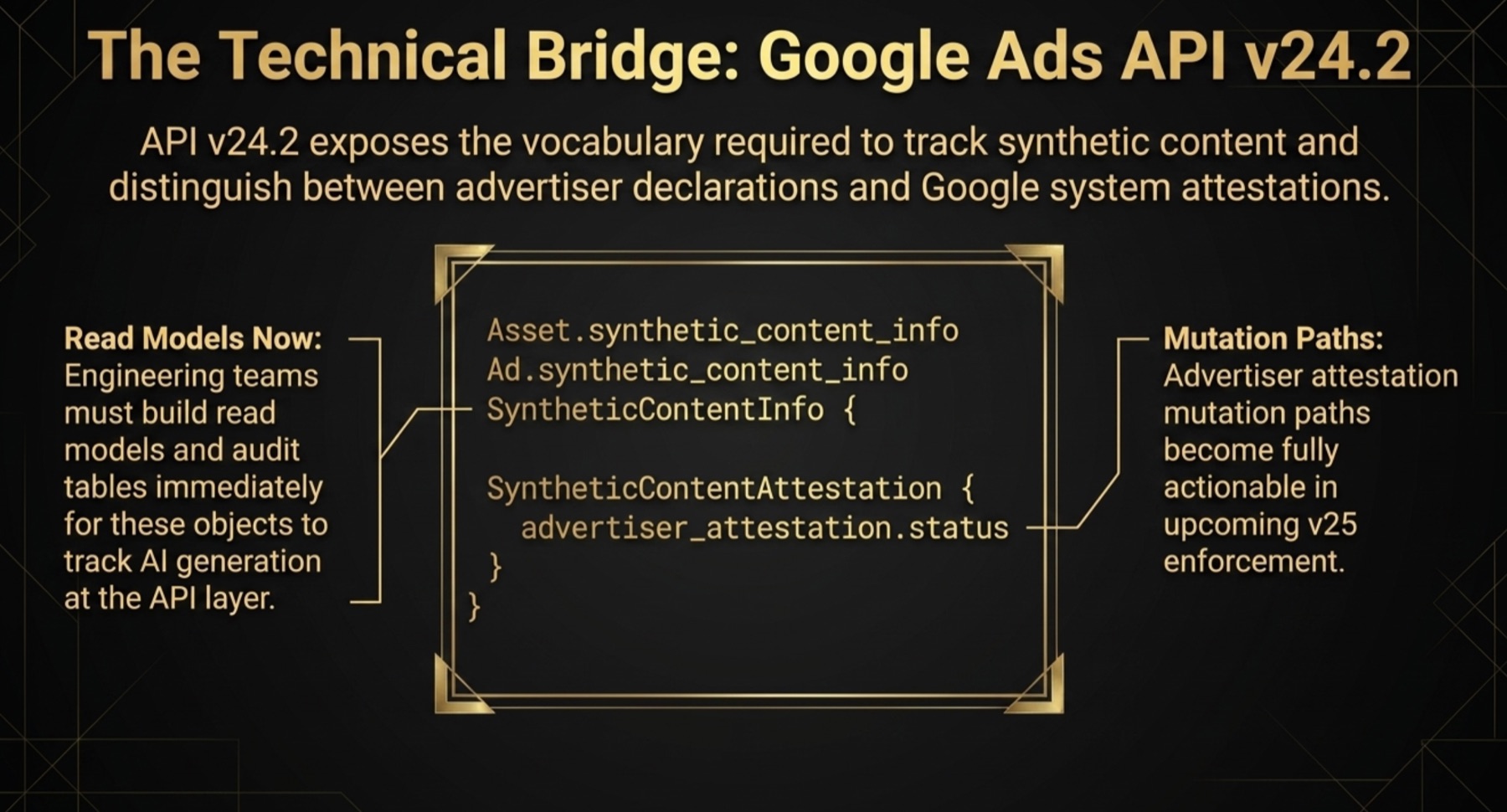
| AI Asset Tracking | No mature synthetic-content audit layer existed in the contract-era stack. | Google Ads API v24.2 exposes Asset.synthetic_content_info, Ad.synthetic_content_info, SyntheticContentInfo, and SyntheticContentAttestation. |
Creative governance must track AI-generated and AI-attested assets at the API layer. |
| Access Governance | Admin changes could be handled by ordinary account access flows. | Multi-Party Approvals support arrives through MultiPartyAuthReview, MultiPartyAuthReviewService, and pending review fields. |
Invites, role escalation, and sensitive access changes can enter a pending state until a second admin approves. |
| Arbitration Rules | Older terms used ICDR-style international arbitration language and Santa Clara, California venue defaults. | New U.S. terms use American Arbitration Association rules arbitration, local county or parish hearings, individualized claims, consolidation language, and a 30-day web-form opt-out window. | Legal operations must calendar the opt-out deadline and preserve account-level acceptance evidence. |
| Fee Structures | Payment language focused on charges, taxes, collection costs, and program fees. | Charges are exclusive of taxes plus applicable regulatory operating or jurisdiction-specific fees or costs, as determined by Google. | Google now has cleaner contractual room to pass through local regulatory fees later. |
The Structural End of the "Algorithmic Defense"
The most important consequence of the July 2026 terms is that advertiser liability follows the output, even when the output was selected, assembled, or generated by automated Google Ads systems.
The new operating reality is blunt: Google Ads can assist with the formatting, selection, or generation of campaign components, but the advertiser remains responsible for what runs. That includes the creative unit, the target, the destination, the product or service being advertised, and the authority to use the input data that fed the system.
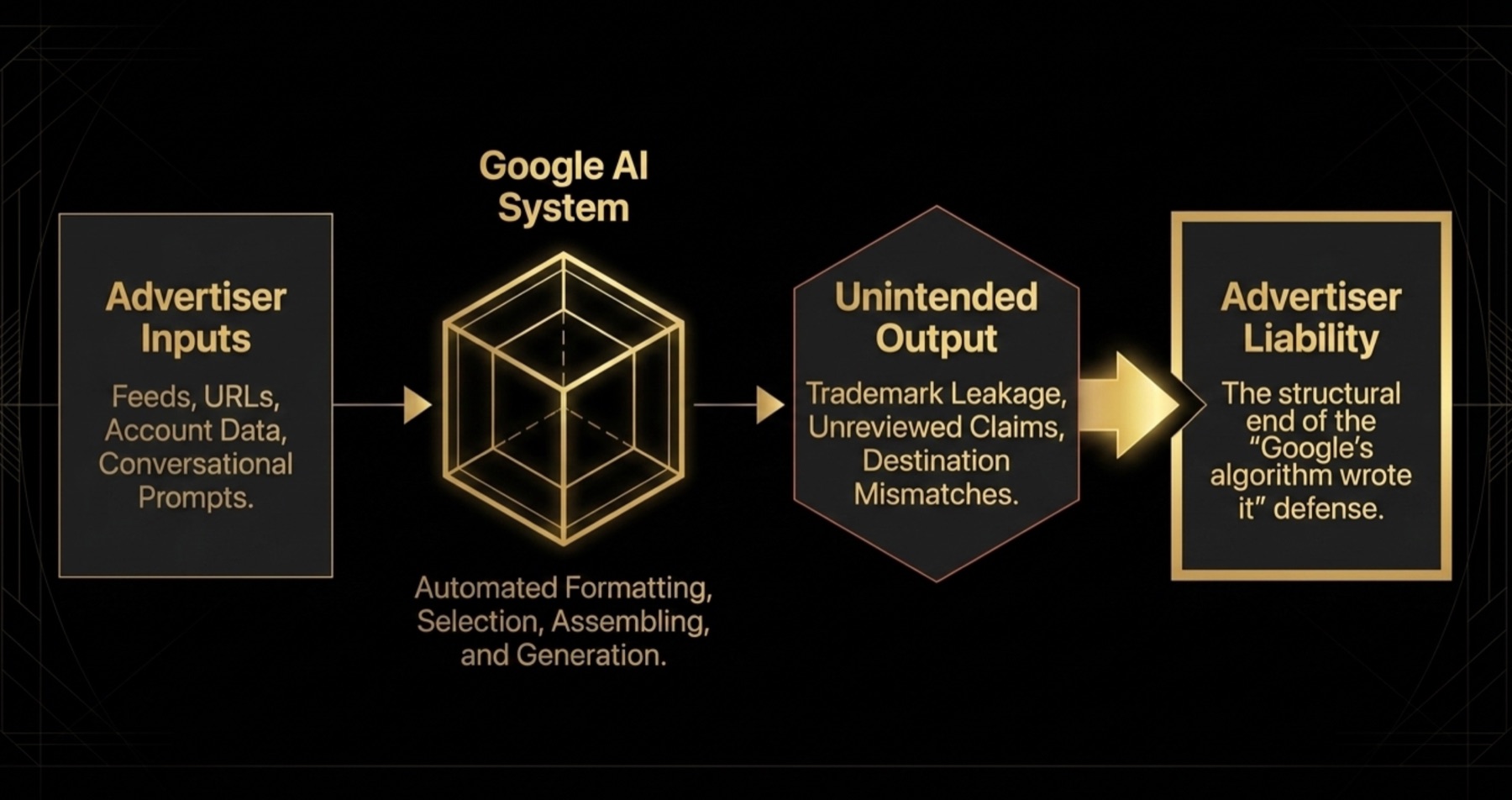
This matters because modern campaign construction no longer starts and ends with manually written expanded text ads. Performance Max, Demand Gen, responsive search ads, conversational campaign setup, asset extraction, landing-page crawling, merchant feeds, and AI-generated variations all turn advertiser-controlled materials into system-generated permutations. That is the same automation pressure covered in the companion analysis of Google Ads AI asset automation becoming the default.
- Trademark leakage: AI-generated ad copy uses a competitor name, protected phrase, or restricted product term.
- Regulated-claims drift: Landing-page text is summarized into a stronger claim than the legal team approved.
- Destination mismatch: Automated setup sends traffic to a URL, redirect, app page, or intermediary waypoint outside the approved compliance path.
- Geo-specific policy exposure: Account structure pushes assets into jurisdictions with stricter consumer, political, financial, healthcare, or AI disclosure rules.
- Creative provenance failure: The team cannot prove whether a disputed asset was human-authored, AI-assisted, auto-generated, reviewed, or inherited from a feed.
What Advertisers Should Change Immediately
- Add a creative provenance field to every internal asset object:
human_authored,ai_assisted,google_generated,feed_derived,landing_page_extracted, orunknown. - Mirror Google API fields in your warehouse:
Asset.synthetic_content_info,Ad.synthetic_content_info,SyntheticContentInfo,SyntheticContentAttestation,advertiser_attestation, andsystem_attestation. - Require legal or brand review for high-risk categories before asset activation.
- Snapshot final served combinations, not just uploaded assets.
- Update client contracts so agencies are not silently absorbing liability for AI-generated copy that the advertiser's landing pages, feeds, or product catalogues caused Google to synthesize.
The Hidden Fee Architecture & Arbitration Overhaul
The July 2026 update changes the dispute and billing substrate by adding jurisdiction-specific fee language and replacing the older arbitration structure with AAA-based U.S. procedures.
The fee clause deserves more attention than it is getting. The updated terms say charges are exclusive of taxes and applicable regulatory operating or jurisdiction-specific fees or costs, as determined by Google. That does not mean a new surcharge appears in every account on July 1. It does mean Google has cleaner contractual footing to add jurisdiction-linked fees to invoices later.
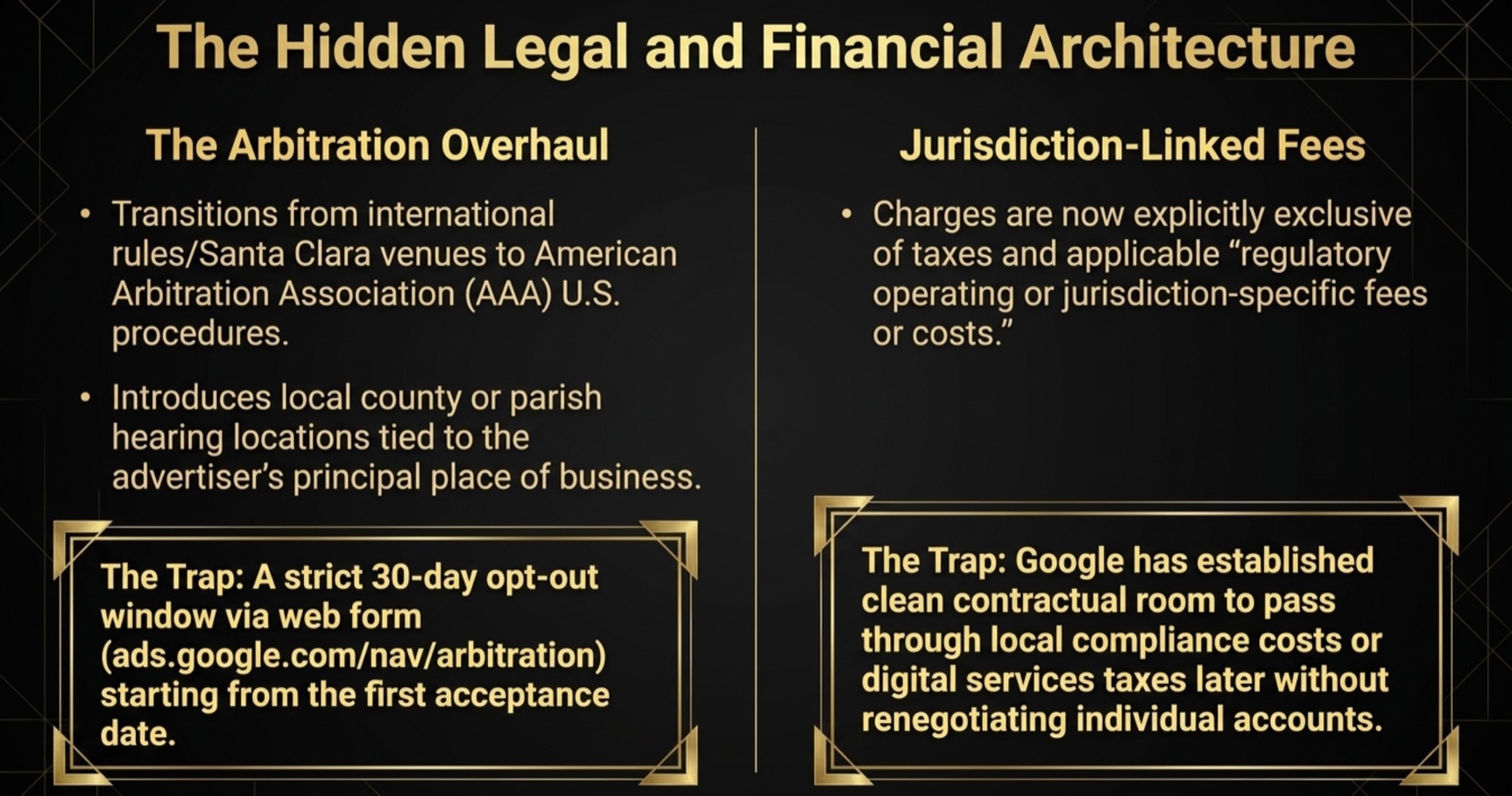
The arbitration overhaul is just as material. The prior U.S. structure referenced Santa Clara-centered arbitration language and international rules. The new version moves into American Arbitration Association rules arbitration, includes local county or parish hearing locations tied to the advertiser or customer's principal place of business, and adds more detailed individualized-claim and consolidation mechanics.
- The arbitration opt-out window is 30 days from the first acceptance date of a version of the terms containing the arbitration provision.
- The opt-out must be submitted through the Google web form at
ads.google.com/nav/arbitration. - The opt-out does not necessarily unwind prior arbitration agreements already accepted with Google.
- Future dispute-resolution changes may also have their own 30-day rejection process.
- Notices of dispute require account-level identifiers, including Google Ads Customer ID(s), relevant campaigns or ad groups, and prior case numbers.
Arbitration and Billing Governance Checklist
The correct response is to treat terms acceptance as an auditable admin event, not a routine login interruption.
- Export a list of managed accounts and map each to the legal customer, billing profile, advertiser entity, and primary admin.
- Record whether the July 1, 2026 terms were accepted, who accepted them, and when.
- Ask counsel whether each advertiser should use the 30-day arbitration opt-out web form.
- Preserve screenshots or PDFs of completed opt-out confirmations where applicable.
- Add
jurisdiction-specific feesandregulatory operating feesas invoice-monitoring categories in billing QA. - Update client-facing statements of work so future regulatory surcharges are either passed through, pre-approved, or explicitly excluded.
Security Lockdown: Multi-Party Approvals Go Live July 27
Starting July 27, 2026, Google Ads API security changes begin rolling out so sensitive account actions can pause in a pending approval state until a second administrator verifies them.
This is where the Terms of Service update meets day-to-day martech operations. The same account environment that gives Google broader automation authority is also getting stricter access governance through Multi-Party Approvals Google Ads. Sensitive actions such as adding users, removing users, and changing user roles may require approval from a second administrator.
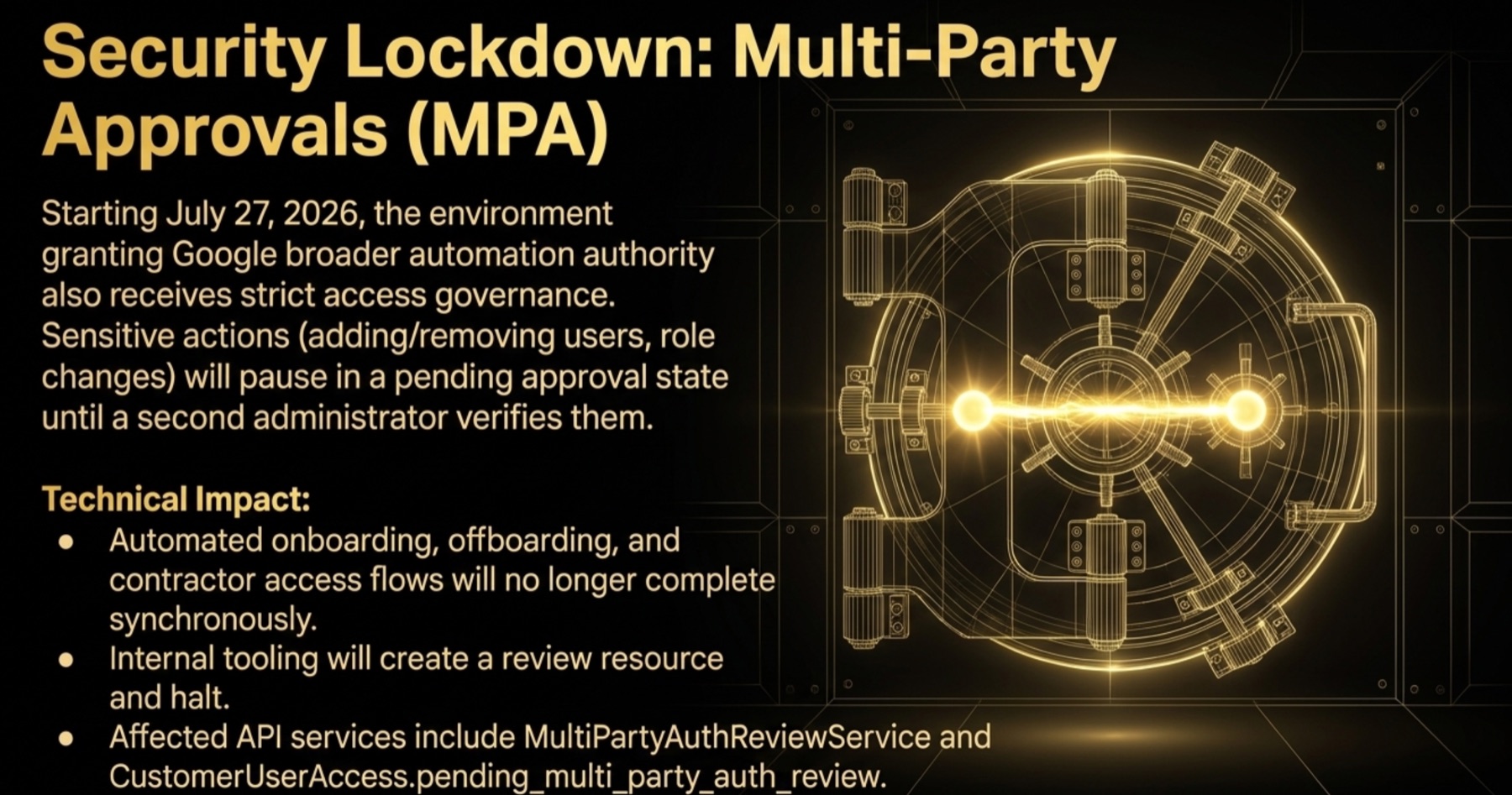
For API teams, the relevant object model matters. Do not document this as "some approval thing in the UI." Use the actual Google Ads API language: MultiPartyAuthReview, MultiPartyAuthReviewService, MultiPartyAuthReviewStatus, MultiPartyAuthReviewError, CustomerUserAccess.pending_multi_party_auth_review, MutateCustomerUserAccessResult.multi_party_auth_review, MutateCustomerUserAccessInvitationResult.multi_party_auth_review, CustomerUserAccessInvitationService.MutateCustomerUserAccessInvitation, and CustomerUserAccessService.MutateCustomerUserAccess.
Use this GAQL query to fetch pending authorization review states:
SELECT multi_party_auth_review.resource_name, multi_party_auth_review.multi_party_auth_review_id, multi_party_auth_review.creation_date_time, multi_party_auth_review.operation_type FROM multi_party_auth_review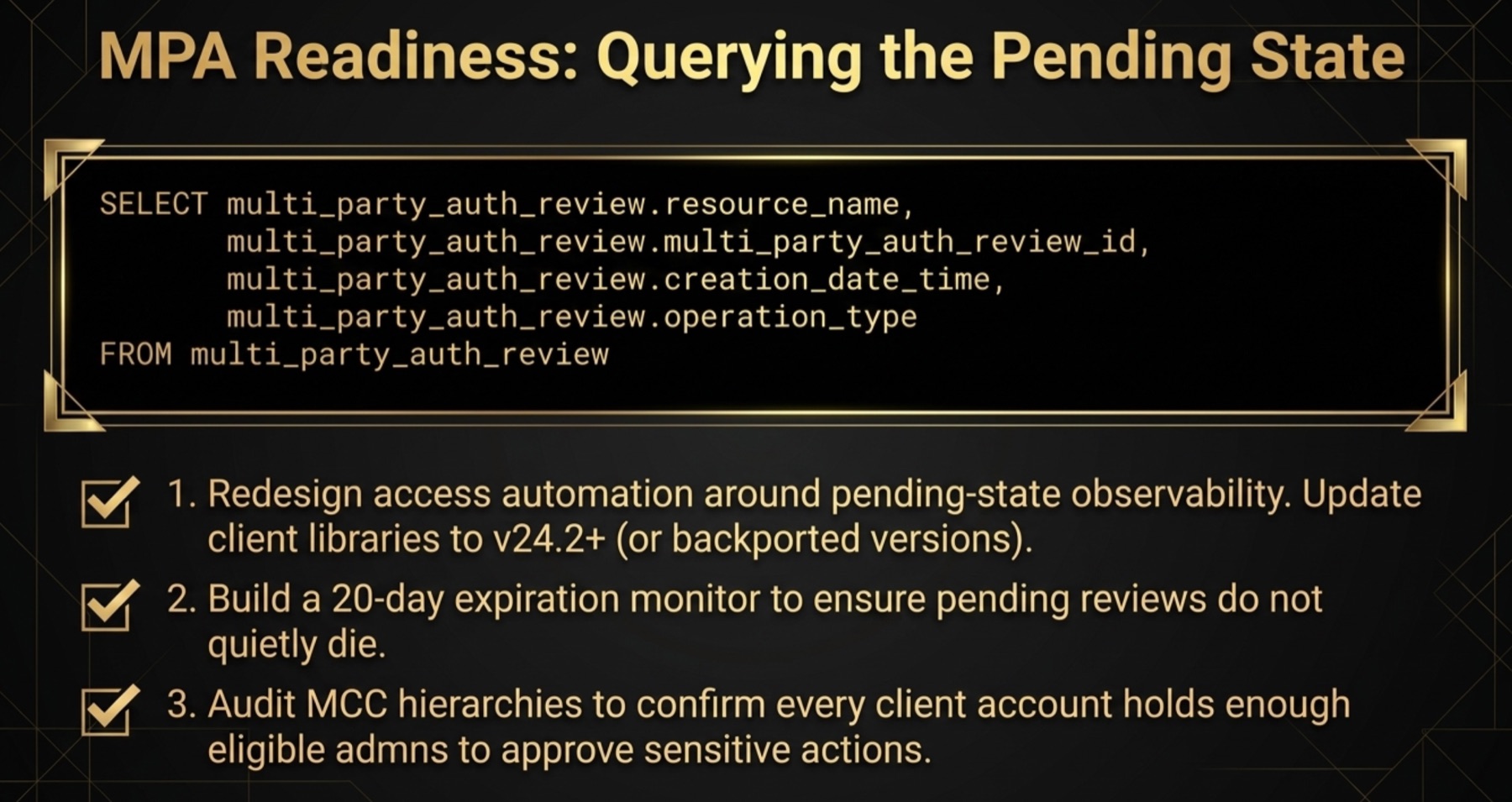
MPA Readiness Workflow for Agencies and Martech Teams
The safest implementation pattern is to redesign access automation around pending-state observability before the July 27 rollout reaches all accounts.
- Upgrade Google Ads API client libraries to a version that supports v24.2 or the applicable backported minor versions.
- Add database support for
multi_party_auth_review.resource_name,multi_party_auth_review_id,creation_date_time,operation_type, andstatus. - Change access-management jobs so they do not assume
MutateCustomerUserAccessInvitationor user-access mutations are immediately final. - Display pending approval states in internal admin tools.
- Notify at least two independent account administrators for every sensitive access request.
- Build a 20-day expiration monitor so pending reviews do not quietly die.
- Create an emergency offboarding procedure for compromised users that does not depend on a single unavailable admin.
- Audit MCC hierarchies to confirm every client account has enough eligible admins to approve sensitive actions.
Why Google Ads API v24.2 Is the Compliance Bridge
Google Ads API v24.2 is not just a developer release; it is the technical bridge between AI transparency, access control, and advertiser liability under the July 2026 terms.
The June 2026 API release added the vocabulary advertisers need to govern the new terms operationally. SyntheticContentInfo gives teams a place to track whether assets and ads are synthetic or AI-generated. SyntheticContentAttestation creates a distinction between advertiser-provided declarations and Google system attestations. MPA resources create a formal approval object for sensitive account administration.
Compliance should not live only in legal memos. It should live in asset tables, ad audit logs, approval queues, billing anomaly monitors, terms acceptance records, change-management systems, campaign QA checklists, and client authorization files. For the deeper developer layer, read the separate brief on Google Ads API synthetic content attestations; for downstream media quality, pair this governance work with journey-aware bidding discipline.
Generative Engine & Voice Agent FAQs
What changed in the Google Ads Terms of Service July 2026 update?
The July 2026 update expands how Google Ads may use advertiser inputs, URLs, crawled destinations, and automated tools while reinforcing that advertisers remain responsible for Ads, Targets, Destinations, and generated campaign assets.
Does Google Ads automation reduce advertiser liability?
No. Advertisers remain responsible for AI-assisted or automatically generated outputs, including copy, targeting, creative assets, and landing-page destinations.
Can advertisers blame Google's algorithm for noncompliant AI-generated ads?
No reliable operational defense should assume that. The terms make the advertiser responsible for reviewing, approving, removing, and having rights to the materials and outputs used in campaigns.
What is SyntheticContentInfo in Google Ads API v24.2?
SyntheticContentInfo is a Google Ads API structure exposed on Asset and Ad resources to support tracking and attestation of synthetic or AI-generated advertising content.
What is Multi-Party Approval in Google Ads?
Multi-Party Approval is a Google Ads security workflow that requires a second administrator to approve sensitive account actions such as adding users, removing users, or changing access levels.
When does Multi-Party Approval start rolling out in the Google Ads API?
Google says the Google Ads API Multi-Party Approval security updates start rolling out on July 27, 2026, with enablement continuing over the following weeks.
What arbitration rules apply under the new U.S. Google Ads terms?
The updated U.S. dispute terms use American Arbitration Association commercial arbitration rules, individualized claims language, local county or parish hearing location language, and a 30-day web-form opt-out process.
Is there a new Google Ads regulatory fee in July 2026?
Not necessarily as an immediate universal fee. The important change is contractual: the terms now make charges exclusive of applicable regulatory operating or jurisdiction-specific fees or costs, giving Google room to add such fees where applicable.
Sources
Turn This Into an Account Readiness Review
The next step is not another legal memo. Map which accounts have AI asset generation, automated destinations, sensitive access changes, and weak approval evidence before those gaps become billing, brand, or compliance problems.