
Important Nuance
I could not find a public Meta Help Center page with the exact migration language at the time of writing. The update is being reported from Meta's advertiser notice and in-account rollout, with multiple industry sources citing the same details: purchase-event custom audience retention expanded from 180 days to 730 days, effective May 18, 2026, and existing 180-day purchase audiences were set to update unless advertisers opted out before the deadline.
That means the right action is not panic. It is verification inside your own Ads Manager account.
What Changed?
Meta's purchase-event custom audiences for website and app activity are no longer just a six-month memory bank. The reported update expands the maximum retention window to 730 days, or two years.
That affects any account using the Purchase event to build retargeting pools, exclusion audiences, lookalike sources, Advantage+ audience signals, customer lifecycle segments, or win-back campaigns.
On paper, this sounds like a simple audience-size upgrade. More historical purchasers means larger pools, richer lookalike sources, and longer customer memory. For some brands, that is useful.
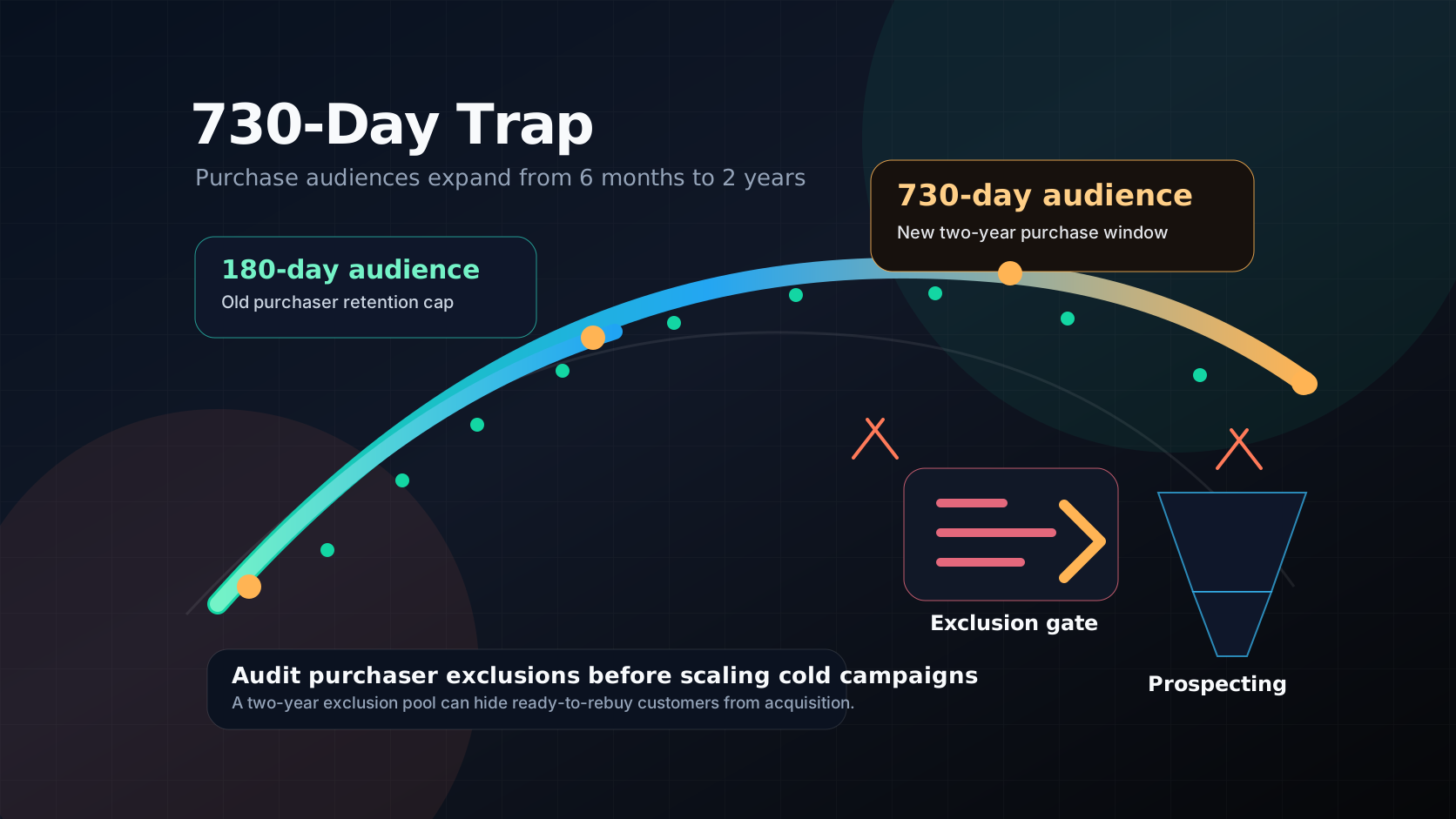
But the hidden danger is in your exclusions. If you exclude past purchasers from prospecting campaigns, that exclusion may now reach back two full years instead of 180 days. For a brand with a six-to-12-month repeat purchase cycle, you may have just removed some of your highest-value warm prospects from cold acquisition.
This is the same kind of platform-default risk covered in the Google Ads AI asset automation article: the setting is useful when intentional, dangerous when inherited quietly.
Why the Exclusion Risk Is Bigger Than the Retargeting Risk
A larger retargeting audience can hurt performance by adding colder users. That is manageable if you split audiences by recency and watch frequency, cost, and return on ad spend.
A larger exclusion audience is more dangerous because it can hide opportunity. If your cold prospecting campaign excludes all purchasers from the last 730 days, Meta may be prevented from reaching people who bought 10, 14, or 20 months ago and are ready to buy again.
| Use Case | What 730 Days Can Help | What 730 Days Can Break |
|---|---|---|
| Retargeting | Larger purchaser pools for cross-sell, upsell, win-back, and seasonal reactivation. | Audience quality can dilute if old buyers are treated like recent buyers. |
| Prospecting exclusions | Can prevent wasted spend on truly ineligible or recently converted customers. | Can suppress ready-to-rebuy customers from top-of-funnel scaling. |
| Lookalike sources | Can increase seed size for accounts with lower purchase volume. | Can mix old buyer cohorts with different product, price, or market behavior. |
| Lifecycle strategy | Can support broader customer segmentation when paired with recency windows. | Can flatten all customers into one vague "purchased before" bucket. |
Pipeline Architect Note
A 730-day purchase audience is not a strategy. It is raw memory. The strategy is deciding which customer recency windows should be targeted, excluded, reactivated, or used as signals.
The Repurchase Cycle Decision Matrix
The right retention window depends on how quickly customers realistically come back. A skincare brand, supplement brand, apparel brand, mattress brand, and B2B lead-gen advertiser should not all use the same purchaser exclusion logic.
| Business Type | Likely Repurchase Pattern | Recommended Audience Logic |
|---|---|---|
| Consumables / CPG | Frequent replenishment or seasonal repeat purchase. | Use shorter exclusions for recent buyers, then create 90/180/365/730-day reactivation segments. |
| Apparel / lifestyle | Repeat purchase varies by season, offer, and customer type. | Segment purchasers by recency and value. Avoid one broad 730-day exclusion for all prospecting. |
| High-ticket durable goods | Long replacement cycles, lower repeat purchase frequency. | A 730-day exclusion may be reasonable, but cross-sell and referral campaigns need separate logic. |
| Lead generation | Purchase event may represent booked service, closed deal, or tracked conversion. | Audit whether "Purchase" means customer, lead, deposit, or offline sale before excluding anyone for two years. |
For ecommerce teams, this connects directly to profitability measurement. A retention window should reflect margin, payback, repeat purchase timing, and incrementality, not just the largest audience Meta allows.
The Audit: What to Check Today
Start with the campaigns where the mistake would be expensive: high-spend prospecting, Advantage+ Shopping, evergreen acquisition, and anything using purchaser exclusions.
- Open Audiences in Meta Ads Manager. Filter for website and app activity custom audiences using the Purchase event.
- Check retention windows. Identify every audience now set to 730 days.
- Map audience usage. Document whether each audience is used for targeting, exclusion, lookalikes, Advantage+ signals, or reporting.
- Prioritize exclusions. Any 730-day purchaser audience used as a prospecting exclusion should be reviewed first.
- Rebuild recency segments. Create clear windows such as 30, 90, 180, 365, and 730 days where they match the buying cycle.
- Update naming conventions. Rename audiences so the window is visible, for example Purchasers - 180D - Exclusion or Purchasers - 730D - Winback.
- Monitor performance drift. Watch prospecting spend, reach, frequency, CPM, CPA, new-customer rate, and MER after edits.
If you use manual QA tools, add this to the same pre-launch checklist as creative previewing in the Meta Ad Previewer. Audience logic is creative targeting by another name: it decides who even gets a chance to see the ad.
How to Rebuild the Audience Stack
A better structure is not one giant purchaser audience. It is a ladder of recency and intent.
- Purchasers 0-30 days: Suppress from acquisition, show onboarding or cross-sell only if appropriate.
- Purchasers 31-90 days: Exclude or nurture depending on replenishment timing and product category.
- Purchasers 91-180 days: Test cross-sell, bundle, review, referral, or repeat purchase angles.
- Purchasers 181-365 days: Consider win-back, seasonal, category expansion, or new product campaigns.
- Purchasers 366-730 days: Use carefully for reactivation, lookalike seeding, or lifecycle analysis, not automatic prospecting suppression.
For lead-gen advertisers, the equivalent is pipeline stage. Do not exclude everyone who triggered a Purchase-like conversion if that event only means a form submission, booked consultation, or deposit. Use the Lead Gen Pipeline Guide to think through which events represent a real customer versus a lead still in motion.
Measurement: How to Know If the Change Hurt You
The problem with a silent audience expansion is that the effect may look like a normal performance wobble. Prospecting may spend less, reach fewer qualified people, or shift budget into colder pockets without an obvious error message.
- New-customer rate: Did the campaign actually acquire more new buyers, or did broader exclusions just restrict delivery?
- Reach and frequency: Did eligible audience size shrink in prospecting ad sets after the audience migration?
- CPA and MER: Did reported CPA improve while blended revenue quality got worse?
- Repeat purchase revenue: Did returning-customer revenue dip after old buyers were excluded from acquisition-style campaigns?
- Incrementality: Use the Conversion Lift and Incrementality Guide to separate platform-reported efficiency from true incremental demand.
The goal is not to force every account back to 180 days. The goal is to make the retention window intentional. Some accounts should embrace 730 days. Some should split it. Some should keep exclusion windows much shorter.
Use the Meta Custom Audience Exclusion Audit Checklist to document the current window, data source, campaign coverage and appropriate next action for every active exclusion before changing delivery.
Sources Checked
FAQ: Meta 730-Day Purchase Audiences
Did Meta change all custom audiences to 730 days?
No. The reported change is specific to purchase-event custom audiences for website and app activity. Other website activity audiences may still have different retention limits, so check the actual audience settings in Ads Manager.
Are 730-day purchase audiences bad?
No. They can be useful for long-cycle categories, win-back campaigns, seasonal buyers, and larger lookalike seeds. The risk comes from using the 730-day audience as a blunt exclusion or treating all buyers from the last two years as equally warm.
Should I revert every exclusion to 180 days?
Not automatically. Revert or segment based on your real repurchase cycle. If customers commonly buy again after six to 12 months, a 730-day prospecting exclusion may be too aggressive. If they rarely buy again within two years, a longer exclusion may still make sense.
What is the safest next step?
Audit every active purchase-based custom audience, especially those used as exclusions. Then create recency-based segments so retargeting, prospecting suppression, win-back, and lookalike seeding each use the right window.
Do Not Let Audience Defaults Run Your Funnel
The 730-day window can be useful, but only when it matches the economics of your customer lifecycle.
Read the Profitability Guide