What is Meta Andromeda?
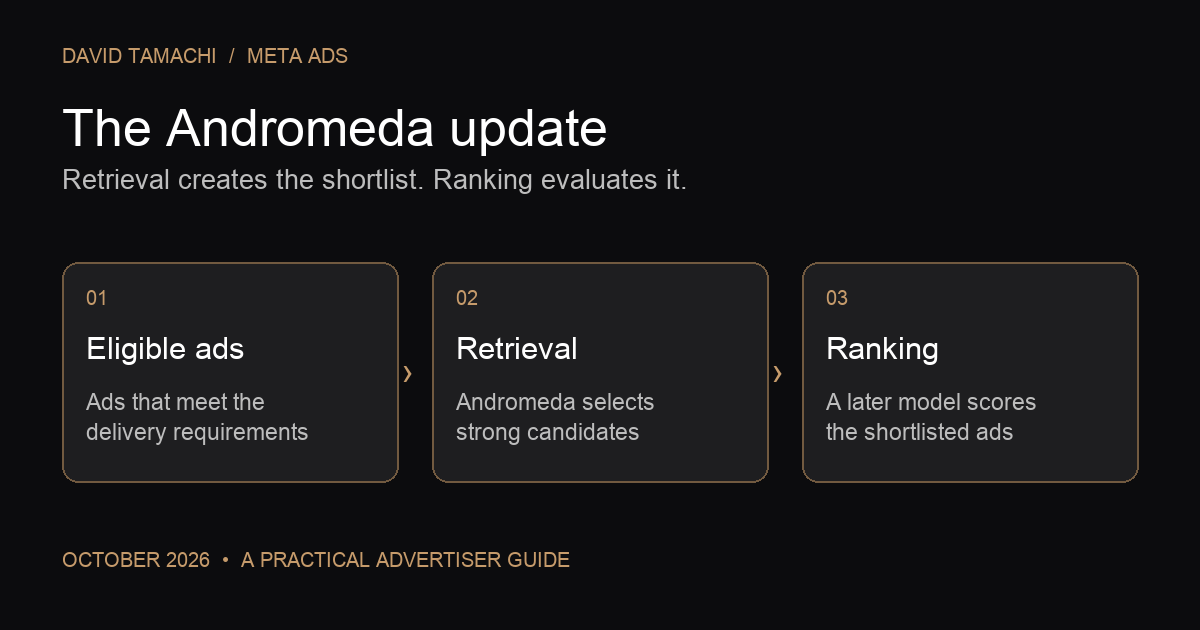
Meta Andromeda selects ads for a shortlist before detailed ranking. Think of retrieval as deciding which candidates get considered, and ranking as assessing those candidates more closely. Strong later-stage scoring cannot help an ad that never enters that shortlist. This is an explanation of the pipeline, not a way to observe why a particular ad received little delivery.
The October 2026 engineering post builds on Andromeda’s original 2024 introduction. It describes more expressive retrieval models and a more efficient GPU pipeline. Meta presents the resulting advertiser benefits as automatic. Read Meta’s engineering announcement.
| Stage | Job | Advertiser implication |
|---|---|---|
| Eligibility | Establish which ads meet delivery requirements. | Check approval status and campaign settings before blaming creative. |
| Retrieval | Select promising candidates from eligible ads. | Andromeda is part of the infrastructure that creates the shortlist. |
| Ranking | Evaluate shortlisted candidates in greater detail. | Retrieval and ranking are separate steps in the same delivery pipeline. |
What changed in the October 2026 update?
Meta describes specialized retrieval models and tighter integration of the model, system, and GPU hardware. The purpose is to improve matching across a larger candidate pool within the same latency budget. The announcement reports a 2.4% increase in Facebook conversions from Andromeda since 2025. That figure is a historical platform result, not the isolated effect of the October announcement or a forecast for your account. Source: Engineering at Meta, October 28, 2026.
Do advertisers need to activate Andromeda?
The announcement identifies no activation step in Ads Manager. There is no migration checklist in the post for advertisers to complete. Treat the update as a reason to review your testing process, rather than an instruction to interrupt working campaigns.
Start with a specific problem: expensive qualified leads, weak new-customer acquisition, declining response, or insufficient creative learning. If you cannot name the problem and the outcome you want to improve, an account rebuild will be difficult to evaluate.
What should advertisers change in creative testing?
Test different customer arguments, then measure which argument improves the business outcome. A new background colour can be a useful execution test, but it does not answer the same question as a different problem, proof point, or use case. Separate concept tests from small execution refinements.
| Dimension | Example comparison | Question to answer |
|---|---|---|
| Customer problem | Save time vs reduce operating costs | Which reason attracts valuable customers? |
| Product use case | Everyday workflow vs specialist application | Which application generates qualified demand? |
| Proof | Product demonstration vs customer testimonial | Which evidence resolves the buyer’s hesitation? |
| Offer | Single product vs a relevant bundle | Does the offer improve acquisition economics? |
Example: testing two reasons to book a service
A service business might compare “get your weekend back” with “avoid an expensive emergency repair.” Keep the service, geography, landing page, and qualification criteria consistent where practical. Evaluate booked, qualified jobs and their value, alongside the cost per lead. This is an illustrative test, not an account result or a claim about how Meta labels either message.
Do not launch every dimension at once. Pick one question, document the variants, and give the comparison enough opportunity to produce useful evidence. When causal attribution matters, use an appropriately designed experiment. Unequal spend across ads in one ad set is not a randomized creative test.
Does Andromeda require broad targeting or consolidation?
The engineering announcement does not establish a universal requirement to broaden targeting or consolidate campaigns. Those decisions should follow the account’s objectives, constraints, economics, and test evidence.
If fragmentation is limiting useful learning, test a simpler structure against a defined baseline. If geographic, eligibility, customer-exclusion, or business constraints matter, document them before changing delivery. Avoid changing targeting, budget, creative, and offer simultaneously when your goal is to learn which change helped.
For more context on later-stage scoring, read my Meta Adaptive Ranking Model explainer. For weakening creative response, use the creative fatigue diagnostic before assuming a platform update caused the decline.
How should advertisers measure results?
Choose a business outcome first, then use platform metrics to explain it. For lead generation, that may mean cost per qualified appointment or acquired customer. For ecommerce, it may mean new-customer acquisition cost and contribution after advertising costs. A cheaper platform conversion is only helpful when the underlying outcome remains valuable.
- Record the baseline: spend, conversion definition, attribution window, customer quality, and relevant reporting delays.
- Set a primary metric: select one outcome that decides whether the experiment worked.
- Add guardrails: monitor lead quality, margin, refunds, or other outcomes the business cannot afford to worsen.
- Allow reporting to mature: avoid comparing a complete baseline with recent days that still lack conversions or CRM outcomes.
- Document competing explanations: promotions, seasonal demand, pricing, and website changes can affect the result.
If the platforms disagree, use the Meta, GA4, and CRM conversion reconciliation guide. Use the Campaign Forensics Lab to organize the timeline and competing explanations.
Your next-campaign checklist
- Confirm the campaign’s business objective and measurement setup.
- Check delivery eligibility and the actual performance pattern.
- Choose one distinct creative hypothesis worth testing.
- Keep a documented baseline and identify overlapping changes.
- Decide the success metric and spend limits before launch.
- Review qualified outcomes before expanding the change.
Download the creative test worksheet
Meta Andromeda: frequently asked questions
What is Meta Andromeda?
Meta Andromeda is Meta’s personalized ads retrieval system. It selects a shortlist of eligible ads before a later ranking stage evaluates those candidates in greater detail.
Do I need to activate Andromeda in Ads Manager?
Meta describes automatic benefits from its retrieval infrastructure. Its October 28, 2026 engineering announcement identifies no advertiser activation step.
Is Andromeda the same as Advantage+?
No. Andromeda is an underlying retrieval system. Advantage+ refers to advertiser-facing automation products. They operate at different levels of the advertising workflow.
Should I rebuild my campaigns because of Andromeda?
The announcement alone is not a reason to rebuild a working account. Define a business problem, preserve a baseline, and test a specific change before making a wider restructuring decision.
How many creative variations should I test?
There is no universal count established by this announcement. Choose a manageable set of distinct concepts that your budget can give a meaningful comparison, rather than multiplying cosmetic variations.
Does Andromeda guarantee better ROAS?
No. Meta’s reported conversion improvement is an aggregate historical result. Your return depends on the offer, delivery, measurement, costs, and downstream customer value.
Sources and editorial approach
This guide was published November 1, 2026. Technical descriptions and the reported conversion figure come from Meta’s October 28, 2026 engineering announcement. Creative testing examples and measurement recommendations are editorial analysis. No client performance results are claimed.
Build a better campaign test
Start with a clear question, distinct creative, and a business outcome you can trust. Use the Campaign Forensics Lab to organize the evidence, or explore the free marketing tools.