
Important Nuance
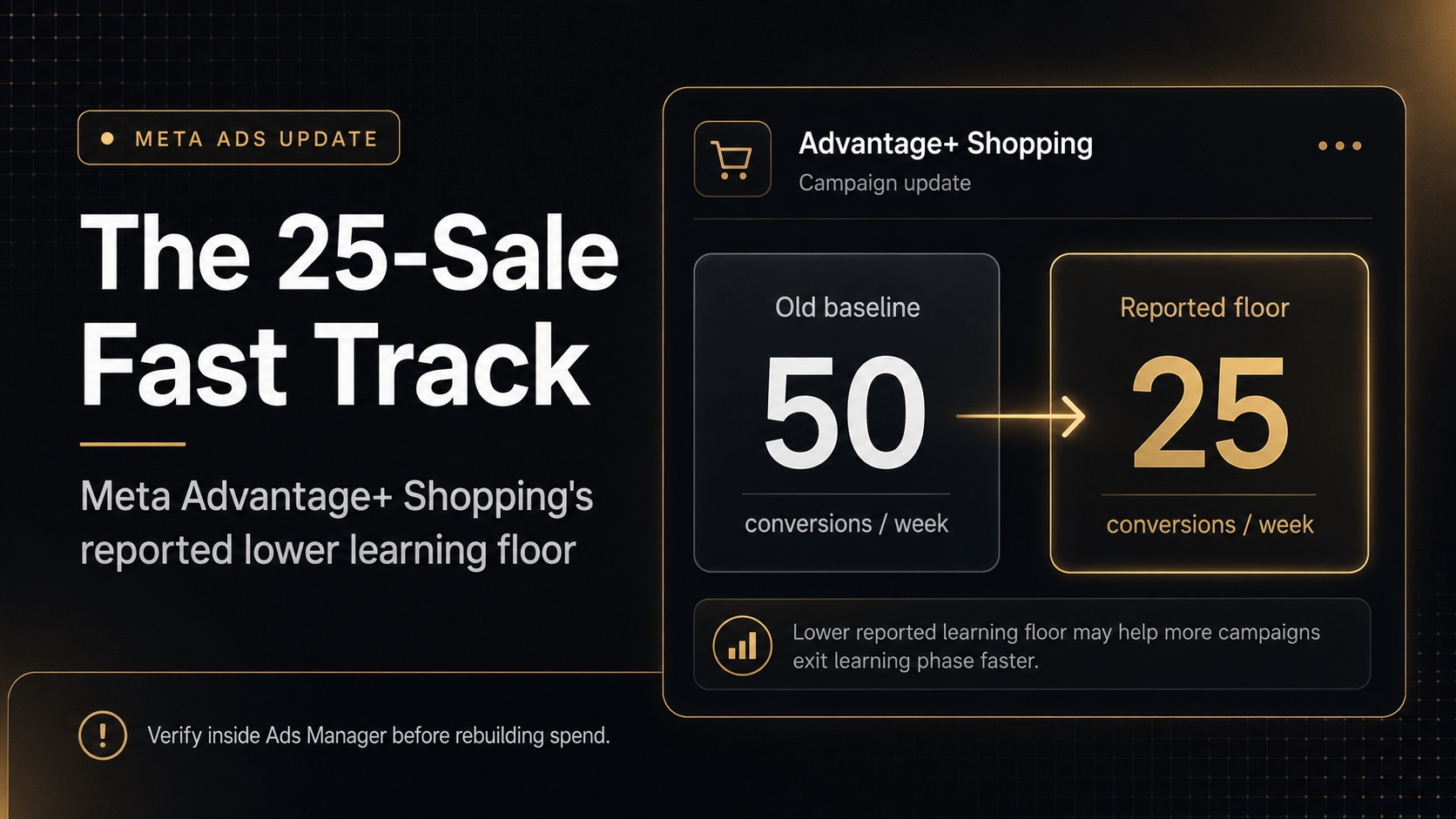
I found multiple 2026 third-party guides stating that Meta lowered the Advantage+ Shopping threshold to 25 purchase conversions per week. I did not find a public Meta Help Center page that clearly confirms a global ASC-specific 25-conversion rule as of June 14, 2026.
Meta's public learning documentation still describes learning limited around about 50 optimization events after the last significant edit. So the practical guidance is simple: treat 25 as a reported or account-level rollout signal to verify, not a universal rule to repeat blindly.
What Is Being Reported?
Advantage+ Shopping Campaigns, often shortened to ASC, are Meta's automated ecommerce campaign structure for sales objectives. Instead of manually splitting audiences, placements, and many ad sets, advertisers feed the system budget, creative, product data, and conversion signals while Meta automates delivery.
The reported change is simple: the weekly purchase volume needed for ASC to leave the unstable learning window is said to have dropped from 50 purchases per week to 25 purchases per week.
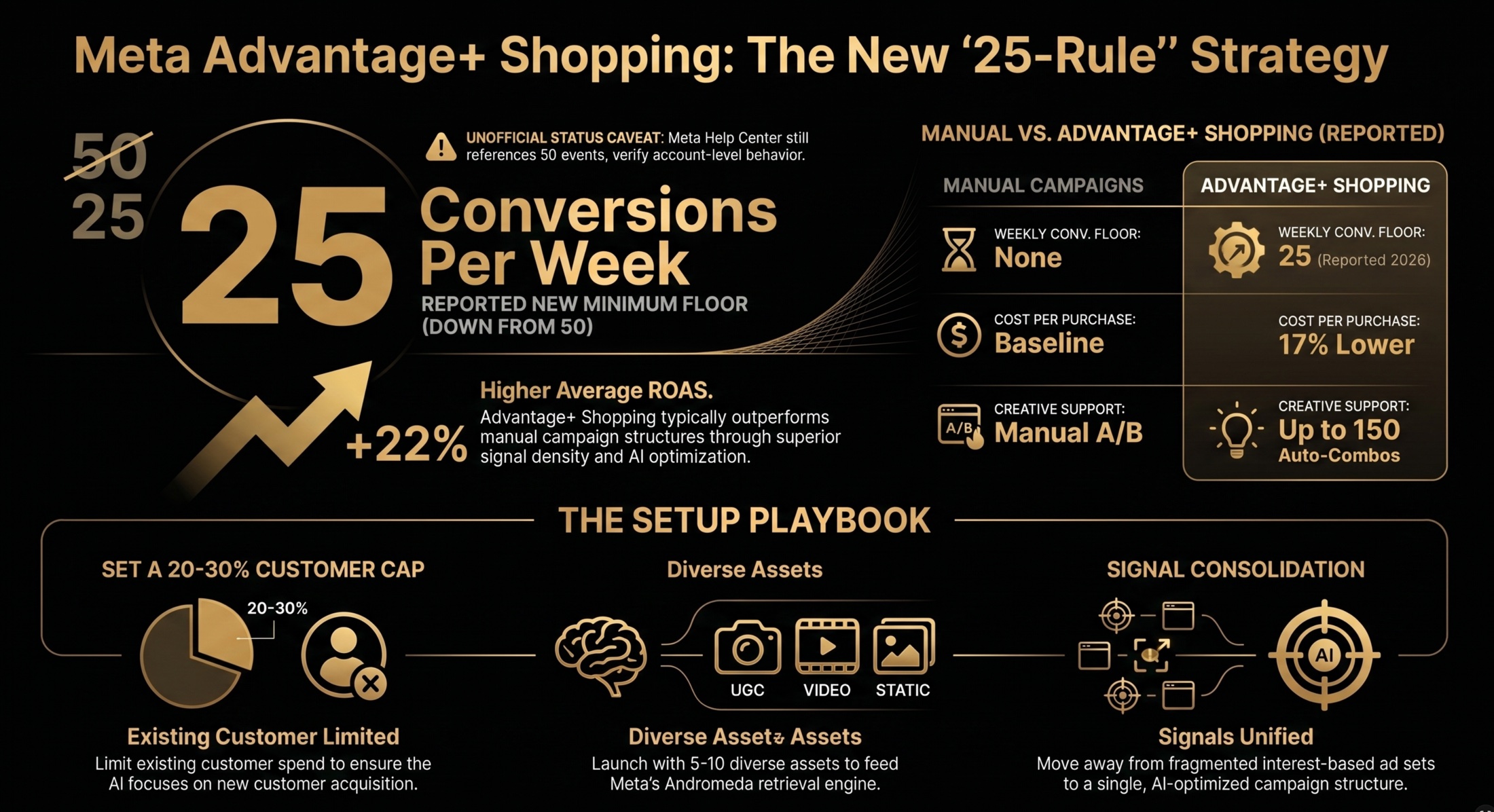
Let's cut the noise. If you are managing paid social budgets in 2026, you already know that Advantage+ Shopping Campaigns are the gravity center of Meta's ecommerce ad delivery. Meta has publicly said Advantage+ Shopping can automate up to 150 creative combinations and, in a 15-test study, drove 12% lower cost per purchase compared with business-as-usual ads. Several 2026 industry guides now cite larger directional benchmarks, including 17% more purchases per dollar and roughly 22% higher ROAS versus manual structures.
But for years, a structural barrier kept smaller ecommerce advertisers from confidently using this automation: the 50-conversion-per-week learning target. If you could not hit that velocity, campaigns often stayed in the Learning Limited gutter, forcing smaller brands back into fragmented manual ad sets.
If the reported 25-conversion threshold is active in your account, it is a meaningful shift. A brand that can generate three or four purchases per day may now have enough signal density to test Advantage+ Shopping without starving the algorithm.
This does not mean every small advertiser should dump all spend into ASC tomorrow. It means the old assumption deserves a fresh look. Smaller ecommerce accounts that were previously forced into fragmented interest stacks may now be able to simplify.
That fits the broader Meta direction covered in the Meta Business Agents article and the technical explanation of Meta's trillion-parameter Adaptive Ranking Model: the platform keeps absorbing more of the targeting, delivery, and conversion workflow. The media buyer's job shifts from micromanaging audiences to designing the cleanest signal environment. When response weakens, use the Meta creative fatigue diagnostic to separate creative repetition from auction pressure, audience saturation, and post-click failure.
Why This Matters for Smaller Advertisers
The 50-conversion learning target created a structural advantage for larger accounts. If a campaign needed roughly 50 optimized events in a week, then the budget math punished low-volume brands before strategy even entered the conversation.
Fragmenting budget is also one of the fastest ways to weaken performance in Meta's current delivery environment. When spend is split across too many ad sets, each learning pool gets less signal, creative exits learning more slowly, and the account creates more internal auction overlap.
| Scenario | Old 50-Event Math | Reported 25-Event Math |
|---|---|---|
| $25 CPA | About $1,250 per week, or $179 per day, to reach 50 purchases. | About $625 per week, or $89 per day, to reach 25 purchases. |
| $50 CPA | About $2,500 per week, or $357 per day. | About $1,250 per week, or $179 per day. |
| $100 CPA | About $5,000 per week, or $714 per day. | About $2,500 per week, or $357 per day. |
That is the democratization angle. The lower the required purchase count, the more realistic it becomes for boutique ecommerce brands, regional retailers, niche DTC products, and smaller catalog businesses to use Meta's automated shopping engine without constantly falling into learning limited.
Pipeline Architect Note
A lower conversion floor helps only if the events are real, deduplicated, and economically meaningful. Twenty-five clean purchases can teach the system more than 50 noisy, duplicated, or low-quality events.
What Changes Strategically
If the 25-sale threshold is active in your account, the immediate strategy change is not "trust the machine." It is stop starving the machine.
Many smaller accounts still run five or six tiny ad sets, each with its own interest cluster, budget fragment, and creative mix. That structure can make the account feel more controlled while preventing any one learning pool from getting enough purchase signal.
| Old Lower-Budget Pattern | Better Test Under a 25-Sale Floor | What to Watch |
|---|---|---|
| Multiple interest ad sets split by persona, product, or lookalike size. | One consolidated ASC structure with stronger creative variety. | Learning status, purchase volume, creative winner concentration, and new-customer mix. |
| Daily edits to budgets, ads, and targeting when CPA swings. | Launch clean, then hold long enough for signal to accumulate. | Whether edits are repeatedly restarting learning before the campaign stabilizes. |
| Optimizing around platform ROAS alone. | Judge ASC by contribution margin, repeat purchase quality, and blended revenue impact. | MER, CAC, returning customer share, contribution margin, and incrementality. |
This is where the ecommerce profitability lens matters. Advantage+ Shopping can make purchase volume easier to consolidate, but it can also over-credit returning customers or efficient-looking low-margin orders if the account does not define success clearly.
The Verification Checklist
Before rebuilding a Meta account around the reported floor, check the foundation. The lower threshold does not rescue bad instrumentation or weak creative.
- Confirm weekly purchase volume. Look at the last 7, 14, and 28 days. You want consistent volume, not one lucky spike.
- Check event quality. Make sure Pixel and Conversions API purchase events are firing, deduplicating, and matching real orders.
- Look for in-account guidance. If Ads Manager surfaces ASC recommendations, learning diagnostics, or account-specific thresholds, prioritize that over generic commentary.
- Audit existing customer definitions. Make sure Meta can distinguish current customers from prospects where possible.
- Review product feed health. Fix bad titles, missing images, stale pricing, out-of-stock products, and weak product attributes.
- Prepare enough creative. ASC needs variation in hooks, formats, product angles, proof, offers, and landing destinations.
- Reduce overlapping auctions. Avoid running manual prospecting and ASC structures that fight for the same users with the same offer.
- Set a clean test window. Avoid frequent significant edits during the first 7 to 14 days.
For lead-gen or hybrid ecommerce accounts, the same concept applies to the pipeline guide: do not optimize toward the easiest event if that event does not represent real business value.
Who Should Move First?
The strongest candidates are accounts that already have clean purchase tracking and are hovering near the new reported floor. If an account reliably generates 25 to 40 weekly purchases, ASC deserves a controlled test.
- Good fit: Ecommerce brands with 25+ weekly purchases, stable product availability, clean tracking, and enough creative to let the system explore.
- Good fit: Regional retailers or niche DTC brands that were too small for the 50-event playbook but too mature for manual interest micromanagement.
- Wait: Accounts below 15 to 20 weekly purchases, accounts with broken CAPI or Pixel duplication, and brands without enough creative variety.
- Be careful: High-AOV brands where 25 sales can represent a very small sample of buyers, long attribution lag, or heavy returning-customer bias.
How to Run the Test
A clean ASC test should answer one question: does a simplified structure produce better business output than the fragmented structure it replaces?
- Start with one business objective: Purchases, not a vague blended goal that changes mid-test.
- Keep creative diverse: Include product proof, UGC, offer-led creative, problem-solution angles, and catalog-friendly assets.
- Give the test time: Evaluate in 14-day windows where possible, especially at lower volume.
- Measure new versus returning customers: A beautiful ROAS number can hide retention-heavy delivery.
- Watch blended metrics: Compare platform CPA and ROAS against MER, CAC, revenue quality, and margin.
The wrong conclusion would be "25 conversions means ASC will work for every small account." The better conclusion is "25 conversions may be enough signal to stop splitting budget across ad sets that never learn."
What Not to Do
The lower floor, if active, makes automation more accessible. It does not make account discipline optional.
- Do not use 25 as a magic number. Thresholds describe minimum signal, not guaranteed performance.
- Do not ignore public Meta docs. If your account still behaves like it needs 50 events, manage it that way.
- Do not judge daily volatility too quickly. Lower-volume accounts naturally swing harder.
- Do not consolidate bad data. A single campaign fed by poor tracking simply learns the wrong thing faster.
- Do not forget creative fatigue. Automation distributes creative. It does not invent a better offer for you.
Sources Checked
- Meta Business Help Center: About Learning Limited
- Meta Business Help Center: Best Practices for Meta Ads Delivery
- Meta for Business: Advantage+ Shopping Campaigns
- Meta Newsroom: Introducing New Automation Tools to Increase Sales and Drive Growth
- 1ClickReport: Advantage+ Shopping 25-Conversion Rule 2026
- Gezar: Advantage+ Shopping Campaigns Setup Guide 2026
- Alex Neiman: Meta Advantage+ Shopping Campaigns Guide
- 27Five: Meta Advantage+ Shopping Campaigns Ecommerce Playbook
Frequently Asked Questions: Meta Advantage+ Shopping Campaigns in 2026
What is the minimum conversion threshold for Meta Advantage+ Shopping Campaigns in 2026?
Multiple 2026 industry guides report that Meta lowered the Advantage+ Shopping threshold from 50 to 25 purchase conversions per week. This theoretically allows smaller ecommerce brands generating roughly four purchases per day to use AI-powered campaign optimization. However, public Meta Help Center documentation still references needing around 50 optimization events to exit the learning phase, so advertisers should verify this threshold behavior inside their own accounts before restructuring.
How much daily budget is required for an Advantage+ Shopping Campaign?
To exit learning under the reported 25-conversion rule, your daily ad spend must support roughly 3 to 4 purchases per day. At a $25 CPA, that can be around $90 per day. At a $50 CPA, it is closer to $180 per day. At a $100 CPA, the minimum is closer to $360 per day. For small to mid-size businesses, a practical starting range is often $150 to $300 per day, assuming the CPA math and margin can support it.
Do Advantage+ Shopping campaigns perform better than manual Meta ad campaigns?
Often, but not automatically. Meta's public Newsroom source says a 15-test study found Advantage+ Shopping drove 12% lower cost per purchase compared with business-as-usual ads. Third-party 2026 guides also report benchmarks such as 17% more purchases per dollar and roughly 22% higher ROAS versus manual structures. Treat those as directional benchmarks, not a guarantee. Your real scorecard should include contribution margin, blended CAC, MER, new-customer share, and incrementality.
How do I stop Advantage+ Shopping from spending all my budget on past buyers?
Upload your customer list, define existing customers accurately, and set an Existing Customer Budget Cap. Many ecommerce playbooks recommend a cap around 20% to 30%, which pushes most spend toward prospecting while still allowing some budget to serve returning customers. Without this guardrail, ASC can make platform ROAS look strong by leaning too heavily into people who already know the brand.
How many ad creatives should I use in an Advantage+ Shopping Campaign?
Launch with at least 5 to 10 diverse creative assets. Meta's public Advantage+ Shopping announcement says the system can automate up to 150 creative combinations, so give it enough material to work with: short-form video under 15 seconds, lifestyle images, UGC, static product shots, carousels, and dynamic catalog ads. In ASC, creative is one of the strongest targeting signals you control.
How long does the Advantage+ Shopping learning phase take?
Third-party 2026 setup guides commonly describe the learning phase as 7 to 10 days, with lower-volume accounts sometimes needing closer to two weeks for a reliable read. Avoid budget shifts over roughly 20%, pausing ads, replacing creative aggressively, or changing optimization events during the initial test window because significant edits can reset learning and waste signal.
Use Automation Only After the Signal Is Clean
The lower ASC floor is exciting because it rewards cleaner account architecture. The win is not fewer buttons. It is stronger signal density.
Read the Profitability Guide