Short Answer
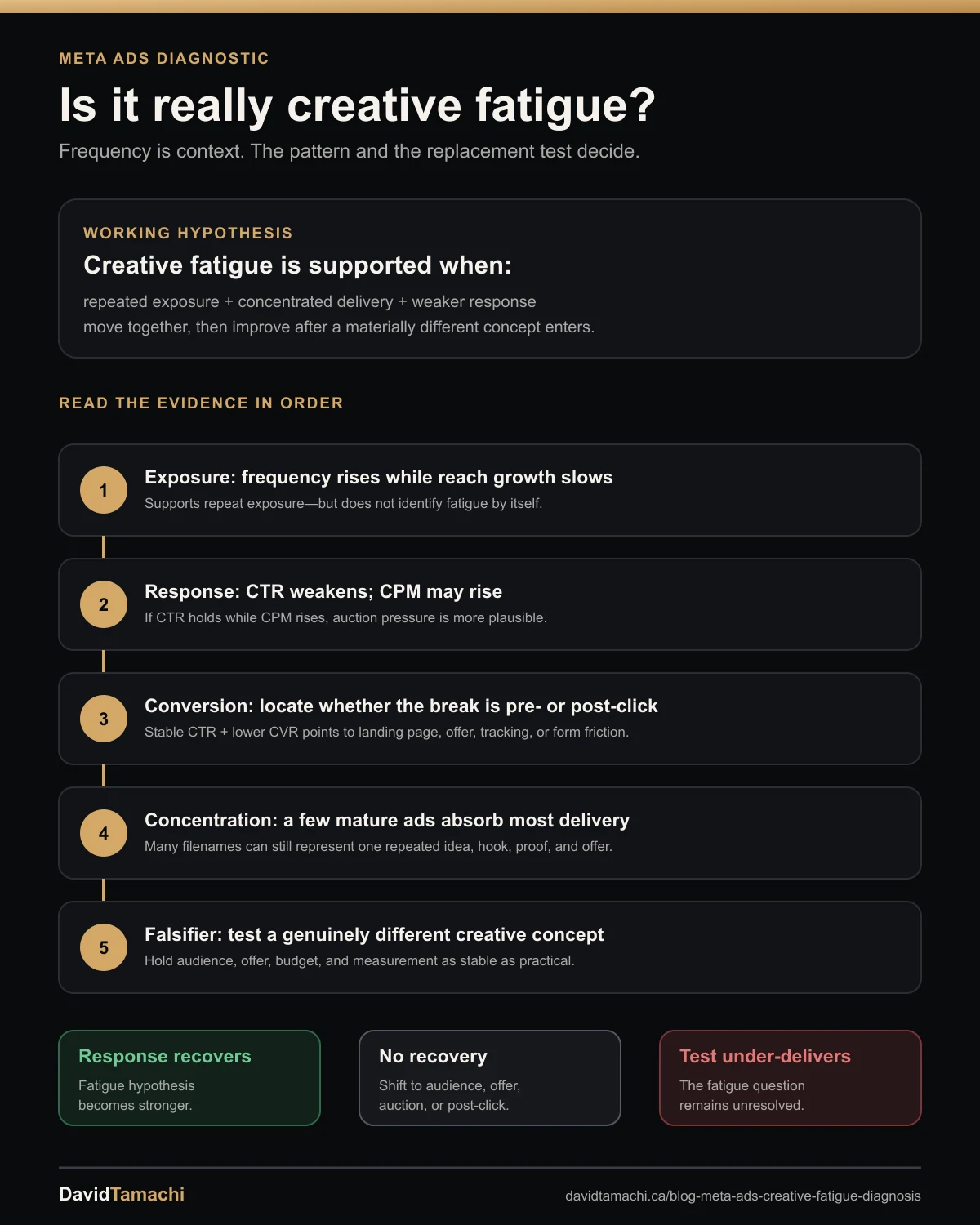
To diagnose Meta Ads creative fatigue, compare equal time windows and look for a sequence: the same audience sees the ads more often, a small group of ads absorbs most delivery, click-through rate weakens, and cost per result deteriorates without a better competing explanation. Then test materially different creative while holding the audience, offer, budget, and measurement setup as stable as practical. If response recovers, the fatigue hypothesis becomes stronger. If it does not, investigate auction cost, audience fit, the offer, the landing experience, or tracking.
This is a diagnosis, not a label generated by one red metric. There is no universal frequency number at which every Meta campaign becomes fatigued. A retargeting campaign, a broad prospecting campaign, a low-consideration purchase, and a complex B2B offer can tolerate very different exposure patterns.
Working definition
Creative fatigue is a plausible explanation when repeated exposure to substantially unchanged advertising reduces incremental audience response. Audience saturation is related but broader: the campaign may be running out of responsive people even when the creative itself is still good. The two can happen together, so the evidence should distinguish creative concentration from audience delivery.
What Evidence Should You Compare?
| Evidence | What it can reveal | What it cannot prove alone |
|---|---|---|
| Frequency, reach, and impressions | Whether exposure per reached person increased while audience expansion slowed. | That people stopped responding because of the creative. |
| CTR and outbound clicks | Whether the ad became less effective at earning a response. | Why response weakened; audience mix and placement mix may have changed. |
| CPM | Whether the cost to access inventory or the audience changed. | Creative fatigue. Competition, seasonality, targeting, and quality can move CPM. |
| Conversion rate and cost per result | Whether weaker performance began before or after the click. | Creative failure if the site, offer, tracking, or conversion mix also changed. |
| Spend and impressions by ad | Whether delivery became concentrated in a small number of long-running ads. | That the highest-spend ad is the cause rather than the current winner. |
| Qualified leads, revenue, or margin | Whether platform deterioration reached the outcome the business values. | Immediate causality when sales cycles and reporting lags are long. |
A Six-Step Creative Fatigue Diagnostic
1. Define the change and choose comparable windows
Record when performance began to weaken and what else changed near that date. Compare equal-length periods with the same weekdays. If the campaign has a strong weekly pattern, seven, fourteen, or twenty-eight-day blocks are usually more informative than two isolated days. Exclude incomplete recent conversion days when attribution lag is material. Write down the original campaign goal before interpreting the metrics.
2. Check exposure without treating it as a verdict
Review frequency together with reach and impressions. Rising frequency with flat reach means more delivery is returning to people already reached. That supports an exposure problem, but it does not identify the cause. If frequency is stable while CPM jumps, auction pressure is a more credible starting hypothesis. If reach expanded into a weaker audience, declining response may reflect audience mix instead of people tiring of the ad.
3. Locate where performance first broke
Trace the funnel in order: impressions, clicks, landing-page behaviour, conversions, and qualified outcomes. When CTR falls before conversion rate, the creative or audience response deserves attention. When CTR holds but conversion rate falls, investigate the destination, offer, site speed, form, inventory, or tracking. When platform conversions hold but qualified leads fall, the apparent creative win may be creating weaker demand.
4. Measure creative delivery concentration
Export performance at the ad level. Calculate each ad’s share of campaign or ad-set spend and impressions. A campaign can contain many ads while behaving like a one-ad campaign if delivery is concentrated. Look at creative age, concept, hook, format, message, and offer—not just file names. Five cosmetic variants of the same visual and claim are not five independent ideas.
5. Challenge competing explanations
Before naming fatigue, check campaign history and adjacent systems. Did the budget, bid approach, audience, exclusions, placements, optimization event, attribution settings, landing page, promotion, price, consent setup, or conversion action change? Did competitors enter a seasonal auction? Did the campaign exhaust a temporary offer? A credible conclusion should state what evidence would make it wrong.
6. Run a controlled creative replacement
Introduce a materially different concept—not only a new crop, caption, or colour. Change the angle, proof, opening frame, visual language, spokesperson, or format while keeping major non-creative conditions reasonably stable. Define the primary success metric and guardrails before launch. A recovery in response and downstream efficiency strengthens the fatigue explanation; no recovery shifts attention toward the audience, offer, auction, or post-click system.
How to Interpret the Pattern
| Observed pattern | More plausible explanation | Next check |
|---|---|---|
| Frequency rises, reach flattens, CTR falls, and a few old ads dominate delivery. | Creative fatigue or audience saturation is supported. | Test a new concept and, if possible, audience expansion separately. |
| CPM rises while CTR and conversion rate remain stable. | Auction pressure is more plausible than fatigue. | Check seasonality, audience size, placement mix, and competitive periods. |
| CTR is stable, but conversion rate and cost per result worsen. | The break is probably post-click or in measurement. | Inspect the landing page, offer, conversion event, tracking, and site performance. |
| Platform results hold, but qualified leads or revenue fall. | Lead quality or downstream operations changed. | Join CRM outcomes to campaign and creative identifiers. |
| Performance falls immediately after an audience, offer, or tracking change. | Creative fatigue remains unresolved. | Separate the overlapping change or run a controlled comparison. |
| A new concept receives little delivery. | The test is inconclusive. | Check whether the comparison had enough opportunity to generate evidence. |
What to Export From Meta Ads Manager
Use daily rows at the ad level when possible. Include date, campaign, ad set, ad, spend, impressions, reach, frequency, link or outbound clicks, the relevant result, conversion value, and the IDs used to join data. Add campaign history or a change log. For a stronger business read, add analytics sessions and conversions, CRM leads and stages, and revenue or margin. Keep the definition of the conversion event consistent across both periods.
The Campaign Forensics Lab can normalize a Meta campaign export, place changes on the timeline, compare before and after evidence, surface competing explanations, challenge assumptions, and produce a brief. It runs locally in the browser, so uploaded CSV data is not sent to a server.
Strong conclusion format
Finding: creative fatigue is supported, not proven. Evidence: frequency rose, reach growth slowed, CTR declined, and two mature ads held most delivery. Falsifier: a new concept fails to improve response under comparable delivery. Unresolved: a seasonal CPM increase overlaps the decline. Action: run the replacement test, then inspect qualified outcomes before scaling.
Common Diagnostic Mistakes
- Using a universal frequency threshold: frequency is context, not a diagnosis.
- Refreshing the asset but not the idea: cosmetic variants may leave the same exhausted message in market.
- Pausing the current winner immediately: preserve a comparison long enough to learn, subject to spend and business risk.
- Reading blended campaign averages only: averages can hide one fatigued creative or a shift between audiences and placements.
- Changing creative, audience, budget, and offer together: the result may improve, but the cause remains unknowable.
- Stopping at platform conversions: lead quality, revenue, and margin can reverse the platform-level conclusion.
FAQ
What Meta Ads frequency is too high?
There is no universal frequency threshold that proves creative fatigue. Interpret frequency with reach, CTR, conversion rate, creative concentration, campaign objective, audience type, and the time window.
Does a high CPM prove creative fatigue?
No. CPM can rise because of auction competition, seasonality, audience constraints, placement mix, or other delivery factors. Fatigue becomes more plausible when exposure and response evidence deteriorate together.
Should I pause a winning creative as soon as performance falls?
Not automatically. Confirm the pattern, introduce a materially different replacement, and preserve a useful comparison when budget and business risk allow. An abrupt pause can remove the control before the alternative has evidence.
How many Meta ad creatives should I run?
There is no single correct number for every account. The useful goal is enough meaningfully different concepts to create choice and learning without spreading the available delivery so thin that none receives interpretable evidence.
What fields should I export to diagnose creative fatigue?
Export daily ad-level rows with date, campaign, ad set, ad, spend, impressions, reach, frequency, clicks, the relevant result, conversion value, and joinable IDs. Add change history and downstream analytics, CRM, or revenue outcomes when available.
Can a before-and-after comparison prove creative fatigue?
A before-and-after comparison can support the hypothesis, but overlapping changes can still explain the result. A controlled creative replacement with a defined success metric provides stronger evidence.
Sources and Method
Reviewed August 3, 2026. This diagnostic framework combines first-party platform guidance with an evidence-led measurement workflow. Meta recommends creative-level reporting and creative diversification across formats and placements in its ad creative strategy guidance. Meta also includes creative diversification, account simplification, data quality, and results validation in its Performance 5 guidance, and describes variation and optimization in Advantage+ creative. These sources support diversification and measurement; they do not establish a universal fatigue threshold. The interpretations above are a transparent analytical framework, not a claim that Meta publishes this exact scoring model.
Continue the Investigation
Use the Campaign Forensics Lab to stress-test the fatigue hypothesis against campaign, analytics, CRM, finance, and experiment evidence. If Meta, GA4, and CRM disagree, use the conversion reconciliation guide. Preview creative safely with the Meta Ad Previewer, or review how modern paid-media platforms change the diagnostic job.