Paid media diagnostic guide
Campaign performance changed. Find out what changed with it.
Campaign forensics is the process of reconstructing a paid media performance shift from multiple evidence sources. Instead of assuming the most recent edit caused the result, it compares timing, platform delivery, traffic behaviour, measurement changes, lead quality, revenue, profit, and controlled-test evidence.
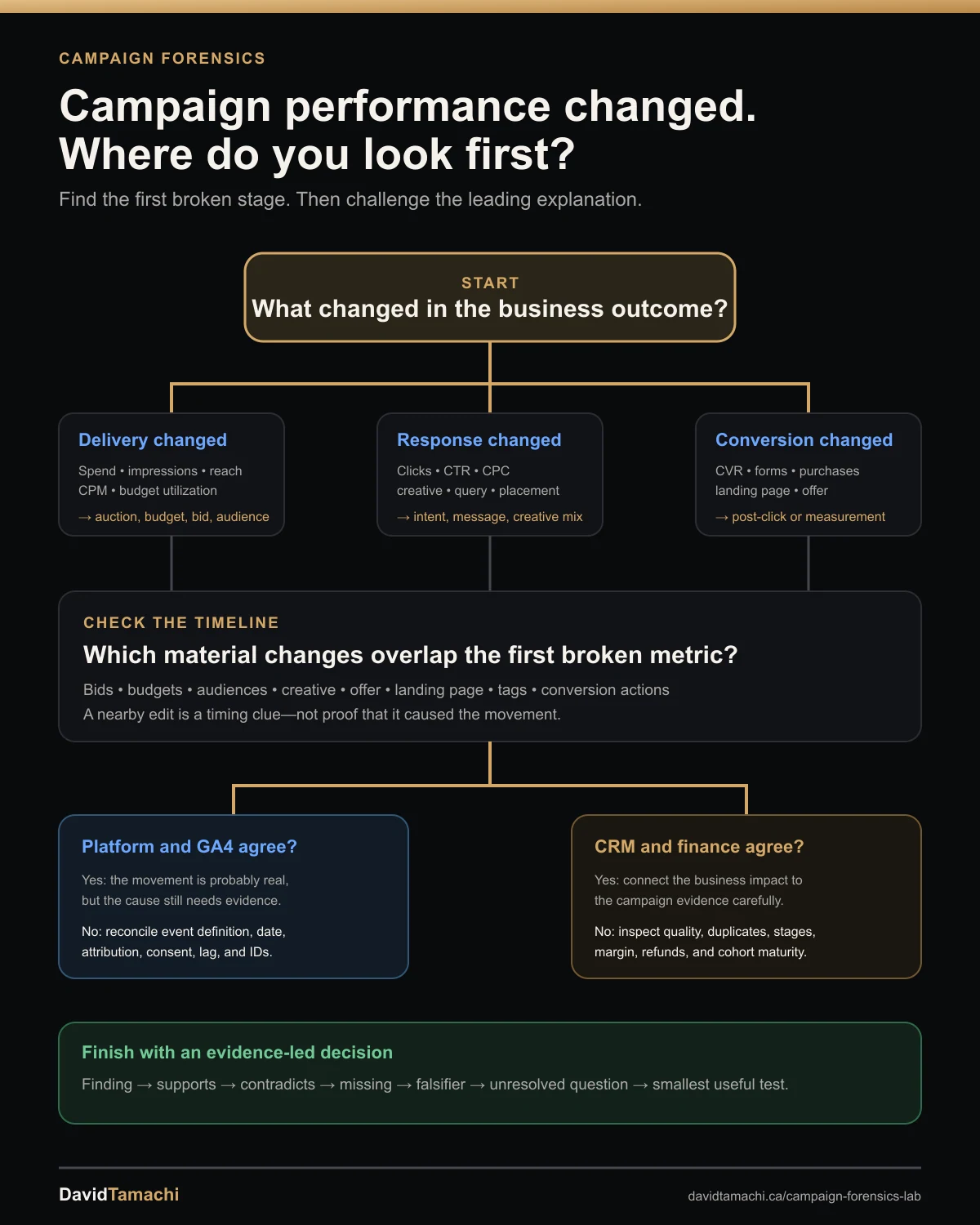
When CPA rises or conversions fall, check whether spend, traffic mix, conversion rate, tracking, creative exposure, lead quality, or unit economics changed in the same window. Rank the explanations, identify contradictory evidence, and run the smallest test that can separate the leading causes.
Diagnostic coverage
What the Campaign Forensics Lab can diagnose
CPA increased
Separates higher auction cost, weaker conversion rate, traffic-quality changes, tracking shifts, and low sample volume.
Conversions dropped
Checks delivery, click volume, conversion lag, form completion, landing-page behaviour, and downstream lead quality.
Meta creative fatigue
Requires a pattern of repeat exposure, worsening response, rising CPM, and concentrated creative delivery—not frequency alone.
LinkedIn lead weakness
Shows observed economics and lead-form completion changes while leaving the root cause unresolved without audience and CRM evidence.
Tracking or attribution changed
Flags measurement contamination when conversion actions, tags, GA4 events, or attribution definitions change near the performance shift.
ROAS hides weak profit
Connects platform revenue to COGS, shipping, fees, discounts, refunds, and ad spend before calling growth profitable.
Evidence requirements
What data should you use to investigate a campaign change?
No single export is a complete source of truth. Platform files describe delivery and attributed outcomes; analytics, CRM, finance, and experiments test whether those outcomes were real and valuable.
| Evidence source | Questions it can answer | What it cannot prove alone |
|---|---|---|
| Google, Meta, or LinkedIn performance | Did spend, reach, clicks, conversions, CPA, CPM, frequency, or attributed value change? | Whether the platform caused incremental business results. |
| Campaign change log | Which bids, budgets, audiences, creatives, offers, pages, or tracking settings changed near the inflection? | Which overlapping change caused the movement. |
| GA4 landing-page data | Did sessions, key events, device mix, or landing-page conversion behaviour change? | Lead quality, closed revenue, or profit. |
| CRM outcomes | Did raw leads become qualified leads, sales opportunities, or revenue? | Whether unattributed demand would have happened without ads. |
| Finance data | Did attributed revenue clear product, fulfilment, fee, refund, discount, and media costs? | Incremental lift without a credible counterfactual. |
| Experiment or holdout | How did treatment perform against a concurrent control? | A trustworthy causal estimate when assignment, power, or measurement is weak. |
Channel mapping matters: when multiple platforms are active, GA4, CRM, finance, and experiment rows must identify the relevant channel. Unmapped outcomes remain available but are not borrowed into a channel-specific conclusion.
How to use the tool
A four-step campaign forensics workflow
- 1
Choose the investigation scope
Start with Google Ads, Meta Ads, or LinkedIn Ads. Use the blended view only to find portfolio-level movement, then return to each channel before taking action.
- 2
Add the evidence you actually have
Upload CSV exports for performance, changes, GA4, CRM, finance, or experiments. Missing evidence lowers confidence instead of blocking the analysis.
- 3
Review competing explanations
Read what supports, contradicts, or is missing from the leading hypothesis. Check the runner-up and any confidence cap before accepting the TL;DR.
- 4
Challenge, test, and document
Challenge the logic, run the sensitivity test, and create a decision brief that records the evidence, falsifiers, unresolved question, and next test.
Transparent methodology
A diagnostic brain you can inspect
The Campaign Forensics Lab is deterministic. Channel adapters normalize Google, Meta, and LinkedIn evidence without applying one platform’s rules to another. The shared brain checks timing, measurement integrity, segment concentration, business outcomes, unit economics, experiments, and competing explanations. Every score and confidence cap is traceable; uploaded data never leaves the browser.
Confidence is evidence coverage—not causal probability. When changes overlap, measurement changes are unresolved, the sample is small, or the top explanations are too close, the brain limits confidence and recommends the smallest useful test.
Channel context
How the diagnostic logic changes by ad platform
Google Ads performance changes
Google-specific checks include query exclusions, search intent, bid-strategy changes, Target CPA or Target ROAS constraints, impression-share pressure, conversion actions, and landing-page conversion rate. A query cleanup can reduce raw conversions while improving lead quality, so CRM evidence can materially change the decision.
Meta Ads creative and auction changes
Meta-specific checks require more than a high frequency number. The fatigue hypothesis strengthens when repeat exposure rises while CTR falls, CPM rises, and one creative receives most delivery. Audience edits, offer changes, and tracking changes remain competing explanations.
LinkedIn Ads lead-generation changes
LinkedIn often has smaller samples and longer B2B outcome delays. The tool can identify rising click cost, falling form completion, or zero-conversion periods, but it will not invent an audience-quality explanation without segment and CRM evidence.
Frequently asked questions
Campaign forensics FAQ
What is campaign forensics?
Campaign forensics is a structured investigation of why paid media performance changed. It aligns dated performance, account edits, site behaviour, downstream outcomes, business economics, and experiments to rank competing explanations without claiming more certainty than the evidence supports.
Why did CPA increase after a campaign change?
CPA can rise because media cost increased, conversion rate fell, traffic mix changed, delivery shifted, tracking definitions changed, or normal sample noise affected the comparison. A nearby edit is a timing clue, not proof that the edit caused the increase.
How do you diagnose Meta Ads creative fatigue?
Look for repeat exposure together with worsening response: rising frequency, falling CTR, rising CPM, and delivery concentrated in a small number of creatives. High frequency by itself does not prove fatigue.
What should I check when LinkedIn Ads leads drop?
Check spend, impressions, click cost, click-through rate, lead-form opens, form completions, audience or form changes, conversion lag, and CRM-qualified outcomes. Low volume should remain directional until more evidence is available.
Can before-and-after campaign analysis prove causality?
Usually not. Before-and-after analysis is useful for diagnosis and prioritization, but overlapping changes, seasonality, demand, competition, and measurement shifts weaken causal claims. A well-designed concurrent control is stronger evidence.
Does the Campaign Forensics Lab upload my advertising data?
No. CSV parsing and analysis run in the browser. The current tool does not send uploaded campaign, analytics, CRM, finance, or experiment files to a server.
Continue the investigation