
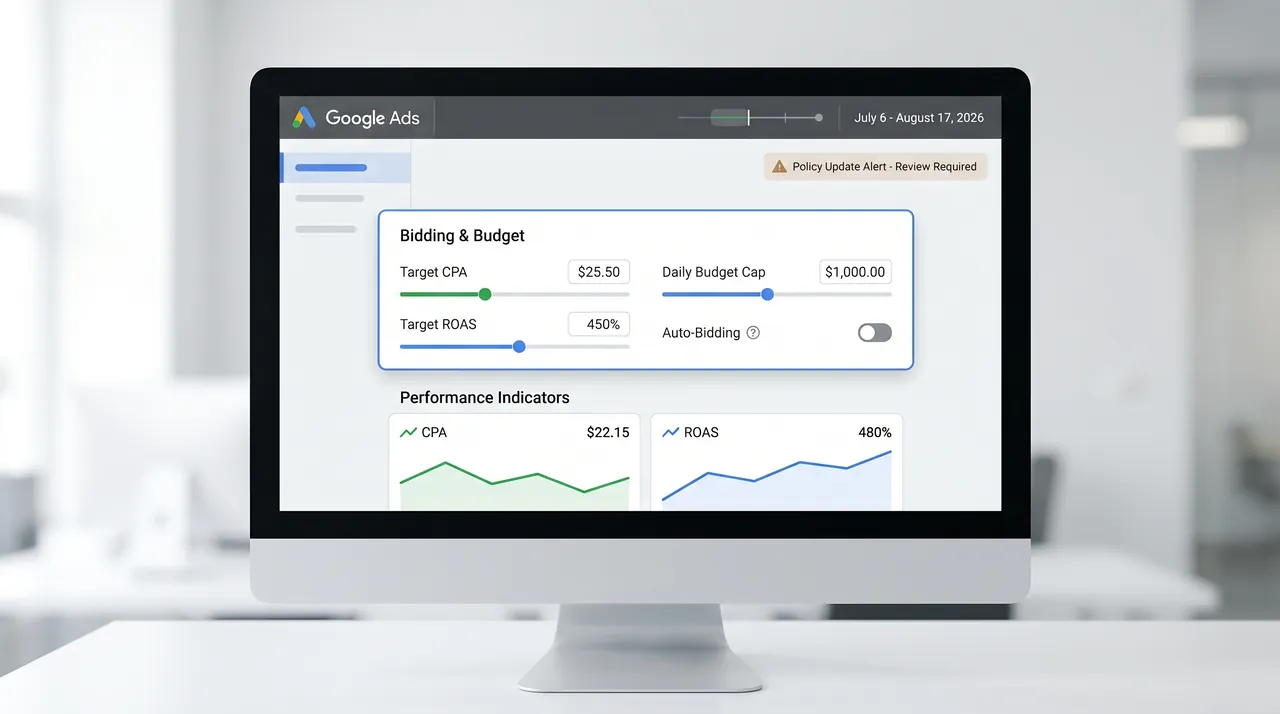
The August 17 Risk in Plain English
A Limited by budget campaign running Target CPA or Target ROAS can currently perform better than its setting. After August 17, Google says affected campaigns will optimize more consistently toward the target you entered—even when the budget changes.
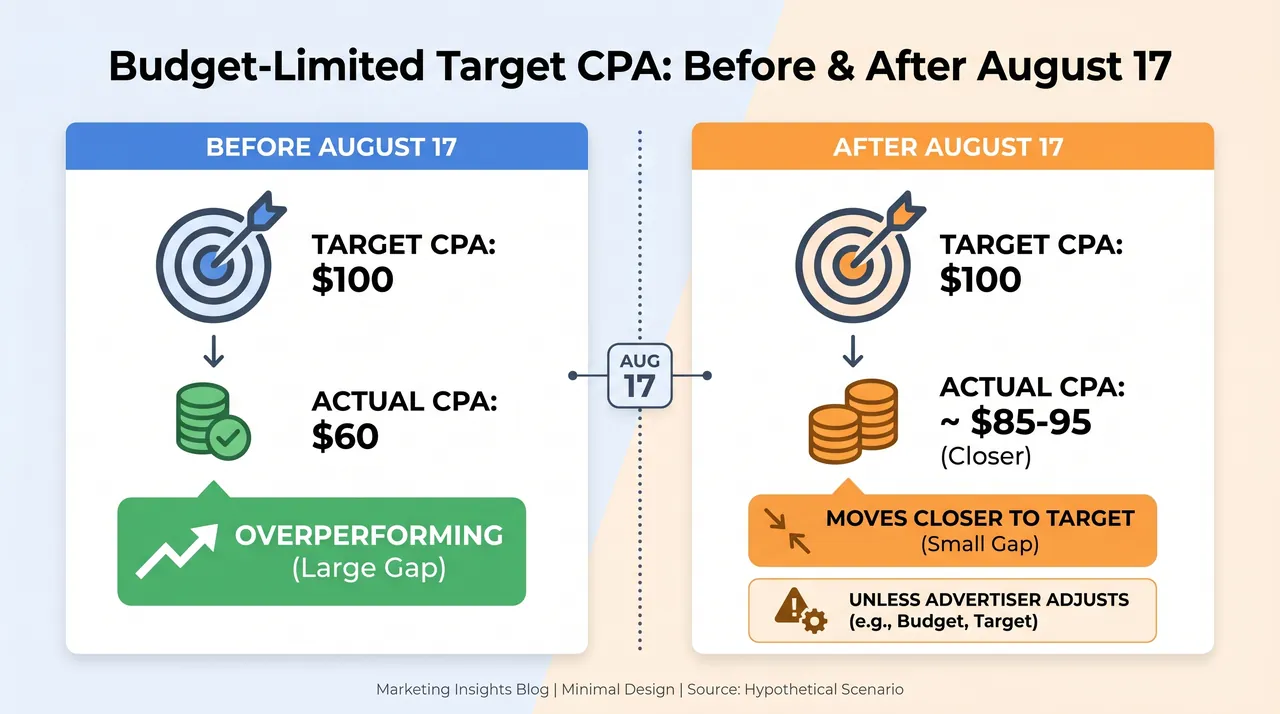
A campaign with a $100 Target CPA and $65 actual CPA may therefore move upward toward $100. A campaign with 400% Target ROAS and 800% actual ROAS may move downward toward 400%. Google will not automatically change the target or budget; it is changing how closely bidding follows the existing target.
This is the Google Ads target bidding update August 17 2026 that PPC managers cannot treat as a routine recommendation refresh. The exposure is concentrated in campaigns that are budget-constrained, use an affected target strategy and materially outperform the target. Google also says Performance Max and Demand Gen may redistribute traffic across channels after the change.
The decision is simple: does the target in Google Ads represent the result the business can afford, or is it a stale ceiling the algorithm has quietly been beating?
Start With a 60-Day Target Gap Audit
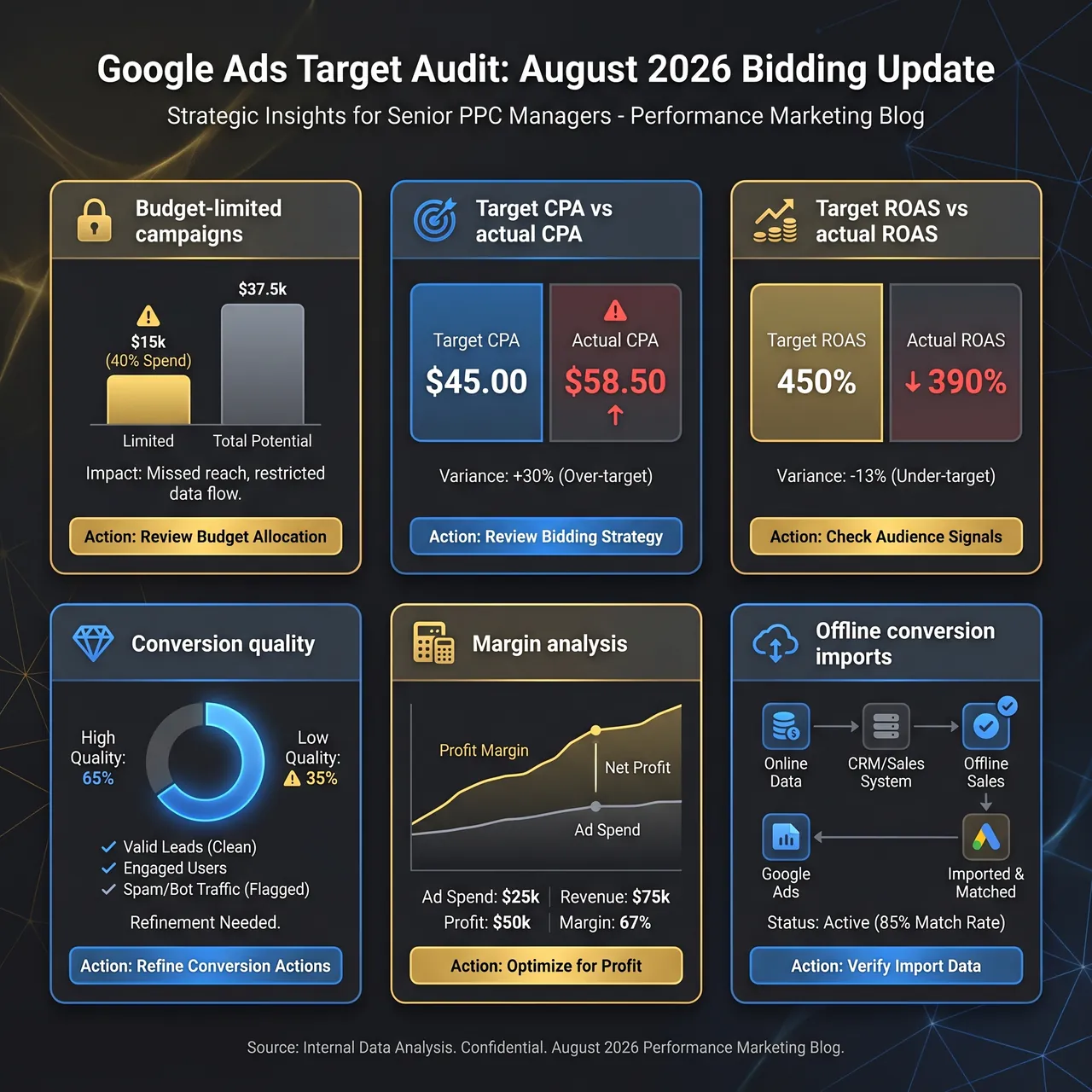
Export the last 60 days for every affected campaign, then split the period into two 30-day windows. Include campaign type, status, bid strategy, current target, actual CPA or ROAS, cost, conversions, value, daily budget, average daily spend, primary conversion actions and conversion lag.
For lead generation, add qualified leads, opportunities, closed customers and offline CPA. For ecommerce, add gross margin, contribution margin, returns, fulfilment costs and break-even ROAS. Exclude immature days when conversions or CRM outcomes have not finished reporting.
- Target CPA gap: current Target CPA minus actual CPA.
- Target ROAS gap: actual ROAS minus current Target ROAS.
- Highest priority: persistent budget limits, meaningful spend, a wide target gap and stable results in both 30-day windows.
Do not convert one seasonal peak, one large order or a period with incomplete conversion lag into a permanent bid target.
The Four-Way Decision Framework
Path A: The Target Alignment Play
Best for high-performing lead generation or ecommerce campaigns where current efficiency must be protected.
Lower Target CPA or raise Target ROAS toward the strongest sustainable result in the 60-day audit. Do this when lead quality or contribution margin is healthy, the campaign has credible conversion volume and efficiency matters more than incremental scale.
Example: a campaign has a $120 Target CPA, a $76 actual CPA and a maximum affordable qualified-lead CPA of $165. A front-end target near $76 may protect recent platform efficiency only if the relationship between platform leads and qualified leads has remained stable.
For ecommerce, do not blindly copy recent ROAS. If actual ROAS is 525%, break-even is 360% and 450% is the sustainable operating target, 450% may be more defensible than either a stale 300% setting or a peak-performance 525% target.
Path B: The Budget Expansion Play
Best for profitable campaigns with approved headroom and unmet demand.
If the current target reflects real margin or pipeline economics, increasing the budget may be cleaner than tightening the target. Confirm that sales capacity, inventory, cash flow and geographic coverage can absorb more volume. Use the budget recommendation as a forecast—not as approval to spend.
- Validate profitability using CRM revenue or contribution margin.
- Set the maximum acceptable monthly spend.
- Increase budget in a controlled step.
- Avoid simultaneous target, landing-page or conversion-goal changes.
- Wait one to two conversion cycles before evaluating.
Timing matters: Google says budget increases made under the old behaviour can cause efficiency fluctuations. The post-August system is specifically intended to make scaling at the stated target more predictable.
Path C: The Strategy Pivot
Best for fixed-budget accounts where total output matters more than holding a rigid CPA or ROAS.
Switch to Maximize Conversions when conversions carry similar value, or Maximize Conversion Value when values differ. These strategies aim to spend the available budget without a target constraint, so actual CPA or ROAS can fluctuate when budget or auction conditions change.
Before a Maximize Conversions transition, remove weak secondary actions from bidding, import qualified offline stages, verify conversion values and document a rollback threshold. If junk leads and qualified opportunities look identical to Google, the system can maximize the wrong outcome.
Path D: Do Nothing
Best when the historical target already matches true business margins.
No action is reasonable when Target CPA equals the maximum sustainable acquisition cost, Target ROAS reflects contribution margin, the business wants more volume at that target and conversion inputs are reliable.
Leaving a $100 Target CPA untouched means telling Google that conversions approaching $100 remain acceptable—even if the campaign recently delivered them for $60. Do nothing because the target is correct, not because nobody reviewed it.
One campaign, one explicit decision: align the target, expand the budget, pivot the strategy or keep the current setting. “Accept recommendation” is not a fifth strategy.
Bid Target Adjustment Tool Audit Protocol
The Bid Target Adjustment Tool has been available since July 6. Google says notifications are triggered for advertisers with an affected target-based campaign that was Limited by budget at some point in the last 12 months.
- Open the account notification. Sign in to Google Ads and open the target-bidding change banner. If it is absent, check the affected campaign's settings; Google says the tool is becoming available there as deployment continues.
- Inventory the flagged campaigns. Record current target, recent actual performance, suggested target, budget status, spend, conversions and owner.
- Validate the window. Compare the tool with the last 30 days, previous 30 days and a 60-day total. Add year-over-year context when seasonality matters.
- Audit lead quality. Check which conversion actions feed bidding, qualified-lead rate, spam, duplicates and offline imports.
- Audit margin. Recalculate ROAS after discounts, returns, shipping, payment fees, product mix and new-customer economics.
- Assign Path A, B, C or D. Portfolio bidding and shared-budget changes must be decided at the portfolio or shared-budget level.
- Review before clicking Apply. Save the old target, baseline the account, obtain approval and record the rationale.
Do not blindly accept the automated recommendation. The Apply action changes the bid target; it is not an acknowledgement button. A lower platform CPA can still be worse if qualified-lead rate collapsed, and a high revenue ROAS can still lose money after margin and returns.
Pre-August 17 vs. Post-August 17 Behaviour
| Campaign | Pre-August 17 behaviour | Post-August 17 behaviour | Audit focus |
|---|---|---|---|
| Search | A budget-limited target campaign may beat the setting by entering a narrower set of efficient auctions. | Bidding should optimize more consistently toward Target CPA or Target ROAS, including as budget changes. | 60-day target gap, search terms, conversion actions and offline outcomes. |
| Shopping | Budget pressure can concentrate spend in efficient product auctions and actual ROAS may exceed the target. | Performance should move more consistently toward stated Target ROAS as incremental auctions become eligible. | Contribution margin, product groups, returns, discounts and stock. |
| Performance Max | A constrained campaign may overachieve CPA or ROAS while favouring its most efficient inventory. | Efficiency may move toward the target and traffic allocation across Google channels may change. | Asset and listing groups, branded demand, customer settings and channel movement. |
| Demand Gen | Budget-limited Target CPA, Target ROAS or Target CPC campaigns may outperform the setting. | Bidding should move closer to the entered target; inventory allocation may also shift. | View-through and engaged-view conversions, audience quality and downstream value. |
Travel campaigns are also included. Display and Hotel already use the newer behaviour. App, Video Reach and Video View campaigns keep their previous behaviour. Target-based campaigns that are not budget-constrained are not expected to change because of this update.
The 21-Day Execution Calendar
Days 21–15: Inventory and diagnose
Export affected campaigns, compare 30- and 60-day actuals, pull CRM or margin data, flag tracking problems and assign an owner.
Days 14–8: Decide and approve
Assign every campaign to a path, model budget scenarios, calculate profitable thresholds, obtain approval and prioritize the largest target gaps.
Days 7–1: Implement and protect the baseline
Make the approved change, avoid unrelated restructuring, annotate the date and export a pre-change benchmark.
August 17 onward: Monitor by conversion cycle
Track spend, conversion volume, actual CPA or ROAS, qualified-lead rate, revenue, margin and multi-channel allocation. Google recommends waiting one to two conversion cycles before judging performance.
Related Reading
Sources and Further Reading
FAQ
Which campaign types are affected by the August 17 Google Ads target bidding update?
The update applies to budget-constrained Search, Shopping, Performance Max, Demand Gen and Travel campaigns using Target CPA or Target ROAS. Demand Gen Target CPC is also affected. Display and Hotel already use the newer behaviour; App, Video Reach and Video View are not moving as part of this update.
Should I raise my Google Ads budget before changing Target CPA or Target ROAS?
Raise the budget when the target is profitable, the business wants more volume and operations can absorb it. Adjust the target when protecting current efficiency matters more. Stage budget changes carefully before August 17 because the old bidding behaviour can still fluctuate.
Can I trust Performance Planner forecasts during the transition?
Use caution. Google says Performance Planner and related forecasts will reflect the new behaviour, but may have some inaccuracies from August 17 through August 31. Validate forecasts against actual conversion lag and business margins.