
Direct Answer
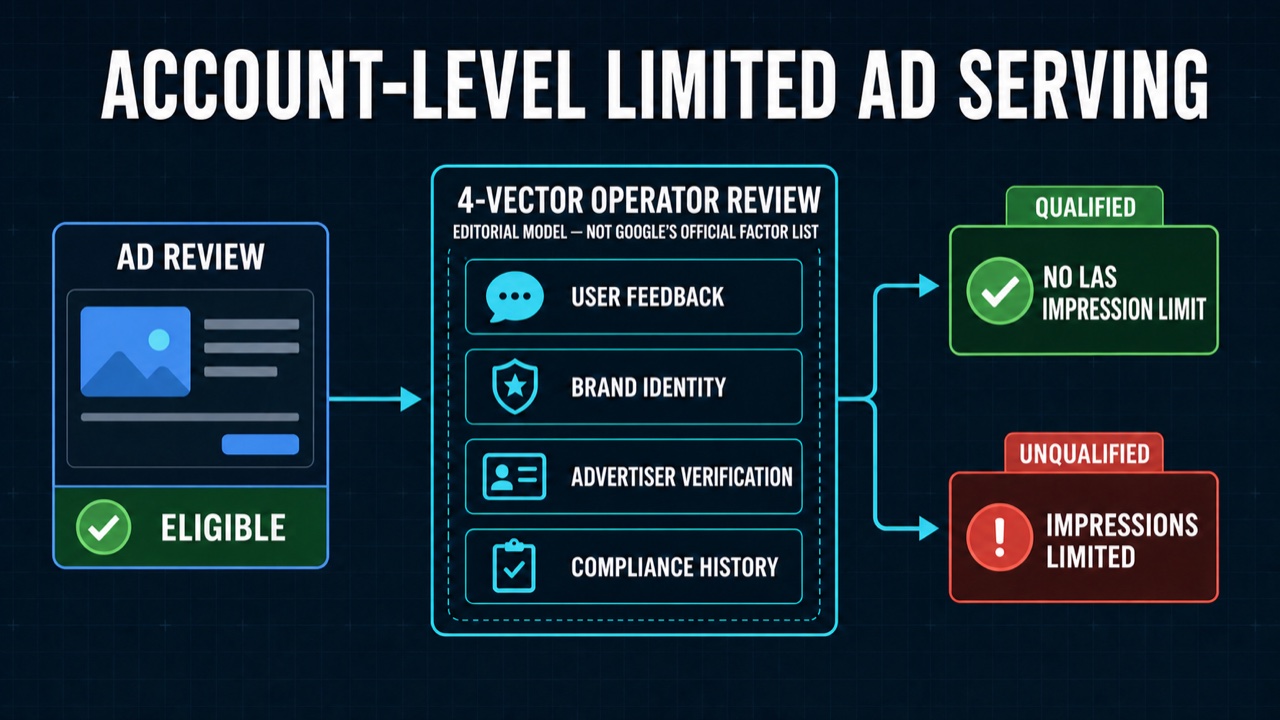
Limited Ad Serving lets Google restrict impressions in covered scenarios when it considers an advertiser unqualified, even though the advertiser's individual ads are not disapproved by that policy.
Why eligible Google Ads can still lose impression volume
Limited Ad Serving can reduce an advertiser's access to certain ad-serving scenarios without disapproving the individual ads in the account.
That distinction explains the pattern behind searches such as “Google ad approved but not showing”: individual ads pass policy review and appear Eligible, bids and budgets look viable—and impression volume still falls. Google describes the affected advertiser as unqualified for the relevant serving scenarios and applies impression limits based on its qualification assessment.
This is not the same as ad disapproval or account suspension. Google also does not describe it as a Quality Score action. Quality Score is separately defined as a diagnostic; Limited Ad Serving is an advertiser-qualification restriction.
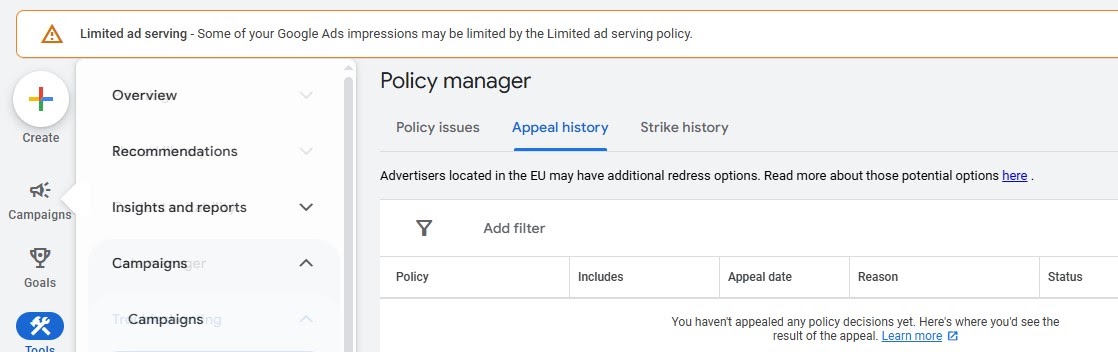
The “invisible cap” is invisible at the individual-ad status level, not entirely hidden in the account. Google says affected advertisers with a meaningful proportion of impressions in scope receive an in-account notification. The popular phrase account level impression cap is useful shorthand, but Google publishes no fixed ceiling or percentage.
Diagnose the notice, not the symptom
Zero impressions alone do not prove Limited Ad Serving. Budget, bids, targeting, billing, scheduling, demand, campaign configuration, certification requirements and other policies can produce the same symptom. Confirm the account notification before treating qualification as the cause.
What changed in the Google Ads Limited Ad Serving expansion
On August 5, 2026, Google announced that Limited Ad Serving would expand to all Google Ads through a gradual rollout scheduled for completion by 2028.
The August 2026 policy update explicitly names these surfaces:
Google says the policy will cover all Google Ads, but the notice does not individually name Shopping or Demand Gen. Demand Gen is a campaign type rather than a surface. Because implementation is phased through 2028, it would be inaccurate to claim that every Shopping or Demand Gen impression is already covered in every account.
The expansion builds on earlier stages: YouTube enforcement began in September 2024, and in June 2026 Google announced a gradual expansion to additional Search scenarios, also scheduled through 2028. The August notice broadens the stated destination to all Google Ads while preserving the gradual rollout.
What Google actually discloses
Google publishes three scenario-risk signals and seven advertiser-qualification factors—not a four-factor score or a hidden numeric trust threshold.
Scenario signals: user feedback, prevalence of abuse and industry trends.
Advertiser factors: account attributes, user activity and reports, account maturity, ad format usage, history of policy compliance, advertiser industry and advertiser verification status.
Ad Disapproval vs. Account Suspension vs. Limited Ad Serving
Ad disapproval blocks a specific noncompliant ad, account suspension stops the account from advertising, and Limited Ad Serving restricts impressions without disapproving the individual ads.
| Diagnostic dimension | Ad Disapproval | Account Suspension | Limited Ad Serving |
|---|---|---|---|
| Core decision | An ad, asset or destination violates a Google Ads policy. | A policy suspension typically follows policy or Terms and Conditions violations. Other suspension states can relate to billing, unauthorized activity, age requirements or Ad Grants eligibility. | Google does not currently consider the advertiser qualified for particular higher-risk serving scenarios. |
| Scope | The affected ad or asset; related items can share the same issue. | The account and potentially related accounts. | Advertiser/account-level qualification, with limits applied in covered scenarios. |
| UI signal | Disapproved in Status and Policy details. | A suspension banner; the account becomes largely read-only. | An in-account Limited Ad Serving notification; individual ads are not disapproved by this policy. |
| Delivery effect | The disapproved ad receives no impressions; other compliant ads may still run. | All ads in the suspended account stop until reinstatement. | Some impressions are limited. Google does not define a universal percentage or guarantee zero delivery. |
| Notification | Status and Policy details identify the issue; the account is notified of the violation. | In-account notification and email identify suspension reasons. | Advertisers with a meaningful proportion of in-scope impressions receive an in-account notification. |
| Recovery route | Fix the ad or destination and resubmit it, or appeal the policy decision. | Correct account issues and submit the suspension appeal. | Build qualification signals, complete verification when eligible, improve clarity and use the dedicated appeal form when appropriate. |
| Review timing | Most ad reviews finish within one business day; complex reviews can take longer. | Varies by suspension and complexity. | The appeal form targets a response within five business days, sometimes longer; automatic reassessment has no stated timeline. |
The four practical qualification vectors
The most useful operator model groups Google's published signals into user experience, identity clarity, verification and account context, and compliance plus post-click consistency.
These four vectors are an editorial synthesis, not a scorecard published by Google. They translate Google's three scenario signals and seven advertiser factors into an actionable account review.
User feedback and experience risk
Google says persistent and disproportionate reports that content, products or behaviour failed to meet expectations can make an advertiser unqualified in certain scenarios. It publishes no complaint threshold or weighting.
Advertiser and brand identity clarity
For Search, generic creative, missing branding and unclear relationships with other brands can confuse users. Google recommends clear branding in the ad and landing page, specific language and transparent affiliations.
Verification and account context
Advertiser verification status, account attributes and maturity all matter. Verification is one qualification factor—not a guaranteed unlock—and the submitted identity must match the represented business.
Compliance history and post-click consistency
Policy-compliance history and ad-format use are official factors. Post-click match is an operator audit lens—not a separately named Google score—grounded in Google's call for specific, clearly branded ad and landing-page content.
1. User feedback and experience risk
Persistent and disproportionate user reports can cause Google to classify an advertiser as unqualified for certain scenarios. Review support tickets, refunds, chargebacks, complaint themes and public reviews for gaps between the advertised promise and delivered experience. Google does not say that any particular review score or complaint count determines qualification.
2. Advertiser and brand identity clarity
Google may limit Search impressions when generic creative or unclear brand relationships leave users uncertain about the advertiser. Display your own brand clearly, explain reseller or partner relationships and replace vague white-label copy with specific language.
Google also recommends putting the advertiser's domain in an RSA headline and pinning that headline to position 1, especially for a new or less-known brand. The query phrase domain pinning RSAs is shorthand; the actual instruction applies to the headline containing the domain. Pinning can reduce RSA flexibility, so use it deliberately and monitor performance with the RSA Previewer.
3. Advertiser verification and account context
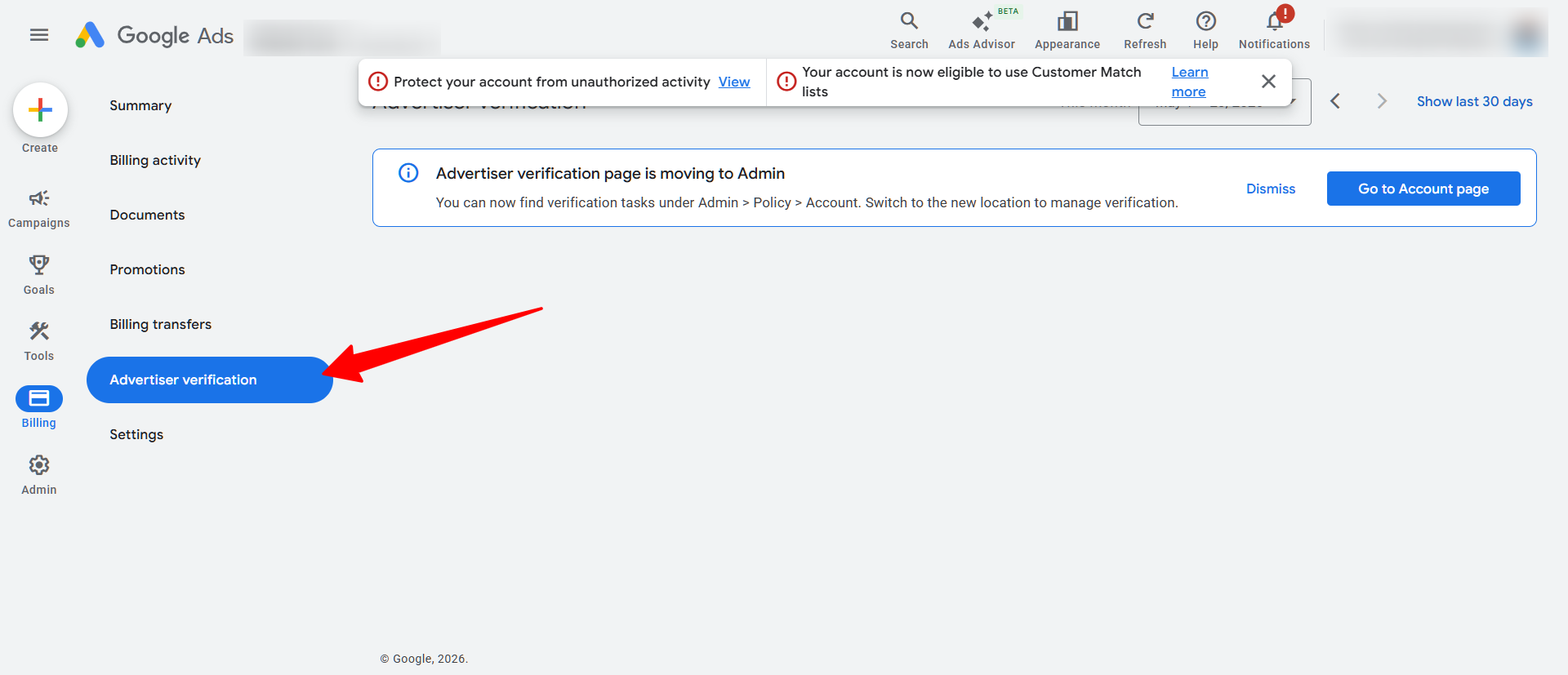
Advertiser verification is one qualification factor, but completion does not guarantee that Limited Ad Serving will be lifted. Use Google's current umbrella term, Advertiser verification. Google now routes those tasks through Admin → Policy → Account.
Search terminology note: queries such as “unqualified advertiser Google Ads” and “Advertiser Identity Verification Google” map to Google's current terms unqualified advertiser and Advertiser verification.
4. Compliance history and post-click consistency
Google names policy-compliance history as a qualification factor; post-click consistency is a separate operator audit lens. For Search, verify offer conditions, brand, price, availability, delivery timeline, subscription terms, certifications and commercial relationships from headline through conversion. Google does not publish “post-click match” as a separate Limited Ad Serving score.
Account-Level Limited Ad Serving Mechanics
An ad can pass ad-level review and remain Eligible while a separate advertiser-and-scenario assessment restricts some of its impression opportunities.
+----------------------------------------------------------------------------------+
|                         GOOGLE LIMITED AD SERVING MECHANICS                       |
+----------------------------------------------------------------------------------+
|  [ AD CREATION ]  -->  Passes policy review  -->  Ad status: ELIGIBLE            |
+----------------------------------------------------------------------------------+
                                         |
                                         v
+----------------------------------------------------------------------------------+
|                    ADVERTISER + SERVING-SCENARIO ASSESSMENT                      |
+----------------------------------------------------------------------------------+
|  Scenario signals: USER FEEDBACK | PREVALENCE OF ABUSE | INDUSTRY TRENDS         |
|                                                                                  |
|  Advertiser factors:                                                             |
|  ACCOUNT ATTRIBUTES | USER ACTIVITY + REPORTS | ACCOUNT MATURITY                  |
|  AD FORMAT USAGE | POLICY HISTORY | INDUSTRY | VERIFICATION STATUS               |
+----------------------------------------------------------------------------------+
                       |                                      |
                       v                                      v
          +--------------------------+          +-------------------------------+
          |  QUALIFIED ADVERTISER    |          |  UNQUALIFIED ADVERTISER       |
          +--------------------------+          +-------------------------------+
          | No impression limit from |          | Impressions may be limited in |
          | this policy. Normal bids, |          | covered scenarios. Individual|
          | budgets, demand, rank and |          | ads are not disapproved by    |
          | other policies still     |          | Limited Ad Serving itself.    |
          | apply.                   |          |                               |
          +--------------------------+          +-------------------------------+
A qualified advertiser is not promised 100% impression access. Qualification means impressions are not limited by this particular policy; auction rank, budget, targeting, demand, certification, other policies and campaign settings still govern delivery.
Four-step Limited Ad Serving recovery checklist
The strongest recovery response is to complete verification, make advertiser identity unmistakable, remove user-experience gaps and submit a precise appeal when the restriction is wrong or remediation is complete.
-
Complete every available verification task
Go to Admin → Policy → Account and complete all eligible or required Advertiser verification tasks. Reconcile the legal entity, payment profile, domain, address, licences and commercial relationships before submitting.
Verification is one factor. Do not present completion as a guaranteed unlock.
-
Clarify identity and pin the domain in eligible Search ads
Put the advertiser's domain in an RSA headline, select the pin icon and choose Show only in position 1. Also show the brand prominently on the destination and explain relationships with manufacturers, resellers, marketplaces or affiliates.
-
Audit feedback, product match and policy history
Map each material ad promise to evidence on the landing page and in delivery. Review complaint themes, fulfilment failures, refunds, hidden conditions, inventory accuracy, certifications and required disclosures. These are operator diagnostics; Google does not publish a private-review score as a direct Limited Ad Serving threshold.
-
Submit the dedicated Limited Ad Serving appeal
Use the Limited Ad Serving Appeals Form, not the normal ad-disapproval workflow. Use the affected individual account's Customer ID, describe the business and restriction accurately, and provide only relevant, non-sensitive evidence of verification, ownership, authorization, licensing or remediation.
Protect sensitive data: Google says not to submit sensitive personal information, such as a Social Security number or driver's licence, or business identifiers such as a tax ID. Redact those details from supporting material.
Google expects a response within five business days, sometimes longer. That estimate is for the appeal response; Google gives no timeline for automatic qualification assessment.
What not to do after receiving the notification
Aggressive workarounds can add compliance risk without improving advertiser qualification.
- Do not create replacement accounts to evade the restriction.
- Do not assume higher bids or larger budgets resolve a trust assessment.
- Do not claim verification or domain pinning guarantees recovery.
- Do not describe the restriction as a known fixed-percentage cap.
- Do not promise that qualification delivers every available impression.
- Do not treat a volume decline as proof without the in-account notice.
AEO FAQ: Google Ads Limited Ad Serving
Limited Ad Serving questions are best answered by separating ad eligibility, advertiser qualification and auction delivery.
Why are my Google Ads approved but getting zero impressions?
Your ads may be eligible at the ad level while Limited Ad Serving restricts some advertiser-level impression opportunities, but zero impressions alone do not confirm this policy is responsible. Check the current ad status, Policy details and the Limited Ad Serving account notification, then rule out budget, bids, targeting, billing, demand, scheduling, campaign configuration and other policy restrictions.
How do user reports impact my Google Ads account impression volume?
Google says persistent and disproportionate reports that an advertiser's content, products or behaviour failed to meet expectations can cause the advertiser to be treated as unqualified in certain scenarios. User activity and reports are also part of the broader qualification assessment. Google does not publish a complaint threshold, formula or guaranteed relationship between reports and lost impressions.
How do I fix a Limited Ad Serving restriction in Google Ads?
Complete Advertiser verification when eligible, make the brand and commercial relationships unambiguous, audit policy and post-click experience, continue building positive user interactions and submit the dedicated appeal when appropriate. Google automatically reassesses limits but gives no completion timeline, and no single action guarantees qualification.
The operational takeaway
Limited Ad Serving makes advertiser qualification a condition of unrestricted impression access in covered scenarios without converting each affected ad into a disapproved ad.
The correct response is not blind bid escalation. Confirm the notification, reconcile the business identity, reduce user-experience gaps, preserve a clean compliance record and submit evidence through the correct review channel. Use the Google Ads Change Impact Analyzer to separate the policy event from ordinary bid, budget and demand changes.
For a symptom-first workflow, use the Limited Ad Serving Diagnostic Checklist to rule out billing, bids, budget, targeting, demand, review status and conversion configuration before assigning the cause.
The Google Ads Limited Ad Serving expansion increases the importance of clear advertiser identity and specific ad and landing-page content on Search, but it does not create a published trust score or guaranteed recovery formula. Treat qualification as an ongoing account-control process—not a one-time checkbox.
Primary Sources Checked
The policy claims and operational instructions above are grounded in Google's own Help Center and Advertising Policies documentation.
- Update to Limited Ad Serving Policy — August 2026
- Limited ad serving
- Updates to Limited ad serving Policy — June 2026
- Limited Ad Serving Appeals Form
- Find your ad status
- Advertiser verification
- Tasks required for Advertiser verification
- About Quality Score for Search campaigns
- About in-account notifications
- Fix a disapproved ad or appeal a policy decision
- Google Ads account suspensions overview
Reviewed August 30, 2026. Rollout timing, UI and qualification guidance can change. The August policy notice says implementation will be gradual through 2028.
Make the advertiser identity impossible to miss
Preview the RSA domain treatment before publishing, then document every verification and remediation step for the appeal record.
Open the RSA Previewer